CM Bhajan Lal Hails Somnath as Symbol of India's Resilience
Synopsis
Rajasthan Chief Minister Bhajan Lal Sharma invoked the Somnath Temple on 5 June 2026 as an eternal symbol of Sanatan faith and cultural pride, declaring that centuries of invasions failed to shake India's spiritual resolve and that the temple stands as inspiration for the nation's enduring strength.
Key Takeaways
Bhajan Lal Sharma , Chief Minister of Rajasthan, posted on 5 June 2026 hailing the Somnath Temple as an eternal symbol of faith and civilisational pride.
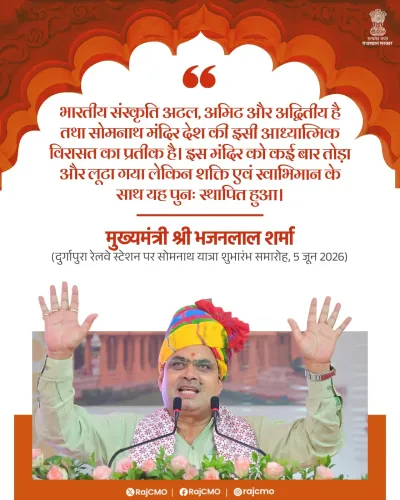
He stated that centuries of invasions — including the sacking by Mahmud of Ghazni in 1026 CE — could not diminish India's spiritual foundations.
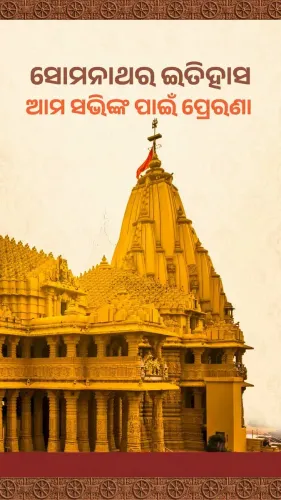
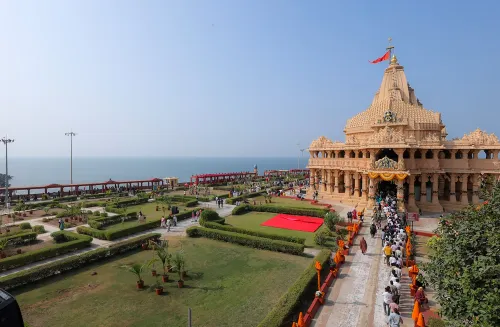
The Somnath Temple in Prabhas Patan, Gujarat is one of the twelve Jyotirlingas, the holiest Shiva shrines in Hindu tradition.
The temple's post-independence reconstruction was initiated by Sardar Vallabhbhai Patel and inaugurated in May 1951 .
The statement aligns with the BJP 's broader pattern of framing major temple sites as markers of India's civilisational resilience.
Analysts will watch for follow-up policy action on heritage tourism circuits linking Gujarat and Rajasthan .
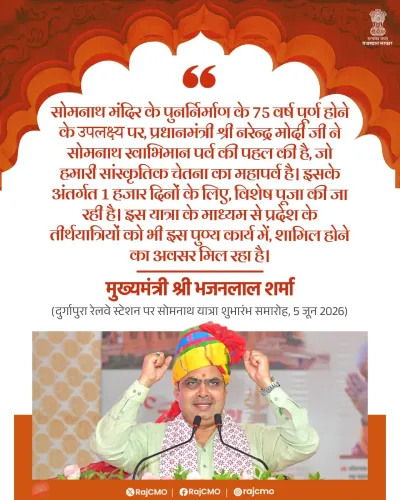
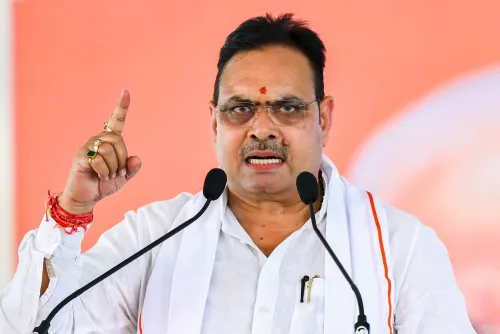
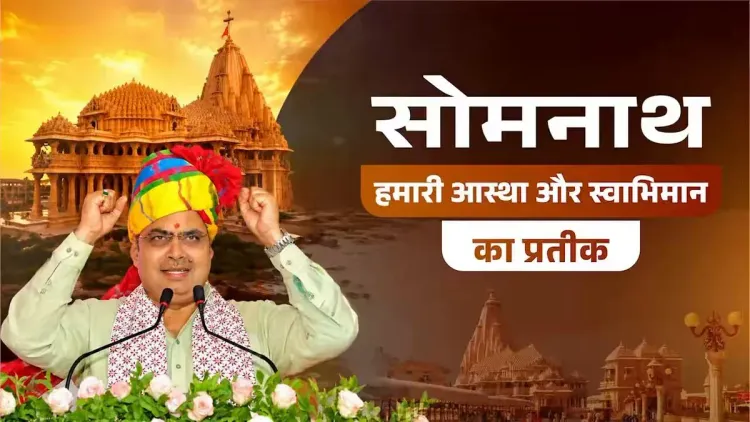
Rajasthan Chief Minister Bhajan Lal Sharma on Friday, 5 June 2026 invoked the Somnath Temple as an enduring symbol of faith, Sanatan consciousness, and civilisational pride, asserting that centuries of invasions could not shake India's spiritual foundations.
Posting on X, Sharma wrote: 'सोमनाथ मंदिर हमारी आस्था, सनातन चेतना और सांस्कृतिक गौरव का शाश्वत प्रतीक है' — 'The Somnath Temple is the eternal symbol of our faith, Sanatan consciousness, and cultural pride.' He added that the temple inspires the belief that 'भारत हर चुनौती का सामना करते हुए और अधिक सशक्त होकर आगे बढ़ता है' — 'India moves forward, growing stronger by facing every challenge.'
Context
The Somnath Temple, situated in Prabhas Patan, Gujarat, is one of the twelve Jyotirlingas — the most sacred shrines dedicated to Lord Shiva in Hindu tradition. The temple's history spans centuries of destruction and reconstruction, most notably its sacking by Mahmud of Ghazni in 1026 CE, and subsequent rebuildings by successive rulers. Its story is frequently cited in Indian public discourse as a metaphor for civilisational endurance.
The modern reconstruction of the temple was initiated after independence under the stewardship of Sardar Vallabhbhai Patel, India's first Deputy Prime Minister, and was formally inaugurated in May 1951 with active support from K.M. Munshi. That act of rebuilding has since carried deep symbolic weight across the political spectrum.
Policy Backdrop
BJP-governed states and central leaders have periodically framed major temple sites as markers of India's civilisational resilience, particularly in the context of historical invasions. Such statements align with the party's long-standing emphasis on cultural nationalism and the safeguarding of Hindu religious heritage.
Sharma, who assumed office as Chief Minister of Rajasthan in December 2023, has consistently engaged with themes of cultural heritage and Hindu tradition in his public communications. Rajasthan itself is home to a dense network of historic temples and heritage sites, giving such statements a degree of local resonance beyond their broader ideological framing.
Stakeholders and Impact
The statement speaks directly to Hindu devotees across the country for whom Somnath holds deep religious significance as a Jyotirlinga. Heritage tourism stakeholders in both Gujarat and Rajasthan stand to benefit from any heightened public attention to temple circuits linking the two states.
Cultural organisations associated with the Sanatan tradition have long championed Somnath as a touchstone of Hindu identity, and statements of this nature reinforce that framing at a senior governmental level.
What's Next
Observers will watch for whether this statement is followed by concrete policy moves — such as state-level heritage tourism schemes or inter-state coordination on temple circuits connecting Gujarat and Rajasthan. For now, the post registers as a significant cultural-nationalist signal from a sitting chief minister, reinforcing the BJP's broader messaging around civilisational pride ahead of what remains an active political calendar in both states.
Point of View
The statement serves both a devotional audience and a political one. It also subtly elevates Rajasthan's chief minister into a pan-Hindu cultural conversation traditionally dominated by voices from Gujarat and Uttar Pradesh. Whether it presages concrete policy — such as a Rajasthan-Gujarat temple tourism corridor — or remains rhetorical positioning will be the test of its lasting significance.
NationPress
19 Sept 2026
Frequently Asked Questions
Why is Somnath Temple historically significant in India?
The Somnath Temple in Prabhas Patan, Gujarat, is one of the twelve Jyotirlingas — the most sacred Shiva shrines — and was repeatedly destroyed by invaders, most notably Mahmud of Ghazni in 1026 CE, making it a powerful symbol of resilience in Indian historical memory.
Who rebuilt Somnath Temple after Indian independence?
Sardar Vallabhbhai Patel, India's first Deputy Prime Minister, initiated the post-independence reconstruction of the Somnath Temple, which was formally inaugurated in May 1951 with the support of K.M. Munshi.
What did Rajasthan CM Bhajan Lal Sharma say about Somnath?
Sharma described the Somnath Temple as the eternal symbol of Sanatan faith, cultural pride, and civilisational consciousness, stating that centuries of invasions could not shake India's resolve and that the temple inspires the nation to grow stronger through every challenge.
What is Sanatan consciousness as referenced by BJP leaders?
'Sanatan consciousness' refers to the belief in the eternal, universal principles of Hinduism — a phrase frequently used by BJP leaders to describe India's enduring spiritual and cultural identity rooted in ancient tradition.
Is Bhajan Lal Sharma the current Chief Minister of Rajasthan?
Yes, Bhajan Lal Sharma has been serving as Chief Minister of Rajasthan since December 2023, representing the Bharatiya Janata Party (BJP).