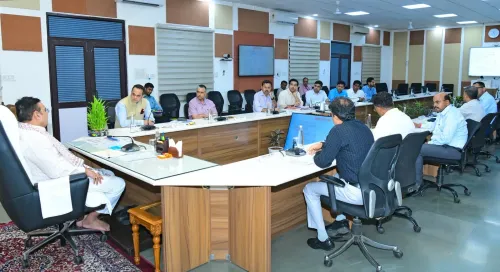
CM Bhajan Lal Sharma chairs cabinet meet on martyr families, govt staff, disabled
Synopsis
Rajasthan Chief Minister Bhajan Lal Sharma announced on 13 August 2026 that the state cabinet approved key welfare decisions for martyr families, government employees, and persons with disabilities, continuing the BJP administration's targeted social-sector policy pattern.
Key Takeaways
Rajasthan CM Bhajan Lal Sharma announced cabinet welfare decisions on 13 August 2026 .
Three beneficiary groups named: martyr families (shaheed parivar), government employees , and persons with disabilities (divyangjan).
The announcement was made via X under the hashtags #AapnoAgraniRajasthan and #CabinetDecision .
Exact benefits, scheme names, and budgetary allocations are pending in official government orders.
Sharma has served as Rajasthan Chief Minister since December 2023 following the BJP's state election victory.
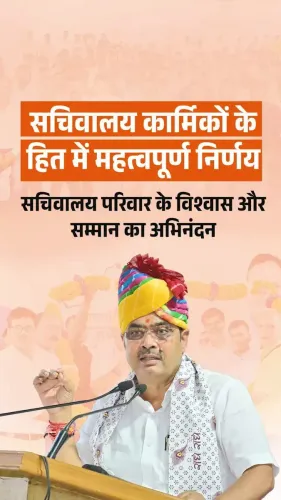
Three groups of Rajasthan citizens — the families of martyrs, government employees, and persons with disabilities — moved to the centre of state policy on Thursday, 13 August 2026, as Rajasthan Chief Minister Bhajan Lal Sharma announced that the day's cabinet meeting had cleared significant welfare decisions in their favour.
Posting on X in Hindi, CM Sharma wrote: 'Aaj mantrimandal ki baithak mein shaheed parivaron ke kalyan, shaskaiy karmikon evam divyangjanon ke hit mein mahatvapurn nirnay liye gaye hain' — 'Today, in the cabinet meeting, important decisions have been taken for the welfare of martyr families, government employees, and persons with disabilities.' The announcement was tagged under #AapnoAgraniRajasthan (Our Leading Rajasthan) and #CabinetDecision, the state government's standard social-media markers for official policy communiques.
Who the decisions target — and why it matters
The three beneficiary groups named are not random. Families of security personnel killed in action have long occupied a politically and emotionally charged space in Rajasthan, a state that contributes a disproportionately large number of soldiers to India's armed forces and paramilitary services. Welfare measures for 'shaheed parivars' — martyr families — typically cover financial assistance, pension enhancements, or priority access to government jobs for next of kin.
Government employees (shaskaiy karmik) represent a powerful organised constituency in the state, and cabinet-level decisions affecting their service rules or benefits carry immediate administrative weight. Decisions for divyangjan — persons with disabilities — usually involve reservation tweaks, accessibility mandates, or direct assistance schemes aligned with central government frameworks.
BJP Rajasthan's cabinet welfare pattern
CM Sharma, who took office in December 2023 after the BJP's return to power in Rajasthan, has periodically used cabinet meetings to roll out targeted welfare announcements for these exact constituencies. The pattern — announce via social media, follow with official government orders detailing eligibility and budgetary allocations — is well established under the current administration.
The specifics of Thursday's decisions — exact amounts, new scheme names, or changes to service rules — are yet to be detailed in official government orders. Those notifications will be the ones to watch for the full picture of what the cabinet actually cleared.
For now, the signal is clear: with welfare for martyrs, bureaucrats, and the disabled on the same cabinet agenda, Sharma is threading together three constituencies that cut across caste, class, and geography — the kind of political geometry that governments in Jaipur have long understood to be worth protecting.
Point of View
Government employees, and persons with disabilities in a single cabinet session is a deliberate political calculation — each group commands loyalty networks that transcend traditional vote-bank lines. For CM Sharma, still consolidating his administrative identity after less than three years in office, these welfare signals serve a dual purpose: they demonstrate policy momentum while pre-empting criticism that the administration has prioritised optics over delivery. The real test, as always, lies in the official orders that follow — the gap between a cabinet announcement and a government notification is where welfare promises most often quietly shrink.
NationPress
13 Aug 2026
Frequently Asked Questions
What decisions did the Rajasthan cabinet take on 13 August 2026?
The Rajasthan cabinet, chaired by Chief Minister Bhajan Lal Sharma, approved welfare decisions for martyr families, government employees, and persons with disabilities. Specific details such as amounts and scheme names are yet to be released in official government orders.
Who is Bhajan Lal Sharma?
Bhajan Lal Sharma is the Chief Minister of Rajasthan and a BJP leader. He assumed office in December 2023 after the BJP won the Rajasthan state assembly elections.
What is the shaheed parivar welfare scheme in Rajasthan?
Rajasthan periodically extends welfare benefits to families of security personnel killed in action, which may include financial assistance, pension support, or preferential government employment for next of kin. The specifics of the 13 August 2026 cabinet decision are pending official notification.
What does divyangjan welfare mean in the context of Rajasthan cabinet decisions?
Divyangjan refers to persons with disabilities. Cabinet decisions in their favour typically cover reservation policies, accessibility schemes, or direct financial assistance aligned with state and central government frameworks.
What is the hashtag AapnoAgraniRajasthan used for?
'Aapno Agrani Rajasthan' translates to 'Our Leading Rajasthan' and is the Rajasthan state government's official campaign tagline used to brand policy announcements and government achievements on social media.