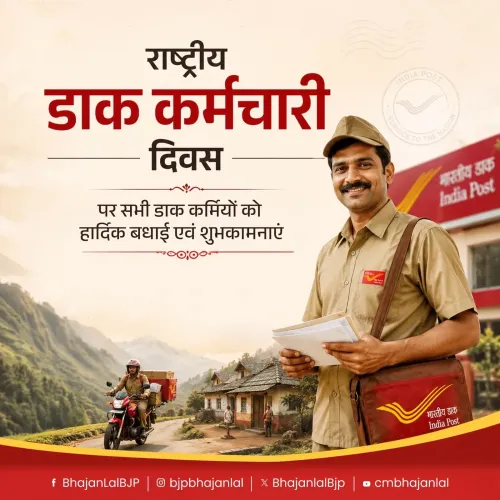
CM Bhajan Lal Sharma Greets Rajasthan on World Post Day
Synopsis
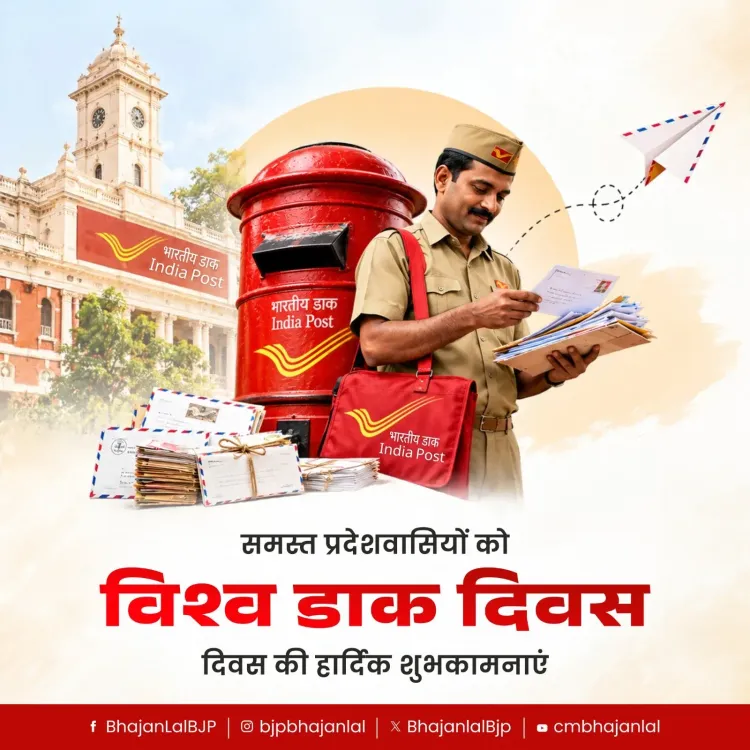
On World Post Day, October 9, Rajasthan CM Bhajan Lal Sharma praised the postal network's decades-long role in connecting communities and delivering essential services, noting its continued evolution into a modern public-service medium.
Key Takeaways
Rajasthan CM Bhajan Lal Sharma extended World Post Day greetings to all state residents on October 9, 2026 .
He credited the postal system with connecting 'every corner of the country' and delivering essential messages and services for years.
The CM highlighted the department's adaptability, noting it has embraced 'new dimensions' while remaining a 'strong medium of public service and communication.' World Post Day marks the anniversary of the Universal Postal Union's founding in Bern in 1874 .
India Post operates one of the world's largest postal networks, with a major footprint across Rajasthan's remote desert districts.
Every letter ever carried across a desert, every money order that reached a family in a remote village — that is the quiet, enduring legacy the world pauses to recognise on World Post Day, October 9. Rajasthan Chief Minister Bhajan Lal Sharma marked the occasion on Friday with a warm message to the people of the state, honouring the postal network's role as a connector of communities across the country.
In his post, CM Sharma extended greetings to samast pradeshvasiyon (all residents of the state), saying the postal system has 'played an important role for years in connecting people across every corner of the country and delivering essential messages and services.' He further noted that, by embracing new dimensions with changing times, the postal department 'continues to be a strong medium of public service and communication even today.'
A network that outlasted the telegram and adapted to the digital age
World Post Day is observed every year on October 9, marking the anniversary of the establishment of the Universal Postal Union (UPU) in Bern, Switzerland, in 1874. India's own postal network — one of the largest in the world — stretches across urban metros and the most remote rural pockets, including vast swathes of Rajasthan's desert districts where it often remains the only reliable delivery infrastructure.
India Post has transformed significantly over the decades, expanding beyond letter delivery into financial services through Post Office Savings Bank accounts, insurance products, and government scheme disbursements. The network today functions as a last-mile delivery partner for e-commerce, a payments bank, and a distributor of welfare benefits — making the CM's point about 'new dimensions' particularly concrete.
Why the message resonates in Rajasthan specifically
For a state as geographically vast as Rajasthan — India's largest by area — the postal network carries outsized significance. Connectivity across its 33 districts and hundreds of remote tehsils has historically depended on the postman as much as on roads or telecom towers. From pension delivery to speed-post logistics for small traders, the department remains a daily reality for millions of residents that no purely digital infrastructure has yet replaced.
The postal system's evolution from handwritten letters to fintech and logistics is, in a sense, a mirror of India's own development journey — patient, expansive, and quietly indispensable. As Rajasthan continues to push infrastructure upgrades, the relevance of that last-mile network only grows.
Point of View
But for Rajasthan — India's largest state by area — it carries a subtle policy undertone: the postal network remains critical last-mile infrastructure that digital alternatives have not yet supplanted. CM Sharma's emphasis on the department 'embracing new dimensions' aligns with the central government's broader push to expand India Post Payments Bank and use post offices as fintech touchpoints in underserved areas. The message also signals that even in an era of hyper-connectivity, elected leaders recognise the political and social capital embedded in public postal infrastructure. Sustaining and modernising that network in a state with vast rural and desert geographies is both an administrative priority and an electoral one.
NationPress
9 Oct 2026
Frequently Asked Questions
Why is World Post Day celebrated on October 9?
World Post Day is observed on October 9 every year to mark the anniversary of the founding of the Universal Postal Union (UPU) in Bern, Switzerland, on that date in 1874.
What did Rajasthan CM Bhajan Lal Sharma say on World Post Day 2026?
CM Bhajan Lal Sharma greeted all Rajasthan residents on World Post Day and praised the postal department for connecting people across every corner of the country, delivering essential services, and adapting to new dimensions over the years.
What services does India Post provide beyond letter delivery?
India Post today offers savings bank accounts, insurance products, government welfare disbursements, e-commerce last-mile delivery, and financial services through India Post Payments Bank, making it a multi-service public institution.
Why is the postal network especially important for Rajasthan?
Rajasthan is India's largest state by area, with remote desert districts where the postal network often remains the most reliable delivery and financial-services infrastructure for millions of residents.
What is the theme of World Post Day 2026?
The specific theme for World Post Day 2026 has not been detailed in the available information; the Universal Postal Union announces a new theme each year to highlight the evolving role of postal services globally.