CM Himanta Remembers Ratan Tata on First Punyatithi
Synopsis
On Ratan Tata's first death anniversary, Assam CM Himanta Biswa Sarma remembers him as a personal ally who built 17 cancer hospitals through the Assam Cancer Care Foundation and backed the Jagiroad semiconductor plant — India's first — now nearing completion.
Key Takeaways
Ratan Tata's first punyatithi was marked on October 9, 2026 by Assam CM Himanta Biswa Sarma with a personal tribute on X.
Tata co-built the Assam Cancer Care Foundation , a network of 17 hospitals across the state to combat high cancer mortality rates.
The Tata semiconductor facility at Jagiroad , described as the first of its kind in India , is expected to become operational by end of 2026 .
The township around the Jagiroad plant will be named Ratan Tata Electronics City .
CM Sarma described Tata as someone who chose Assam personally, asking 'what more could be done for our people' during his visits to the state.
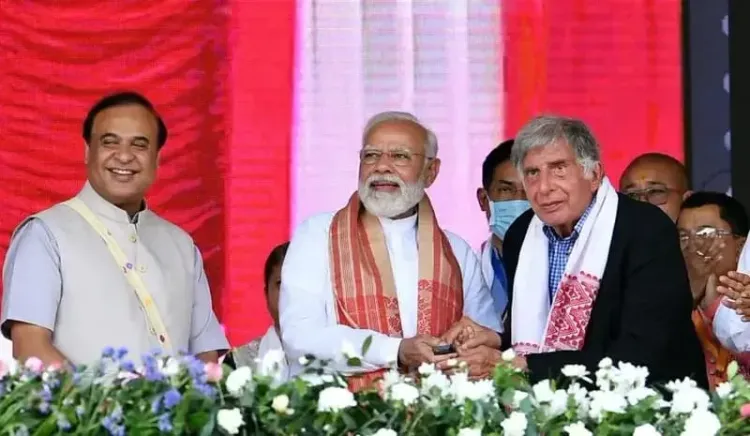
A year after Ratan Tata passed away, Assam Chief Minister Himanta Biswa Sarma paid tribute on Friday, October 9 — not with ceremony, but with memory: of a man who asked what could be done for the people, never just for the ledger.
The hospitals that turned an idea into a lifeline
The tribute at its core is about the Assam Cancer Care Foundation — a network of 17 hospitals mapped across the state to address a quiet crisis: cancer silently claiming thousands of Assam's lives every year. CM Sarma recalls that Tata did not respond with a distant donation. He sat with state officials, mapped the geography of need, and built an institution from scratch.
That foundation, now operational across the state, stands as perhaps the most tangible proof of what the CM describes as a bond of trust — a visiting industrialist who kept coming back, 'warm, unhurried, always asking what more could be done for our people.' The Assam Cancer Care Foundation became, in Sarma's telling, the place where Tata's personal pledge to devote his final years to healthcare found its most concrete expression.
Jagiroad's semiconductor plant — and the city carrying his name
The second strand of the tribute looks forward. CM Sarma announced that the Tata semiconductor facility at Jagiroad — described as the first of its kind in India — is expected to become operational by the end of 2026. The facility was a shared ambition: when Sarma raised the idea of Assam as a technology hub, he writes, Tata 'did not doubt it for a moment.'
The township built around the facility will carry the name Ratan Tata Electronics City — a permanent civic marker for a partnership that began in hospital wards and extended into high-technology manufacturing. Together, the two projects — one in healthcare, one in industry — sketch the arc of what Sarma calls giving the Northeast both 'dignity' and 'ambition' within a single lifetime.
How Assam remembers a man who chose it
There is a particular quality to Sarma's tribute that sets it apart from standard political remembrance. He does not invoke Tata as a national icon — he invokes him as someone who chose Assam, 'like few outsiders ever have.' That framing matters in a region that has historically felt peripheral to India's economic imagination.
On this first punyatithi, the Chief Minister's closing line lands with quiet force: 'Assam does not just mourn a great Indian, we honour a man who believed in us.' For a state now anchored by both a cancer-care network and an incoming semiconductor plant, the belief was, evidently, returned.
Point of View
With Tata's name as the guarantor of both. The tribute also signals continuity — that the Tata-Assam partnership outlives its founder, and that the incoming semiconductor plant carries a moral as much as an economic weight. In a region long starved of marquee investment, honouring that legacy publicly is itself a policy statement.
NationPress
9 Oct 2026
Frequently Asked Questions
When is Ratan Tata's punyatithi in 2026?
Ratan Tata's first death anniversary, or punyatithi, falls on October 9, 2026 . Assam CM Himanta Biswa Sarma posted a tribute on X on this day.
What is the Assam Cancer Care Foundation?
The Assam Cancer Care Foundation is a network of 17 hospitals built across Assam to provide cancer care, developed with the involvement of Ratan Tata and the state government.
What is the Tata semiconductor plant at Jagiroad?
The Tata semiconductor facility at Jagiroad in Assam is described by CM Sarma as the first semiconductor manufacturing plant of its kind in India , expected to become operational by end of 2026 .
What is Ratan Tata Electronics City?
Ratan Tata Electronics City is the name given to the township being developed around the Tata semiconductor facility at Jagiroad, Assam , as a tribute to the late industrialist.
What did Ratan Tata do for Assam?
According to CM Himanta Biswa Sarma, Ratan Tata helped build the Assam Cancer Care Foundation's 17-hospital network , personally engaged with the state's development needs, and backed the Jagiroad semiconductor plant — positioning Assam as a technology hub in the Northeast.