CM Bhajan Lal Sharma Hails IMF's 7% Growth Forecast for India
Synopsis
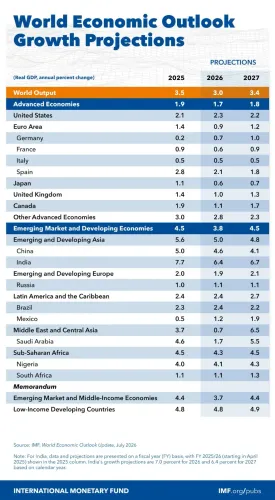
Rajasthan CM Bhajan Lal Sharma highlighted the IMF's World Economic Outlook projection of 7.0% GDP growth for India in 2026 and 2027, calling it a testament to PM Modi's policy resolve and the efforts of 140 crore Indians.
Key Takeaways
The IMF's World Economic Outlook projects India's economy to grow at 7.0% in both 2026 and 2027 .
Rajasthan CM Bhajan Lal Sharma cited the forecast on 13 October 2026 , crediting PM Narendra Modi's leadership and policy continuity.
India has been identified as the fastest-growing major economy in successive IMF assessments since 2021 .
The post invoked the #ViksitBharat vision — the government's goal of a developed India by 2047 .
CM Sharma's amplification of the figure also signals a favourable investment climate for Rajasthan , which has been actively courting industrial and infrastructure investment since December 2023 .
India is set to be the world's fastest-growing major economy for the second straight year — and this time, the International Monetary Fund has put a number to it. Rajasthan Chief Minister Bhajan Lal Sharma cited the IMF's latest World Economic Outlook on Tuesday, 13 October 2026, highlighting the Fund's projection that India will expand at 7.0 per cent in both 2026 and 2027 — even as global economic uncertainty deepens.
In a post on X, CM Sharma wrote that amid worldwide economic turbulence, India's performance 'reflects our strength and policy resolve' — a direct reference to the IMF's framing of India as a relative anchor of stability in its global growth assessment. He credited Prime Minister Narendra Modi's 'visionary leadership' for the country consistently setting new milestones of development and emerging as a 'key driver of the world economy.'
IMF's Consistent Bet on India
The IMF's World Economic Outlook series has, across multiple editions since 2021, identified India as the fastest-growing major economy against a backdrop of global slowdowns — from post-pandemic supply-chain shocks to geopolitical instability in Europe and West Asia. A 7.0 per cent projection for two consecutive years would place India well ahead of every other G20 economy in the same forecast window. The Fund's endorsement carries weight precisely because it is external, multilateral, and methodologically independent.
Viksit Bharat: The Domestic Policy Arc Behind the Number
CM Sharma's post carried the hashtag #ViksitBharat, tying the IMF figure directly to the central government's flagship vision: a developed India by 2047, the centenary of Independence. The Viksit Bharat Sankalp Yatra, launched in November 2023, was designed to saturate last-mile beneficiaries with welfare scheme awareness — part of the policy scaffolding the BJP frames as the engine behind sustained growth numbers.
Sharma also invoked the labour of 140 crore Indians, calling the country a 'ray of hope on the global stage' — language that maps directly onto the Modi government's 'India as a bright spot' communications playbook that has been a fixture of Budget and G20 outreach since at least 2022.
Why Rajasthan's CM Is Amplifying a National Economic Story
BJP chief ministers routinely echo central economic wins for a reason: state governments inherit investor sentiment from the national macro story. A 7 per cent growth headline lifts the environment for state-level infrastructure bonds, global investor roadshows, and industrial corridor announcements — all of which Rajasthan has been actively pursuing since CM Sharma took charge in December 2023. Amplifying the IMF number is as much a signal to Jaipur's own investment pipeline as it is a tribute to Delhi's economic stewardship.
The next test arrives when India's official advance GDP estimates for FY 2025-26 land — those domestic figures will either validate or complicate the IMF's optimism. For now, the projection stands as a rare piece of good news in an uncertain global moment.
Point of View
However, is whether India's own advance GDP estimates corroborate the IMF's 7% call — any gap between external projections and domestic data would sharpen opposition scrutiny on methodology and ground-level growth distribution.
NationPress
13 Oct 2026
Frequently Asked Questions
What does the IMF World Economic Outlook say about India's growth in 2026 and 2027?
The IMF's World Economic Outlook projects India's GDP to grow at 7.0% in both 2026 and 2027, positioning it as the fastest-growing major economy globally during that period.
Who is Bhajan Lal Sharma and why is he commenting on the IMF forecast?
Bhajan Lal Sharma is the Chief Minister of Rajasthan and a BJP leader who took office in December 2023. As a BJP chief minister, he routinely amplifies central government economic achievements, and cited the IMF figure to highlight India's growth trajectory under PM Modi.
What is Viksit Bharat and how does it relate to India's IMF growth projection?
Viksit Bharat is the Indian government's official vision to make India a fully developed economy by 2047, the centenary of Independence. CM Sharma linked the IMF's 7% forecast to this long-term goal, arguing the projection validates the government's policy direction.
Has the IMF previously identified India as the fastest-growing major economy?
Yes. Multiple IMF World Economic Outlook editions since 2021 have consistently identified India as the fastest-growing major economy, even as global growth slowed due to pandemic aftershocks and geopolitical tensions.
What comes next after this IMF forecast for India's economy?
The immediate benchmark will be India's official advance GDP estimates for FY 2025-26, which will indicate whether domestic growth data aligns with the IMF's optimistic external projections.