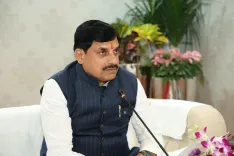
CM Bhajan Lal Sharma Pays Tribute to Father of Fiber Optics
Synopsis
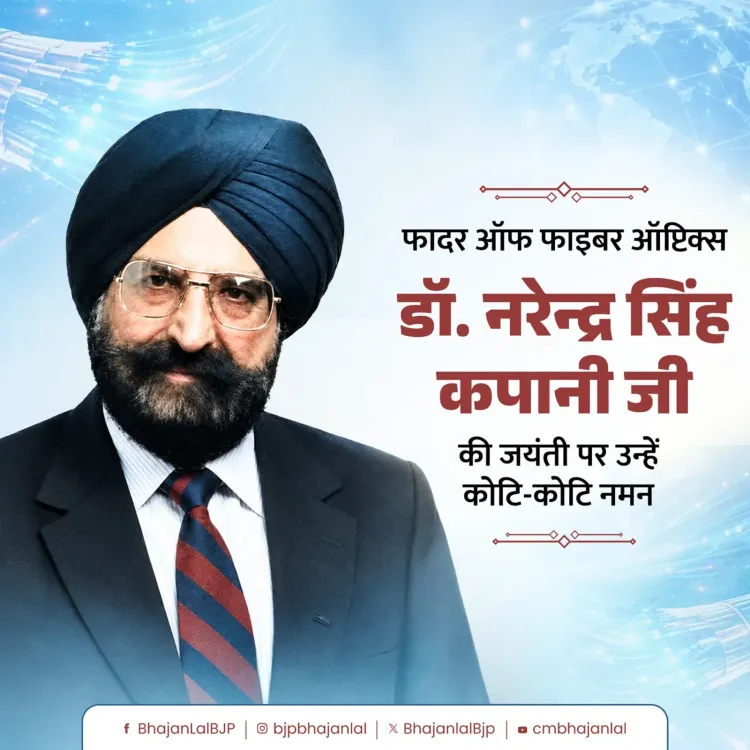
Rajasthan Chief Minister Bhajan Lal Sharma paid tribute to Dr. Narendra Singh Kapany, the Indian-origin physicist credited as the Father of Fiber Optics, on his birth anniversary, calling his discovery a foundation of the global telecommunications revolution.
Key Takeaways
Rajasthan CM Bhajan Lal Sharma posted a tribute to Dr.
Narendra Singh Kapany on his birth anniversary on October 31, 2026 .
Kapany, born in Moga, Punjab , is globally recognised as the Father of Fiber Optics and coined the term itself.
His foundational experiments at Imperial College London in the early 1950s proved that light could be transmitted through flexible glass fibers.
Fiber-optic technology now underpins the modern internet, undersea cables, medical endoscopes, and laser surgery systems.
CM Sharma called Kapany's innovations a 'source of inspiration for every Indian,' reflecting a national pattern of reclaiming diaspora scientific heritage.
On the birth anniversary of a scientist whose work quietly powers every internet call, every streamed video, and every digital transaction on the planet, Rajasthan Chief Minister Bhajan Lal Sharma took to X on Saturday, October 31, 2026, to honour Dr. Narendra Singh Kapany — the Indian-origin physicist the world calls the 'Father of Fiber Optics'.
The man who bent light and rewired the world
Posting in Hindi, CM Sharma offered his deepest respects — 'koti-koti naman' (countless salutations) — to Dr. Kapany, calling his historic discovery in physics a path-breaking contribution that 'showed the global telecommunications and information revolution a new direction.' The tribute was accompanied by an image marking the occasion. Dr. Narendra Singh Kapany, born in Moga, Punjab, is widely credited as the pioneer who first demonstrated that light could be transmitted through flexible glass fibers with minimal loss — a principle that now underpins the entire modern internet. He also coined the very term 'fiber optics,' giving a name to a technology that would eventually carry trillions of bits of data across continents every second.A Punjab-born genius whose legacy runs under every ocean
Kapany's foundational experiments in the early 1950s at Imperial College London established that thin glass strands could guide light around bends — overturning the assumption that light only travelled in straight lines. That insight cascaded into one of the most consequential engineering revolutions in human history: undersea fiber-optic cables, broadband internet, medical endoscopes, and laser surgery systems all trace a direct line back to his laboratory work. Despite being nominated for a Nobel Prize and recognised by Fortune magazine as one of the seven 'Unsung Heroes' of the 20th century, Kapany remained relatively unknown to mainstream audiences during his lifetime — a fact that has made his rediscovery by Indian public figures all the more pointed.Science anniversaries and India's push to reclaim its diaspora heroes
CM Sharma's tribute fits a well-established pattern among Indian political leaders: using the birth anniversaries of Indian-origin scientists and thinkers to spotlight the country's intellectual heritage and inspire younger generations. His post explicitly states that Kapany's innovations 'will always remain a source of inspiration for every Indian' — a framing that positions diaspora achievement as shared national pride. The gesture carries quiet weight at a moment when India is aggressively investing in domestic semiconductor fabrication, 5G rollout, and deep-sea cable infrastructure — all technologies that rest, at their foundation, on the fiber-optic principles Dr. Kapany spent his life proving. A scientist's birthday becomes a mirror for where a nation wants to go next.Point of View
Invoking fiber-optics pioneers carries strategic resonance beyond ceremonial courtesy.
NationPress
31 Oct 2026
Frequently Asked Questions
Who is the Father of Fiber Optics?
Dr. Narendra Singh Kapany , an Indian-American physicist born in Moga, Punjab, is widely recognised as the Father of Fiber Optics. He pioneered the demonstration of light transmission through glass fibers and coined the term 'fiber optics.'
Why did CM Bhajan Lal Sharma post about Dr. Kapany?
Rajasthan Chief Minister Bhajan Lal Sharma posted the tribute on October 31, 2026 to mark Dr. Kapany's birth anniversary, calling his discoveries a source of inspiration for every Indian and a cornerstone of the global telecommunications revolution.
What did Dr. Narendra Singh Kapany discover?
Dr. Kapany demonstrated in the early 1950s that light could be guided through thin, flexible glass fibers around bends, a discovery that became the scientific foundation for modern fiber-optic cables, broadband internet, and medical imaging technologies.
Was Dr. Kapany Indian?
Yes. Dr. Narendra Singh Kapany was born in Moga, Punjab, India . He later became an Indian-American physicist and conducted his landmark fiber-optics research at Imperial College London .
Why is Dr. Kapany considered an unsung hero?
Despite being nominated for a Nobel Prize and named by Fortune magazine as one of the seven 'Unsung Heroes' of the 20th century, Dr. Kapany remained largely unknown to mainstream audiences during his lifetime, even as the technology he invented became central to global communications.