CM Bhajan Lal Sharma Reaffirms Welfare as Rajasthan's Top Priority
Synopsis
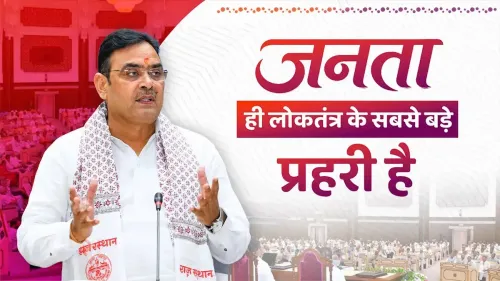
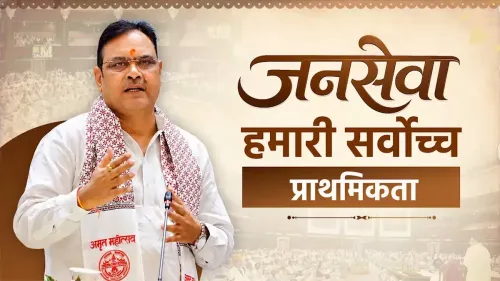
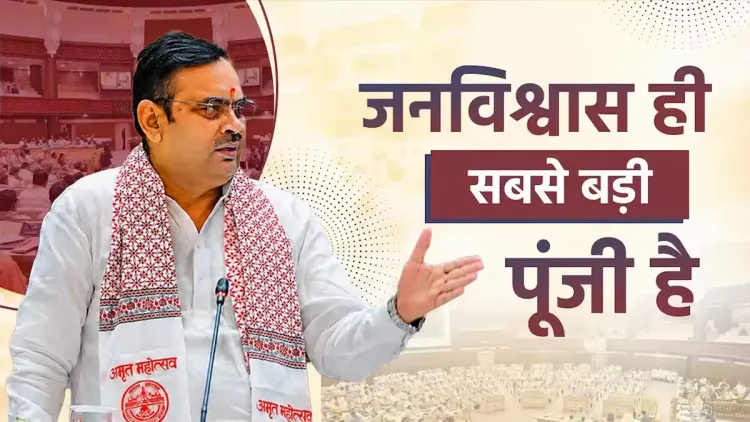
Rajasthan Chief Minister Bhajan Lal Sharma on 15 July 2026 reaffirmed that fulfilling the aspirations of the state's 8 crore people is his government's supreme priority, stating every decision rests on public interest and welfare — a message consistent with the BJP's Jan Kalyan governance framework.
Key Takeaways
CM Bhajan Lal Sharma posted on 15 July 2026 reaffirming welfare as his government's highest priority.
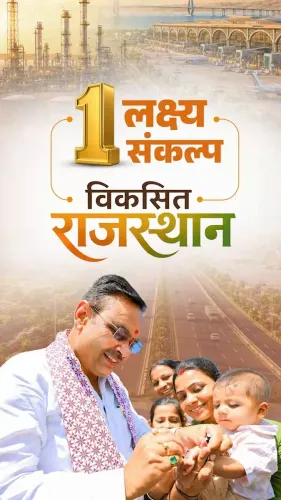
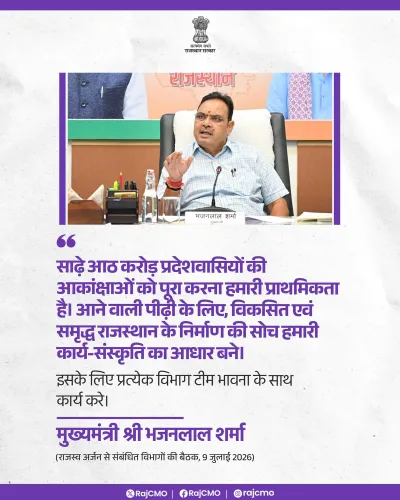
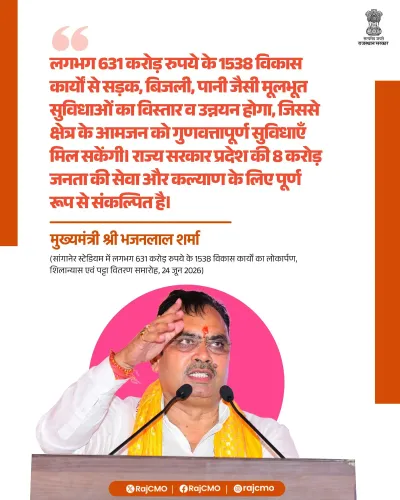
He stated that fulfilling the hopes of 8 crore people of Rajasthan is the supreme responsibility of his government.
Every government decision, he said, is grounded in public interest and public welfare .
The BJP has governed Rajasthan since December 2023 , following its assembly election victory.
The statement aligns with the BJP's broader Jan Kalyan and Jan Hit governance messaging across states.
Future budget sessions and scheme launches in Rajasthan will be key tests of these stated priorities.
Rajasthan Chief Minister Bhajan Lal Sharma on Wednesday, 15 July 2026, publicly reaffirmed that fulfilling the aspirations of the state's people remains the highest duty of his government, stating that every decision taken by his administration is rooted in public interest and welfare.
In his post, CM Sharma wrote in Hindi: 'राजस्थान की 8 करोड़ जनता की उम्मीदों को साकार करना, जनप्रतिनिधि के रूप में हमारी सर्वोच्च प्राथमिकता और दायित्व है' — translated: 'Fulfilling the hopes of 8 crore people of Rajasthan is our highest priority and responsibility as a people's representative.' He added that the foundation of every decision of his government is public interest and public welfare.
Context
Bhajan Lal Sharma assumed office as Chief Minister of Rajasthan in December 2023 after the Bharatiya Janata Party won the state assembly elections. The BJP's campaign in Rajasthan had centred heavily on welfare delivery and good governance, and this post reiterates that central promise to the electorate.
Such reaffirmations from chief ministers are a common feature of Indian political communication, particularly in the months and years following an election victory, as governments seek to signal continuity of purpose to constituents.
Policy Backdrop
The BJP has consistently framed its governance approach across multiple states under the twin pillars of 'Jan Kalyan' (public welfare) and 'Jan Hit' (public interest). Rajasthan, as one of India's largest states by area and among the more populous in the west, presents significant administrative challenges in delivering welfare schemes to rural and semi-urban populations.
Since taking charge, the Sharma government has positioned itself as welfare-oriented, with the stated intent of translating the electoral mandate into tangible programmes. Budget sessions and scheme announcements in the state have been watched closely as indicators of how these priorities are being operationalised.
Stakeholders and Impact
The most direct stakeholders are Rajasthan's approximately 8 crore residents — spanning farmers, urban workers, women, youth, and marginalised communities — whose expectations of improved public services, infrastructure, and welfare delivery underpin the political messaging. The state government's departments, from health and education to agriculture and rural development, are the institutional vehicles through which such commitments are expected to be realised.
Opposition parties in the state are likely to benchmark the government's actual policy outputs against such public declarations, making statements of this nature both a promise and a political accountability marker.
What's Next
Observers will watch upcoming Rajasthan budget sessions and new scheme launches as the clearest indicators of whether the welfare priorities articulated by CM Bhajan Lal Sharma are being translated into concrete policy and budgetary allocations. The government's performance on welfare delivery will likely shape the political narrative in the state ahead of future electoral cycles.
Point of View
The timing suggests an effort to recalibrate public attention toward governance deliverables. Within the BJP's multi-state playbook, the 'Jan Kalyan' framing is a deliberate ideological thread that ties state-level governance to the party's national identity. The real political weight of such declarations will be determined by the specificity and scale of welfare programmes the Sharma government announces in the coming budget and legislative cycles.
NationPress
15 Jul 2026
Frequently Asked Questions
Who is Bhajan Lal Sharma?
Bhajan Lal Sharma is the Chief Minister of Rajasthan and a senior BJP leader who assumed office in December 2023 after the BJP won the Rajasthan Legislative Assembly elections.
What did Rajasthan CM Bhajan Lal Sharma say on 15 July 2026?
He stated that fulfilling the aspirations of Rajasthan's 8 crore people is the highest priority and responsibility of his government, and that every decision is based on public interest and public welfare.
When did BJP come to power in Rajasthan?
The BJP formed the government in Rajasthan in December 2023 following its victory in the state assembly elections held that year.
What is Jan Kalyan in BJP governance?
'Jan Kalyan', meaning public welfare, is a core framing used by the BJP across several state governments to describe welfare-centric policy delivery and social schemes targeting ordinary citizens.
What should we watch for next in Rajasthan governance?
Upcoming Rajasthan budget sessions and new welfare scheme announcements will be the clearest indicators of how the Sharma government translates its stated welfare priorities into concrete policy action.