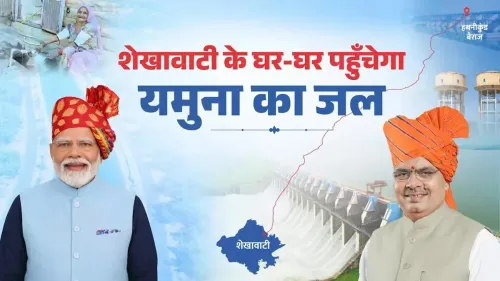
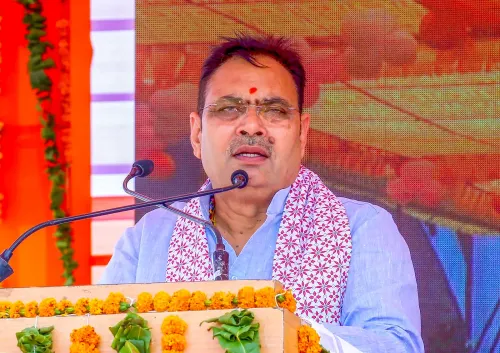
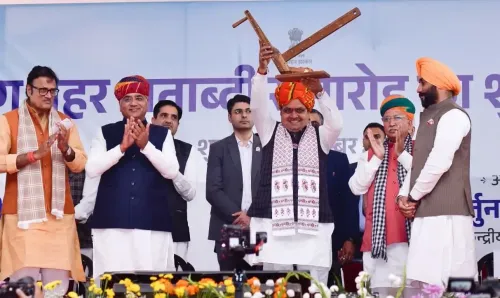
CM Bhajan Lal Accuses Congress of Sabotaging Yamuna Water Deal
Synopsis
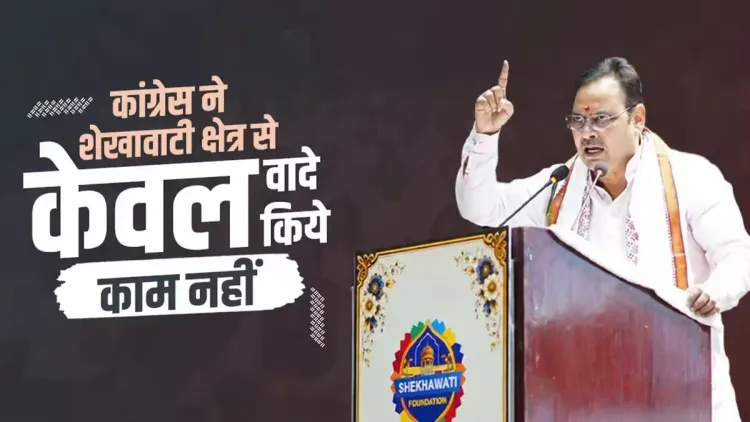
Rajasthan CM Bhajan Lal Sharma has accused Congress of betraying Shekhawati's people by working to cancel a Yamuna water agreement during Haryana elections, with Rajasthan Congress leaders allegedly giving silent consent to the anti-people move.
Key Takeaways
CM Bhajan Lal Sharma publicly accused Congress of deceiving the people of Shekhawati over the Yamuna water agreement on 20 July 2026 .
He alleged Congress created an atmosphere to cancel the water deal during the Haryana assembly elections .
Rajasthan Congress leaders were accused of being present at Haryana campaign events and giving 'silent consent' to the agreement's cancellation.
Shekhawati — comprising Sikar , Jhunjhunu , and Churu districts — faces chronic water scarcity and has long awaited Yamuna water delivery.
The 1994 MoU among five states remains the foundational framework for Upper Yamuna water-sharing, with implementation still incomplete.
The Upper Yamuna River Board and progress on canal or lift-irrigation projects will be key indicators of the agreement's fate.
Rajasthan Chief Minister Bhajan Lal Sharma on Monday, 20 July 2026 accused the Congress of deceiving the people of Shekhawati and actively working to derail an inter-state Yamuna water agreement that his government had been pursuing to bring water to the water-scarce northern Rajasthan region.
Context
In a sharp post on X, CM Sharma alleged: 'शेखावाटी की जनता के साथ कांग्रेस ने केवल वादे और छलावा ही किया है' ['Congress has given the people of Shekhawati nothing but promises and deception']. He charged that while his government was working to translate a Yamuna water-sharing agreement into ground-level implementation, Congress was simultaneously creating an atmosphere to scuttle it during the Haryana assembly elections.
More pointedly, he alleged that Rajasthan Congress leaders were themselves present at campaign events in Haryana and gave 'silent consent' to what he called an 'anti-people decision' to undermine the water deal.
Policy Backdrop
The Yamuna water dispute has deep roots. A 1994 Memorandum of Understanding among Uttar Pradesh, Haryana, Rajasthan, Himachal Pradesh, and Delhi established a framework for sharing Upper Yamuna waters and created the Upper Yamuna River Board to oversee allocations.
Shekhawati — covering the districts of Sikar, Jhunjhunu, and Churu — has long suffered acute water scarcity and has been a focal point in demands for Rajasthan's share of Yamuna waters to be delivered through canal or lift-irrigation infrastructure. Progress on such projects has been slow across successive governments, making the issue politically charged in the region.
Inter-state river water disputes in India have repeatedly spilled into electoral politics, with parties on both sides trading accusations of stalling agreements or sabotaging negotiations ahead of state polls. The current exchange fits that established pattern.
Stakeholders and Impact
The communities most directly affected are farmers and residents of northern Rajasthan's Shekhawati belt, who depend on adequate water supply for agriculture and daily use. Any delay or cancellation of a Yamuna water agreement directly threatens livelihoods in this arid zone.
Haryana, as a co-riparian state, holds significant influence over the pace and terms of any water-sharing implementation. The allegation that Rajasthan's own opposition leaders sided with interests in Haryana against the agreement adds a dimension of intra-state political accountability to what is otherwise a bilateral resource dispute.
What's Next
The Upper Yamuna River Board and the governments of Rajasthan and Haryana are expected to be closely watched for any formal response to the political controversy. Progress on proposed canal or lift-irrigation projects to deliver agreed Yamuna water to Shekhawati districts will be the practical test of whether the agreement survives the political turbulence.
If CM Sharma pushes the issue further — potentially through formal inter-state mechanisms or the courts — the dispute could become a defining water-governance flashpoint for Rajasthan ahead of future electoral cycles.
Point of View
CM Bhajan Lal Sharma is deploying a well-worn but potent political script: casting the opposition as complicit in denying a state its natural resources. The charge that Rajasthan's own Congress leaders stood by while a water deal was undermined is designed to deepen the opposition's credibility problem in the Shekhawati belt, a region with genuine and long-standing water grievances. This fits a broader BJP pattern of converting inter-state resource disputes into loyalty tests for regional voters. Whether the BJP can deliver actual water to Shekhawati — not just political rhetoric — will ultimately determine how durable this messaging advantage proves to be.
NationPress
20 Oct 2026
Frequently Asked Questions
What is the Yamuna water agreement for Rajasthan?
It refers to inter-state arrangements under the 1994 MoU and the Upper Yamuna River Board framework that allocate a share of Upper Yamuna waters to Rajasthan , among other basin states. Delivering this water to the Shekhawati region has been a long-pending demand.
Why is Shekhawati facing a water crisis?
Shekhawati , covering Sikar , Jhunjhunu , and Churu districts in northern Rajasthan, is an arid zone with limited surface water and depleting groundwater. Farmers and residents have long demanded that the state's allocated share of Yamuna waters be delivered through canal or lift-irrigation projects.
What did CM Bhajan Lal Sharma accuse Congress of doing?
CM Bhajan Lal Sharma accused Congress of creating an atmosphere to cancel the Yamuna water agreement during the Haryana assembly elections and alleged that Rajasthan Congress leaders present at Haryana campaign events gave 'silent consent' to this anti-people decision.
What is the Upper Yamuna River Board?
The Upper Yamuna River Board is a statutory body set up under the 1994 MoU among Uttar Pradesh , Haryana , Rajasthan , Himachal Pradesh , and Delhi to oversee the allocation and management of Upper Yamuna waters among the signatory states.
How does the Haryana election connect to Rajasthan's water issue?
CM Sharma alleged that during Haryana assembly election campaigning, Congress worked to build political support for cancelling the Yamuna water-sharing arrangement with Rajasthan, with some Rajasthan Congress leaders allegedly present and acquiescent at those events.