CM Bhajan Lal Welcomes Cabinet Nod to BHAVYA-Rasayan Scheme
Synopsis
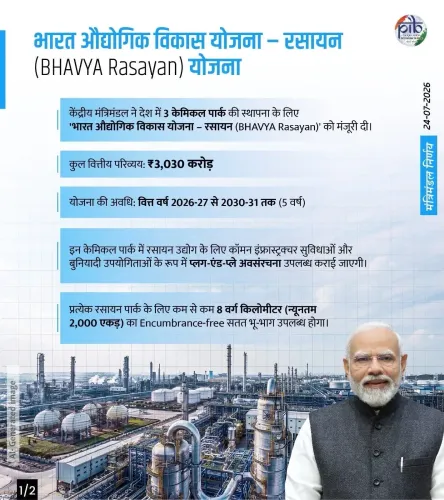
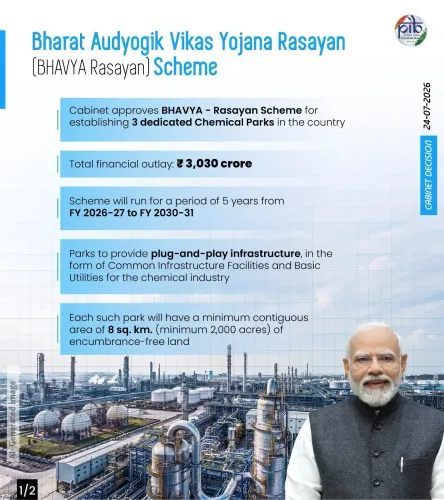
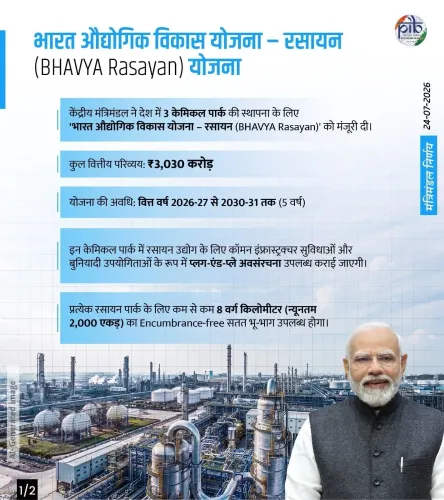
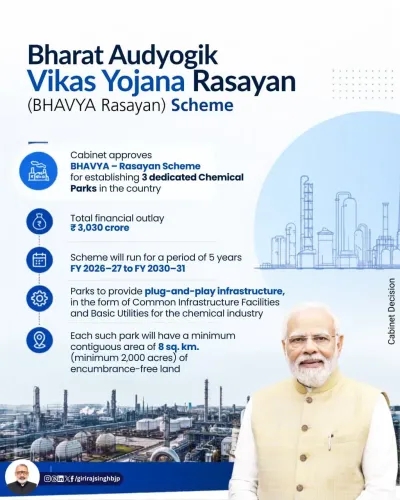
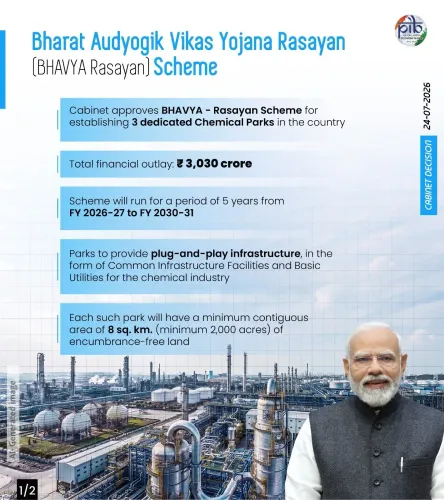
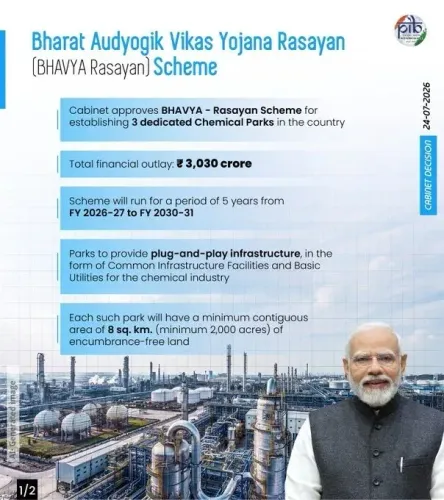
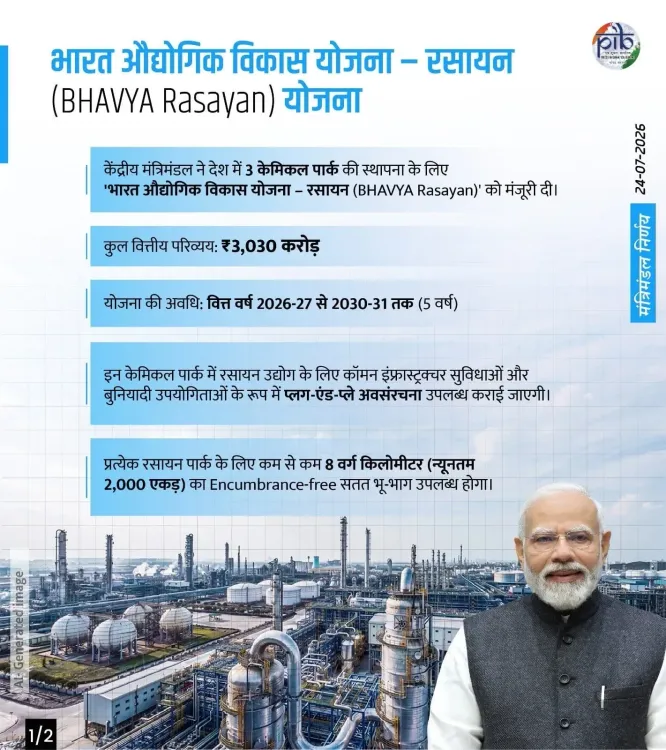
The Union Cabinet has approved the BHAVYA-Rasayan Scheme with a ₹3,030 crore outlay to set up three dedicated chemical parks in India. Rajasthan Chief Minister Bhajan Lal Sharma hailed the decision as far-sighted, saying it will accelerate industrial growth and open new employment avenues in the chemical sector.
Key Takeaways
The Union Cabinet approved the BHAVYA-Rasayan Scheme with an outlay of ₹3,030 crore .
The scheme provides for the establishment of three dedicated chemical parks across India.
Rajasthan Chief Minister Bhajan Lal Sharma publicly welcomed the decision, attributing it to Prime Minister Narendra Modi's leadership.
The parks are intended to accelerate industrial development and generate employment in the chemical sector.
The scheme aligns with the broader Atmanirbhar Bharat and Make in India policy frameworks.
Site selection for the three parks and state-level implementation timelines are the key next steps to watch.
Rajasthan Chief Minister Bhajan Lal Sharma on Friday, 25 July 2026, welcomed the Union Cabinet's approval of the BHAVYA-Rasayan Scheme, calling it a 'far-sighted decision' under the leadership of Prime Minister Narendra Modi. The scheme envisages an outlay of ₹3,030 crore for the establishment of three dedicated chemical parks aimed at accelerating industrial growth and employment generation across India.
Context
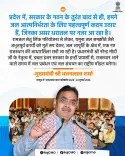
Sharma posted on X expressing gratitude to the Prime Minister, stating — 'BHAVYA - Rasayan Scheme ko di gayi svikrti ek doordarshi nirnay hai' ['The approval given to the BHAVYA-Rasayan Scheme is a far-sighted decision']. He noted that the scheme would 'open new doors of industrial development and employment creation' in the country's chemical sector. The post was accompanied by two images and carried the hashtag #CabinetDecisions, indicating a coordinated response to the Union Cabinet announcement.
The Union Cabinet, chaired by Prime Minister Modi, approved the scheme as part of the central government's broader push to strengthen domestic manufacturing capacity in the chemicals and petrochemicals space.
Policy Backdrop
India's focus on dedicated chemical industry infrastructure has a long lineage. The Petroleum, Chemicals and Petrochemicals Investment Regions (PCPIR) policy, notified in 2007, first promoted integrated chemical industry clusters to attract large-scale investment. The Make in India programme, launched in 2014, further elevated chemicals as a priority manufacturing sector.
The BHAVYA-Rasayan Scheme's three dedicated chemical parks build on this approach, aiming to co-locate upstream and downstream chemical units within common infrastructure. This model is widely seen as a mechanism to reduce import dependence in critical industrial inputs, aligning with the Atmanirbhar Bharat framework for self-reliance.
Stakeholders and Impact
The primary beneficiaries of the scheme are expected to be chemical manufacturers — both large enterprises and small and medium units — who stand to gain from shared infrastructure, logistics, and regulatory facilitation within dedicated park zones. Industrial workers are the other key stakeholder group, with the government positioning the parks as drivers of both direct and indirect employment generation.
Successive central governments have used the dedicated-park model as a tool to integrate supply chains and reduce the fragmentation that has historically limited the competitiveness of India's chemicals sector on global markets.
What's Next
Attention will now shift to the selection of sites for the three chemical parks and the timelines for state-level implementation. States with existing petrochemical and chemical manufacturing ecosystems are likely to put forward investment proposals and bid for park locations. Rajasthan, whose Chief Minister was among the first to publicly welcome the scheme, may be among those seeking to attract one of the designated parks. The pace of land acquisition, environmental clearances, and private investment commitments will determine how quickly the scheme translates from policy approval to ground-level activity.
Point of View
And the speed with which BJP chief ministers such as Bhajan Lal Sharma have amplified it, reflects a well-practised pattern of aligning state-level political messaging with central government announcements ahead of potential electoral cycles. The ₹3,030 crore outlay for three chemical parks is a meaningful, if incremental, addition to India's long-running effort to build integrated chemical manufacturing clusters — a goal that has seen mixed results since the PCPIR policy of 2007. The real test will be in execution: site selection, private investment mobilisation, and clearance timelines have historically been the chokepoints that slow such schemes from announcement to operation. For Rajasthan specifically, positioning early in the public discourse could be a signal of the state's intent to compete for one of the three park locations.
NationPress
25 Jul 2026
Frequently Asked Questions
What is the BHAVYA-Rasayan Scheme?
The BHAVYA-Rasayan Scheme is a Union Cabinet-approved initiative with an outlay of ₹3,030 crore aimed at establishing three dedicated chemical parks in India to boost the chemical industry, industrial development, and employment generation.
How much money has been allocated for the BHAVYA-Rasayan Scheme?
The Union Cabinet has approved an outlay of ₹3,030 crore for the BHAVYA-Rasayan Scheme, which will fund the creation of three dedicated chemical parks across India.
Why did Rajasthan CM Bhajan Lal Sharma welcome the BHAVYA-Rasayan Scheme?
Chief Minister Bhajan Lal Sharma called the Union Cabinet's approval a 'far-sighted decision,' saying it would give new momentum to the chemical industry and open doors for industrial growth and job creation in the country.
How many chemical parks will be set up under the BHAVYA-Rasayan Scheme?
Three dedicated chemical parks will be established under the BHAVYA-Rasayan Scheme as part of the ₹3,030 crore central government initiative.
How does the BHAVYA-Rasayan Scheme relate to Make in India and Atmanirbhar Bharat?
The scheme aligns with both the Make in India programme, which promotes domestic manufacturing in the chemicals sector, and the Atmanirbhar Bharat framework, which seeks to reduce India's import dependence in critical industrial inputs through dedicated industrial infrastructure.