CM Bhajanlal Opens Rajasthan Water Conclave 2026, Cites 1.78 Lakh Jobs
Synopsis
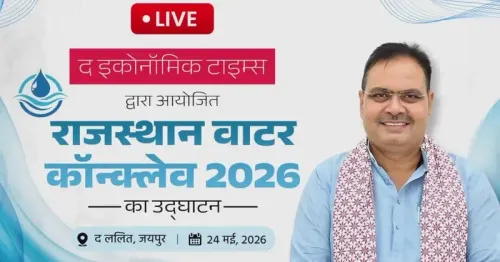
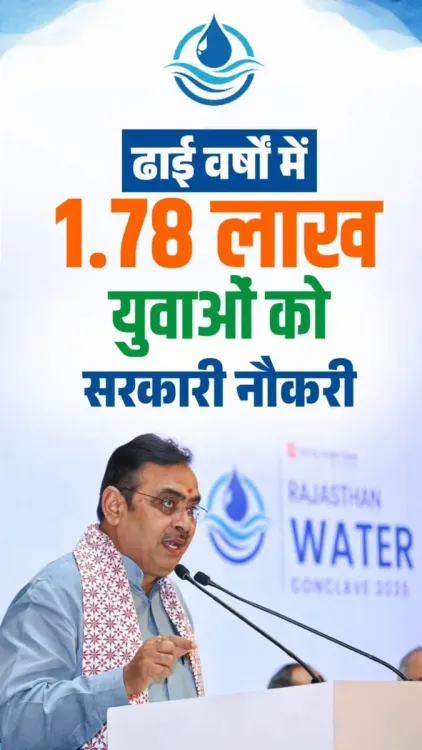
Chief Minister Bhajanlal Sharma inaugurated the Rajasthan Water Conclave 2026 on 24 July, announcing that his government has provided 1,78,000 government jobs in two and a half years while reiterating a zero-tolerance governance policy.
Key Takeaways
CM Bhajanlal Sharma inaugurated the Rajasthan Water Conclave 2026 on 24 July 2026 .
The government claims to have provided 1,78,000 government jobs to youth in two and a half years .
The Chief Minister reaffirmed a zero-tolerance policy as a cornerstone of the current BJP-led administration.
Rajasthan has a long history of state-level water conclaves, building on initiatives like the Mukhyamantri Jal Swavlamban Abhiyan launched in 2016.
The conclave is expected to produce policy announcements on water conservation, groundwater management, and irrigation infrastructure.
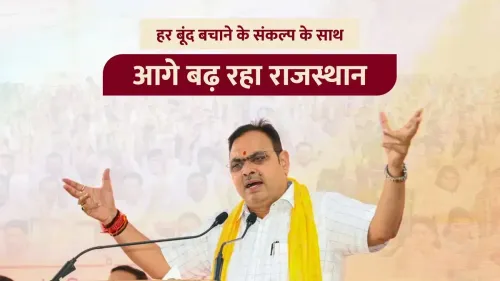
The Chief Minister's Office of Rajasthan announced on Friday, 24 July 2026 that Chief Minister Bhajanlal Sharma inaugurated the Rajasthan Water Conclave 2026, using the occasion to highlight his government's zero-tolerance governance policy and its record on public employment.
Context
Addressing the inaugural ceremony of the conclave, CM Bhajanlal Sharma said the state government is working on a policy of 'zero tolerance' — a reference to its stated commitment to eliminating corruption and irregularities in public administration. He added that over the past two and a half years, the government has provided government jobs to 1 lakh 78 thousand (1,78,000) young people in Rajasthan.
The announcement was made under the hashtag #आपणो_अग्रणी_राजस्थान ('Our Leading Rajasthan'), a campaign slogan used by the current BJP-led state government to promote its development agenda.
Policy Backdrop
Rajasthan, a predominantly arid and desert state in northwestern India, has historically faced acute water scarcity challenges. State-level water conclaves serve as platforms for policymakers, technical experts, and civil society to deliberate on conservation strategies, groundwater management, and irrigation infrastructure.
The state has a precedent of pairing water-sector initiatives with broader governance messaging. The Mukhyamantri Jal Swavlamban Abhiyan, launched in 2016, was an earlier landmark effort to promote water self-reliance through community participation and government investment in conservation structures. The Rajasthan Water Conclave 2026 follows in this tradition of high-profile, state-convened water policy events.
Stakeholders and Impact
The conclave brings together water sector stakeholders — including irrigation officials, groundwater experts, and policymakers — at a time when Rajasthan continues to grapple with seasonal water stress and dependence on the Indira Gandhi Canal and other inter-state river systems. Water security directly affects the livelihoods of millions of farmers and rural households across the state.
The employment figure cited by CM Sharma — 1,78,000 government jobs in roughly 30 months — is significant for a state where youth unemployment has been a persistent electoral and policy concern. If validated through official data, this would represent one of the larger recruitment cycles in the state's recent history, spanning departments from education and health to police and revenue.
What's Next
Detailed policy declarations, project announcements, and resolutions from the Rajasthan Water Conclave 2026 are expected to emerge over the course of the event. Observers will watch for specific commitments on groundwater recharge targets, irrigation coverage, and inter-departmental water-use efficiency measures.
On the employment front, the state government is expected to release official recruitment data that would corroborate the figures cited by the Chief Minister. Both tracks — water governance and public-sector hiring — will serve as key benchmarks as Rajasthan moves toward the next electoral cycle.
Point of View
78,000-job figure, CM Bhajanlal Sharma is deliberately linking environmental governance with economic delivery — a dual narrative that BJP-led state governments have increasingly deployed to shore up incumbent credibility. The zero-tolerance framing reinforces a law-and-order and anti-corruption identity that the party has cultivated since taking power in December 2023. Water policy in Rajasthan carries outsized political weight given the state's arid geography, making this conclave a high-visibility opportunity to signal administrative seriousness ahead of future electoral cycles. Whether the employment numbers withstand official scrutiny will determine how durable this messaging proves to be.
NationPress
25 Jul 2026
Frequently Asked Questions
What is the Rajasthan Water Conclave 2026?
The Rajasthan Water Conclave 2026 is a state-level event focused on water management, conservation, and policy, inaugurated by Chief Minister Bhajanlal Sharma on 24 July 2026.
How many jobs has the Rajasthan government provided in the last 2.5 years?
Chief Minister Bhajanlal Sharma stated that the Rajasthan government has provided 1,78,000 government jobs to young people over the past two and a half years.
What is the zero-tolerance policy mentioned by CM Bhajanlal Sharma?
The zero-tolerance policy refers to the Rajasthan BJP government's stated commitment to eliminating corruption and irregularities in public administration, which CM Sharma has cited as a governing principle.
What was the Mukhyamantri Jal Swavlamban Abhiyan?
The Mukhyamantri Jal Swavlamban Abhiyan was a Rajasthan government scheme launched in 2016 to promote water self-reliance through community participation and government-funded conservation structures.
Why does Rajasthan hold water conclaves?
Rajasthan holds water conclaves because it is a predominantly arid state facing chronic water scarcity, and these events bring together policymakers and experts to deliberate on groundwater management, irrigation, and conservation strategies.