CM Bhajanlal Sharma approves prosecution of 4 Rajasthan officers
Synopsis
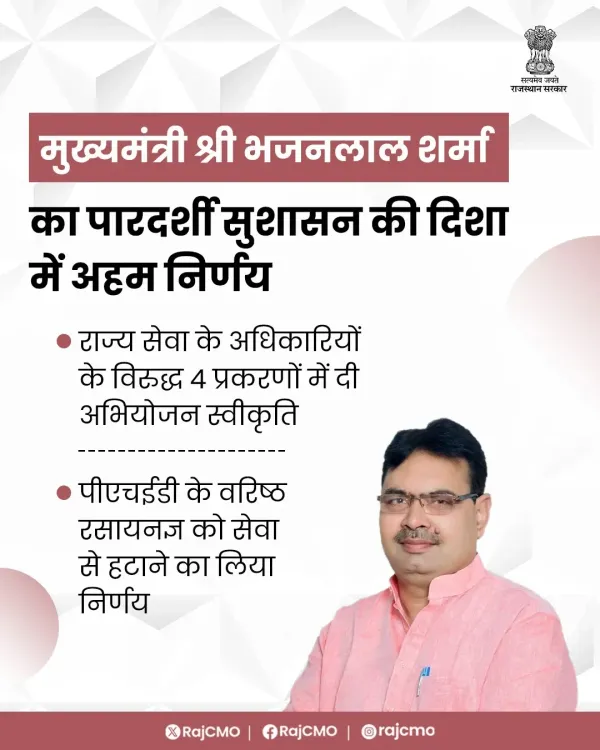
Chief Minister Bhajanlal Sharma has approved prosecution sanctions against four Rajasthan state service officers and ordered the dismissal of a Public Health Engineering Department chemist who fabricated drinking-water quality reports, invoking the Prevention of Corruption (Amendment) Act, 2018.
Key Takeaways
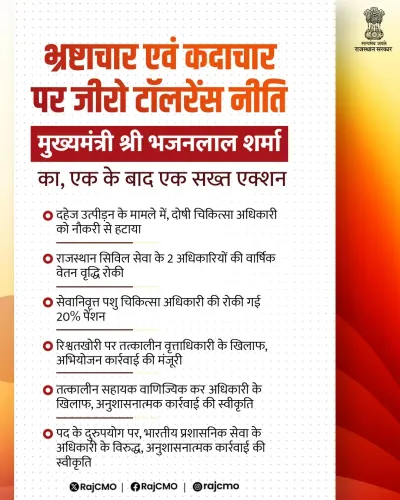
CM Bhajanlal Sharma approved prosecution sanctions in 4 separate cases against state service officers on 28 May 2026 .
A Senior Chemist of the Public Health Engineering Department was dismissed for preparing fake drinking-water quality reports .
A second convicted officer received compulsory retirement under a separate disciplinary order.
Both punitive actions were taken under the Prevention of Corruption (Amendment) Act, 2018 , which allows dismissal after conviction without a fresh departmental inquiry.
The PHED is responsible for mandatory safety testing of potable water across Rajasthan , making falsified lab reports a direct public-health risk.
Court outcomes of the four newly sanctioned prosecutions will determine the long-term deterrent effect of these measures.
The Chief Minister's Office of Rajasthan announced on Thursday, 28 May 2026 that Chief Minister Bhajanlal Sharma has approved prosecution sanctions against four state service officers and ordered the dismissal of a convicted official under the Prevention of Corruption (Amendment) Act, 2018, signalling a firm push for accountable governance in the state.
The CMO's post stated that the Sharma government is 'आमजन को पारदर्शी और जवाबदेह सुशासन देने के लिए प्रतिबद्ध' ('committed to providing transparent and accountable good governance to the common people'). The announcement covers both fresh prosecution approvals and punitive action on an already-decided conviction case.
Context
In the most striking of the disclosed actions, CM Sharma ordered the dismissal of a Senior Chemist of the Public Health Engineering Department (PHED) for preparing fake quality-testing reports on drinking water samples. The PHED is the Rajasthan state agency responsible for ensuring safe rural and urban water supply, and mandatory lab testing of drinking water is a statutory safeguard for public health.
A second convicted officer in a separate case was awarded compulsory retirement rather than outright dismissal. The CMO's statement did not name the individuals involved, consistent with standard practice in departmental disciplinary communications.
Policy Backdrop
The actions are grounded in the Prevention of Corruption (Amendment) Act, 2018, a central law that strengthened the original Prevention of Corruption Act, 1988. The 2018 amendment broadened the definition of bribery, introduced provisions for property attachment, and mandated time-bound trials — making it easier for state governments to move swiftly on conviction-linked dismissals.
Under the amended framework, once a court records a conviction, the sanctioning authority — in this case the Chief Minister — can approve dismissal or compulsory retirement without a fresh departmental inquiry, significantly reducing the procedural timeline for punitive action.
Stakeholders and Impact
Rajasthan's state service cadre, particularly officers in departments handling public utilities and procurement, is the most directly affected group. Prosecution sanctions in four cases simultaneously send a signal across the bureaucracy that pending vigilance matters will not be shelved indefinitely.
For ordinary citizens — especially in Rajasthan's water-scarce districts — the dismissal of an officer who falsified drinking-water quality reports carries direct public-health significance. Fake safety certifications on potable water can mask contamination risks, making the offence particularly consequential in an arid state.
The state's Lokayukta and vigilance commission are the institutional watchdogs that typically monitor follow-through on such sanctions, and their role in tracking the court proceedings will be closely observed by civil society groups.
What's Next
The four prosecution sanctions will now move to the relevant courts, where the pace of trials under the 2018 Act's time-bound provisions will determine outcomes. Legal challenges by the accused officers through service tribunals or high courts remain a standard recourse and could delay final resolution.
Rajasthan's broader anti-corruption posture under CM Bhajanlal Sharma — who took office in December 2023 — will be tested by whether these cases reach conviction or stall at the prosecution stage, a pattern that has historically blunted the deterrent effect of such announcements in multiple states.
Point of View
Which has sought to distinguish itself from its predecessor on anti-corruption messaging. Invoking the 2018 central amendment — rather than routine departmental rules — raises the legal stakes for accused officers and compresses the procedural timeline. However, Rajasthan's track record, like that of most Indian states, shows a persistent gap between sanction approvals and actual convictions, so the credibility of this drive will ultimately rest on courtroom outcomes. The PHED chemist case is politically potent: drinking-water safety resonates strongly with rural voters in an arid state, and the optics of punishing a public servant for endangering public health reinforce the government's 'transparent governance' brand.
NationPress
1 Aug 2026
Frequently Asked Questions
Why did CM Bhajanlal Sharma dismiss the PHED chemist?
CM Bhajanlal Sharma ordered the dismissal of a Senior Chemist of the Public Health Engineering Department for preparing fake quality-test reports on drinking-water samples, an offence that directly endangered public health in Rajasthan.
What is a prosecution sanction and why does the Chief Minister need to give it?
A prosecution sanction is the formal government approval required before a public servant can be prosecuted in court for corruption offences. Under Indian law, this sanction must come from the competent authority — in this case the Chief Minister for state service officers — before a case can proceed to trial.
What does the Prevention of Corruption Amendment Act 2018 say about dismissal?
The 2018 amendment to the Prevention of Corruption Act allows the sanctioning authority to order dismissal or compulsory retirement of a convicted public servant without conducting a fresh departmental inquiry, making post-conviction action faster and more certain.
How many officers face prosecution in Rajasthan after this order?
Four state service officers have been granted prosecution sanctions by CM Bhajanlal Sharma in this round of orders, meaning their cases can now proceed to trial in the relevant courts.
What is the Public Health Engineering Department in Rajasthan?
The Public Health Engineering Department (PHED) is the Rajasthan state agency responsible for planning, building, and maintaining rural and urban drinking-water supply systems, including mandatory laboratory testing of water samples for safety and quality.