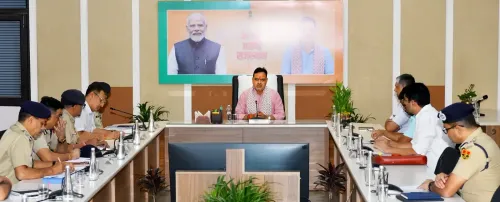
Rajasthan CM Bhajanlal Sanctions Prosecution of 27 Officials

Synopsis
Chief Minister Bhajanlal Sharma has approved prosecution sanctions against 27 Rajasthan officials across 21 corruption cases, targeting land-use fraud by sub-divisional officers and a Deputy SP accused of accumulating assets disproportionate to income.
Key Takeaways
27 officials face prosecution sanctions approved by Rajasthan CM Bhajanlal Sharma in a single announcement on October 24, 2026 .
Sanctions cover 21 cases spanning illegal agricultural-to-non-agricultural land conversion, abuse of office, and illegal gratification.
Two sub-divisional officers are named for land-record manipulation and accepting bribes to decree tenancy land claims.
A then-Deputy Superintendent of Police faces sanction for disproportionate assets and corrupt activities — extending the sweep to the police hierarchy.
Prosecution sanction clears the legal requirement for trying public servants, but convictions will depend on court proceedings that could take years.
The action aligns with CM Sharma's stated zero-tolerance anti-corruption policy since taking office in December 2023 .
Rajasthan's zero-tolerance anti-corruption drive just drew blood at the officer level. The Chief Minister's Office of Rajasthan announced on Saturday, October 24, 2026, that Chief Minister Bhajanlal Sharma has granted prosecution sanctions against 27 officials across 21 cases — targeting land-use fraud, abuse of office, illegal gratification, and assets disproportionate to income.
The CMO's post states that sanctions cover officials who illegally converted agricultural land for non-agricultural purposes, causing financial loss to the state government. Two sub-divisional officers (upakhand adhikari) feature prominently — one for unlawfully converting agricultural land and altering land-use records, another for misusing his position to get tenancy land claims decreed in his favour and for accepting illegal gratification.A Deputy SP and Disproportionate Assets
Perhaps the sharpest signal in this batch: prosecution sanction has been granted against a then-Deputy Superintendent of Police for engaging in corrupt activities and accumulating assets beyond known income sources — the classic disproportionate-assets charge that anti-corruption agencies in India have long wielded against both revenue and police officials. Bringing a police officer of DSP rank into the net alongside revenue functionaries widens the credibility of the crackdown considerably.
Under Indian law, prosecution of a public servant requires prior sanction from the competent authority — in this case, the Chief Minister. Granting sanction does not guarantee conviction, but it clears the legal gate that has historically shielded officers from standing trial. The batch of 21 cases in one announcement is notable in scale for a single day's action.
Land Records: Rajasthan's Perennial Pressure Point
Rajasthan, a state where vast tracts of agricultural and government land intersect with rapidly expanding urban fringes, has seen persistent complaints about revenue officials facilitating illegal land-use conversions. The pattern is well-documented: agricultural plots reclassified for commercial or residential use without lawful sanction, with kickbacks flowing to officers who hold discretionary power over revenue records.
Chief Minister Bhajanlal Sharma, who took office in December 2023 after the BJP's assembly election victory, has publicly anchored his governance pitch on the hashtag #AapnoAgraniRajasthan — 'Our Pioneering Rajasthan' — framing anti-corruption action as central to that vision. Today's prosecution sanctions are the latest operational expression of that stated policy.
What the Sanctions Mean in Practice
Prosecution sanction is a necessary but not sufficient step toward accountability. The cases must now pass scrutiny in court, where timelines in Indian judicial proceedings can stretch over years. Watchdog groups and opposition parties in Rajasthan will be watching whether these sanctions translate into chargesheet filings, trials, and ultimately convictions — or stall after the headline moment. The state vigilance department's follow-through will be the real measure of whether this is a sustained campaign or a periodic signal.
For now, the arithmetic is striking: 27 officers, 21 cases, one day. That is a political statement as much as a legal one — and CM Sharma clearly intends it to be read both ways.
Point of View
21 cases in a single order — are as much a governance signal as a legal act: they tell the bureaucracy that discretionary power over land records and police authority are now under active scrutiny. For CM Bhajanlal Sharma, the move reinforces the BJP's 'double-engine government' accountability narrative ahead of any mid-term optics review. The inclusion of a DSP-rank police officer alongside revenue functionaries is significant — it signals that the crackdown is not limited to softer targets in the revenue hierarchy. The harder test, however, will come when courts begin hearing these cases: India's anti-corruption prosecution record is uneven, and the distance between sanction and conviction remains a yawning gap that activists and opposition alike will use to measure genuine intent.
NationPress
24 Oct 2026
Frequently Asked Questions
What is prosecution sanction in India and why is it needed?
Prosecution sanction is a mandatory prior approval required under Indian law before a public servant can be tried in court for offences related to their official duties. Without it, courts cannot take cognisance of the case, effectively shielding officials from trial.
How many officials did Rajasthan CM Bhajanlal Sharma sanction for prosecution?
Chief Minister Bhajanlal Sharma approved prosecution sanctions against 27 officials across 21 cases , according to the Chief Minister's Office announcement on October 24, 2026.
What crimes are the Rajasthan officials accused of?
The cases involve illegal conversion of agricultural land for non-agricultural use, altering land-use records to cause state losses, misusing official position to get tenancy claims decreed, accepting illegal gratification, and accumulating assets disproportionate to known income sources.
What happens after prosecution sanction is granted in Rajasthan?
Once sanction is granted, the investigating or vigilance agency can file a chargesheet in the relevant court. The court then examines the charges and the trial process begins, which can take months or years depending on the case's complexity.
Who is Bhajanlal Sharma and when did he become Rajasthan CM?
Bhajanlal Sharma is the Chief Minister of Rajasthan representing the Bharatiya Janata Party. He took office in December 2023 after the BJP won the state assembly elections.