CM Bhajanlal Approves Rs 5,100 Cr for Rajasthan Urban Water
Synopsis
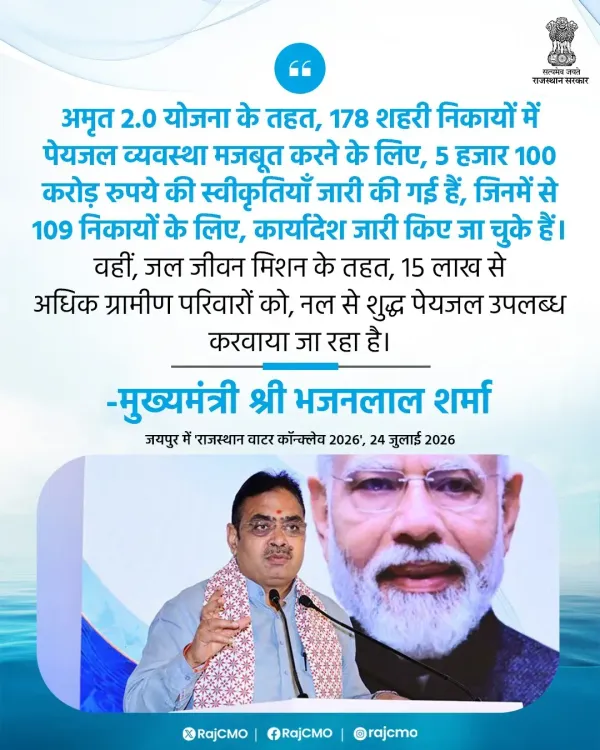
The Rajasthan Chief Minister's Office announced Rs 5,100 crore in approvals under AMRUT 2.0 to upgrade drinking water infrastructure across 178 urban local bodies, with work orders already issued for 109 of them, marking a significant push to address the water-stressed state's urban needs.
Key Takeaways
Rs 5,100 crore in approvals have been issued under AMRUT 2.0 for drinking water infrastructure in Rajasthan .
A total of 178 urban local bodies are covered under these sanctioned approvals.
Work orders — authorising on-site construction — have been issued for 109 of these 178 bodies.
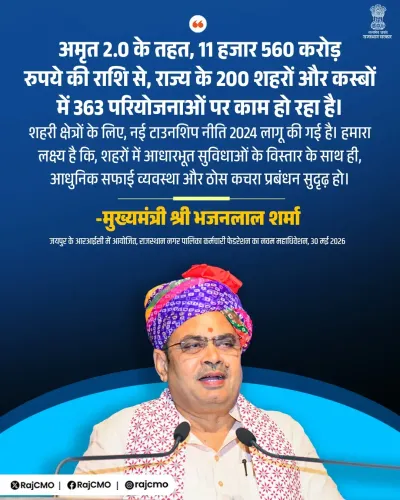
AMRUT 2.0 , launched by the Union Cabinet in 2021 , targets universal piped water coverage in urban India by 2026 with a national outlay of roughly Rs 2.77 lakh crore .
Chief Minister Bhajanlal Sharma , who has led the state BJP government since December 2023 , was tagged in the announcement.
Rajasthan's arid geography makes urban water infrastructure a high-priority policy area for successive state governments.
The Chief Minister's Office of Rajasthan announced on Saturday, 25 July 2026 that approvals worth Rs 5,100 crore have been issued under the AMRUT 2.0 scheme to strengthen drinking water infrastructure across 178 urban local bodies in the state. Work orders have already been issued for 109 of these bodies, signalling that physical execution is underway.
Context
The post from the official Rajasthan Chief Minister's Office account tagged Chief Minister Bhajanlal Sharma and carried the hashtag #आपणो_अग्रणी_राजस्थान ('Our Leading Rajasthan'), the state government's branding for its development agenda. The announcement confirms that sanction orders — a formal prerequisite before any public works spending begins — have been cleared for all 178 urban bodies, while work orders, which authorise contractors to begin on-site activity, are in place for 109 of them.
Policy Backdrop
The Atal Mission for Rejuvenation and Urban Transformation (AMRUT) was first launched by the Government of India in 2015 to plug urban infrastructure gaps in water supply and sanitation. Its successor, AMRUT 2.0, was approved by the Union Cabinet in 2021 with a total national outlay of approximately Rs 2.77 lakh crore, with the stated goal of achieving universal piped water coverage in all urban households by 2026. The scheme operates as a centrally sponsored programme, with funds flowing from the Centre to state governments and then to urban local bodies, which are responsible for project execution.
Rajasthan — a predominantly arid and semi-arid state — has historically faced acute water scarcity in its urban centres. The state has been an active participant in centrally sponsored urban water schemes, using them to expand piped connections and reduce non-revenue water losses in its cities and towns. The Rs 5,100 crore sanctioned under the current announcement represents a significant allocation within that continuing effort.
Stakeholders and Impact
The primary beneficiaries are urban households across the 178 municipal corporations, councils, and boards covered by these approvals. Reliable piped drinking water reduces dependence on tanker supply and groundwater extraction, both of which impose disproportionate costs on lower-income residents. For the 109 bodies where work orders are already issued, residents can expect visible infrastructure activity — pipeline laying, pumping station upgrades, and overhead tank construction — in the near term.
The announcement also carries political significance for Chief Minister Bhajanlal Sharma's government, which took office in December 2023 and has sought to position urban infrastructure delivery as a core plank of its administrative record ahead of future electoral cycles.
What's Next
The critical measure going forward will be physical and financial progress: whether the 69 remaining urban bodies (178 minus 109) receive their work orders promptly, and whether projects across all bodies are completed within the AMRUT 2.0 timeline. The state's urban development department is expected to submit periodic utilisation certificates to the Centre, which are a standard accountability mechanism under such centrally sponsored schemes. Progress metrics may also feature in upcoming state budget presentations or urban development department reviews.
Point of View
100 crore in AMRUT 2.0 sanctions is a tangible milestone in a scheme that has faced execution lag across multiple states since its 2021 rollout. The fact that work orders exist for only 109 of 178 bodies suggests the pipeline is still partially at the administrative stage, and delivery will hinge on how quickly the remaining orders are issued and contractors mobilised. For Chief Minister Bhajanlal Sharma, whose government is building its urban governance credentials, the speed of physical execution — not just sanction announcements — will determine the political and developmental dividend. Rajasthan's chronic water stress means the stakes of under-delivery are higher here than in better-watered states.
NationPress
25 Jul 2026
Frequently Asked Questions
What is AMRUT 2.0 and how does it work in Rajasthan?
AMRUT 2.0 is a centrally sponsored scheme launched in 2021 to achieve universal piped water supply and improved sewerage in urban India. In Rajasthan, funds flow from the Centre to the state government and then to individual urban local bodies, which execute water infrastructure projects such as pipeline networks, pumping stations, and overhead tanks.
How much money has Rajasthan sanctioned under AMRUT 2.0?
The Rajasthan government has issued approvals worth Rs 5,100 crore under AMRUT 2.0 for drinking water projects across 178 urban local bodies in the state.
How many urban bodies in Rajasthan have received work orders under AMRUT 2.0?
Work orders, which authorise contractors to begin physical construction, have been issued for 109 of the 178 urban local bodies covered under the Rs 5,100 crore sanction.
Who is Chief Minister Bhajanlal Sharma?
Bhajanlal Sharma is the Chief Minister of Rajasthan, heading the state BJP government since December 2023. He has been associated with urban development and infrastructure delivery as key priorities of his administration.
Why is urban water supply a major issue in Rajasthan?
Rajasthan is predominantly arid and semi-arid, making it one of India's most water-stressed states. Many urban centres rely on tanker supply or groundwater, and expanding piped drinking water infrastructure is a longstanding policy priority to improve quality of life and reduce costs for urban residents.