Rajasthan CM Bhajan Lal Sharma pushes clean cities, zero-tolerance graft at civic body meet
Synopsis
Rajasthan CM Bhajan Lal Sharma used a civic employees' convention to put hard numbers on the state's anti-corruption drive — 103 suspensions, 108 prosecution sanctions — while unveiling a sweeping urban agenda: 363 AMRUT 2.0 projects worth ₹11,560 crore, 200 million saplings planted, and a first-ever sandalwood forest. The convention signals that Viksit Rajasthan 2047 is being framed as much around governance accountability as infrastructure spend.
Key Takeaways
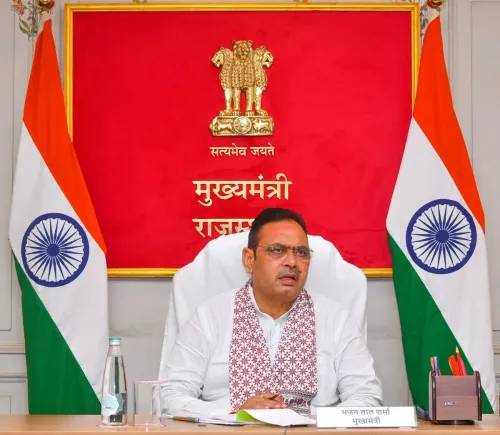
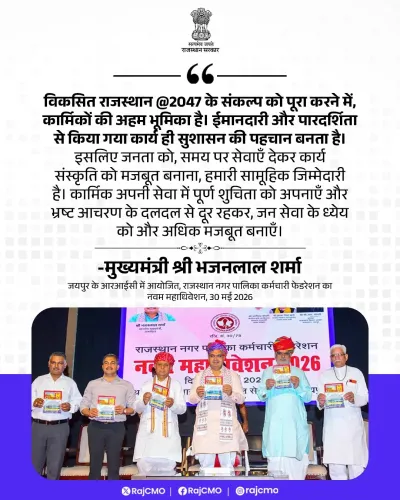
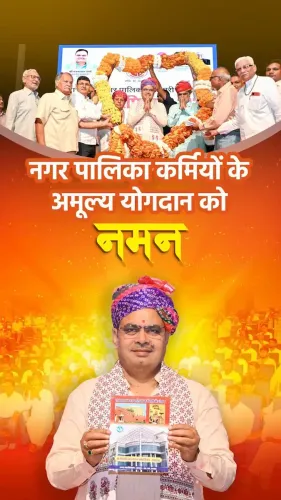
Rajasthan CM Bhajan Lal Sharma addressed the ninth Grand Convention of the Rajasthan Municipal Employees Federation in Jaipur on 30 May .
103 officials suspended, 6 dismissed, and pensions of 11 officials permanently withheld under the state's anti-corruption drive.
Prosecution sanctions granted in 108 bribery and corruption cases ; action initiated in 37 more under Section 17-A of the Prevention of Corruption Act.
Jaipur Greater Municipal Corporation ranked 16th nationally in Swachh Survekshan 2025; Udaipur ranked 13th in its population category.
363 AMRUT 2.0 projects worth ₹11,560 crore are under implementation across 200 cities and towns .
Nearly 200 million saplings planted under Hariyalo Rajasthan ; another 100 million targeted this year.
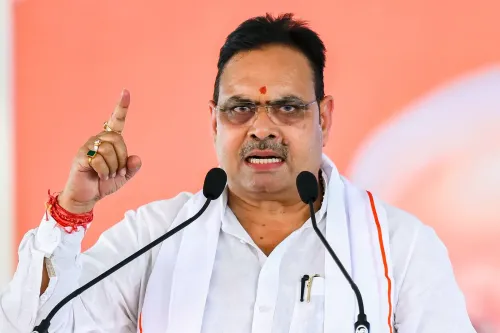
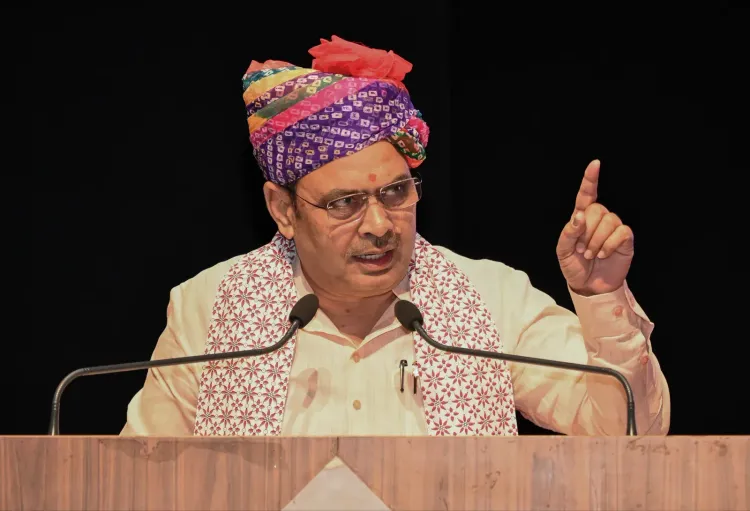
Rajasthan Chief Minister Bhajan Lal Sharma on Saturday, 30 May called on civic body employees to lead the state's urban transformation, stressing that honesty, transparency and timely public service are the bedrock of good governance. Speaking at the ninth Grand Convention of the Rajasthan Municipal Employees Federation at the Rajasthan International Centre (RIC) in Jaipur, Sharma invoked the state's long-term vision of 'Viksit Rajasthan 2047' and urged municipal workers to remain free from corrupt practices.
Zero-Tolerance Anti-Corruption Drive
Chief Minister Sharma underscored that the state government follows a zero-tolerance policy against corruption, guided by Prime Minister Narendra Modi's principle: 'Na khaonga na khane doonga' (Neither will I take bribes nor allow others to). He cited concrete enforcement action: 103 government officials have been suspended, six dismissed from service, and pensions of 11 officials permanently withheld on corruption charges.
Prosecution sanctions have been granted in 108 cases involving bribery, misuse of official position and disproportionate assets. Action has also been initiated in 37 additional cases under Section 17-A of the Prevention of Corruption Act. This is among the most detailed public accounting of anti-corruption enforcement by a Rajasthan government in recent years.
Cleanliness Rankings and Swachh Bharat Push
On urban sanitation, Sharma highlighted Rajasthan's performance in Swachh Survekshan 2025: Jaipur Greater Municipal Corporation ranked 16th nationally among cities with a population above one million, while Udaipur ranked 13th among cities with a population between three lakh and one million. 'Our goal is to make Rajasthan's cities national leaders in cleanliness,' he said.
The Chief Minister credited Prime Minister Modi's Swachh Bharat Mission with evolving into a nationwide people's movement, significantly improving sanitation practices and enhancing dignity through household toilet construction. He also highlighted urban infrastructure development under the Smart Cities Mission.
Urban Infrastructure: AMRUT 2.0 and Township Policy
Under the AMRUT 2.0 scheme, 363 projects worth ₹11,560 crore are being implemented across 200 cities and towns in Rajasthan. The state government has also introduced the Township Policy 2024 to support planned urban growth and strengthen sanitation and solid waste management systems.
Sharma noted that civic body employees serve as the public's most direct point of contact, delivering essential services including sanitation, drinking water, roads, sewerage, park maintenance, firefighting, and birth and death registration. 'With rapid urbanisation, the role of municipal bodies will become even more critical in the coming years,' he said.
Environment, Water Conservation and Green Initiatives
The Chief Minister highlighted the state's ongoing Vande Ganga Water Conservation and Public Campaign, run with community participation. Under the Hariyalo Rajasthan initiative, nearly 200 million saplings have already been planted, with a target of planting another 100 million seedlings this year. Rajasthan also plans to develop sandalwood forests for the first time.
Rising Rajasthan and Broader Governance
Sharma pointed to progress under the Rising Rajasthan initiative, under which MoUs worth nearly ₹9 lakh crore have reportedly materialised. The state government has also constituted a Special Investigation Team (SIT) and an Anti-Gangster Task Force (AGTF), curbed paper leak incidents, and continued providing employment opportunities to youth.
Union Minister of State for Agriculture and Farmers' Welfare Bhagirath Choudhary praised Chief Minister Sharma as a 'son of the soil', noting the state government's welfare measures for farmers alongside the PM-Kisan Samman Nidhi scheme. Minister of State (Independent Charge) for Urban Development and Local Self-Government Jhabar Singh Kharra said the government is working continuously toward good governance, public welfare and infrastructure development across water management, energy, youth welfare and employee welfare. Earlier in the event, Chief Minister Sharma released the Employees' Welfare Souvenir.
As Rajasthan accelerates its urban development agenda, the performance of its civic workforce — and the government's ability to enforce accountability — will be closely watched in the run-up to Viksit Rajasthan 2047.
Point of View
108 prosecution sanctions) is unusually specific for a convention speech and appears designed to pre-empt opposition narratives ahead of local body cycles. Yet the harder question is whether these numbers translate into systemic change or remain episodic enforcement. Rajasthan's Swachh Survekshan rankings — 16th for Jaipur, 13th for Udaipur — are respectable but not top-tier, suggesting the gap between ambition and execution remains real. The ₹11,560 crore AMRUT 2.0 pipeline is substantial, but project implementation quality in Rajasthan's smaller towns has historically lagged disbursement pace. The Viksit Rajasthan 2047 framing gives the government a long runway, but civic workers on the ground will determine whether that vision is credible.
NationPress
14 Oct 2026
Frequently Asked Questions
What is Viksit Rajasthan 2047?
Viksit Rajasthan 2047 is Rajasthan's long-term development vision targeting a fully developed, modern state by the centenary of Indian independence. Chief Minister Bhajan Lal Sharma has placed clean cities, honest governance and urban infrastructure at the centre of this roadmap.
What anti-corruption action has the Rajasthan government taken?
The Rajasthan government has suspended 103 officials, dismissed 6, and permanently withheld pensions of 11 others on corruption charges. Prosecution sanctions have been granted in 108 cases of bribery and misuse of office, with 37 additional cases initiated under Section 17-A of the Prevention of Corruption Act.
How did Rajasthan cities rank in Swachh Survekshan 2025?
Jaipur Greater Municipal Corporation ranked 16th nationally among cities with a population above one million. Udaipur ranked 13th among cities with a population between three lakh and one million, according to Swachh Survekshan 2025 data cited by Chief Minister Sharma.
What is the AMRUT 2.0 scheme and how is Rajasthan implementing it?
AMRUT 2.0 (Atal Mission for Rejuvenation and Urban Transformation) is a central government scheme for urban infrastructure. In Rajasthan, 363 projects worth ₹11,560 crore are being implemented across 200 cities and towns, covering water supply, sewerage and sanitation.
What are the Hariyalo Rajasthan and Vande Ganga initiatives?
Hariyalo Rajasthan is the state's tree-plantation drive under which nearly 200 million saplings have been planted, with a target of 100 million more this year, including a first-ever sandalwood forest. Vande Ganga is a water conservation campaign run with community participation to address the state's water scarcity challenges.