CM Bhajanlal Highlights Nagar Nikay Staff as Citizens' First Contact
Synopsis
The Chief Minister's Office of Rajasthan, citing CM Bhajan Lal Sharma, declared on 31 May 2026 that Nagar Nikay employees are citizens' foremost point of contact with government — spotlighting municipal workers as the frontline face of urban governance under the #AapnoAgrani campaign.
Key Takeaways
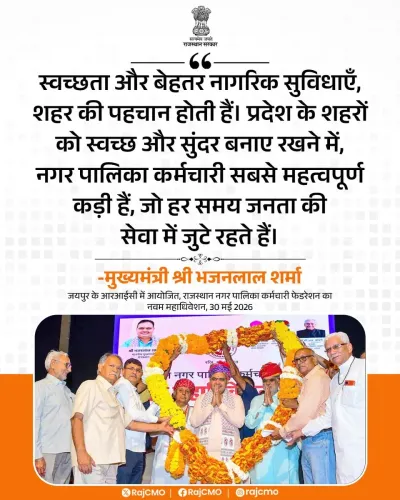
The Chief Minister's Office of Rajasthan posted on 31 May 2026 that Nagar Nikay employees are citizens' 'first and most direct contact' with the government.
CM Bhajan Lal Sharma was tagged in the post, indicating his personal endorsement of the message.
The post was shared under the campaign hashtag #आपणो_अग्रणी_राजस्थान ('Our Rajasthan, Leading Forward').
Nagar Nikays — urban local bodies — derive their constitutional mandate from the 74th Amendment of 1992 and handle frontline civic services for urban residents.
The BJP administration has been in office in Rajasthan since December 2023 , with a stated focus on local governance efficiency.
Possible follow-up measures include municipal employee training programmes or performance-linked incentives for urban local body staff.
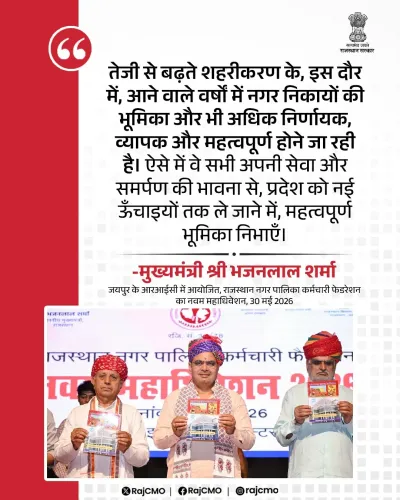
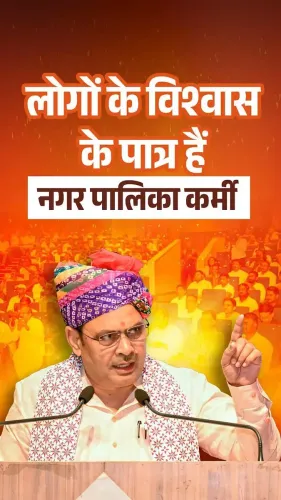
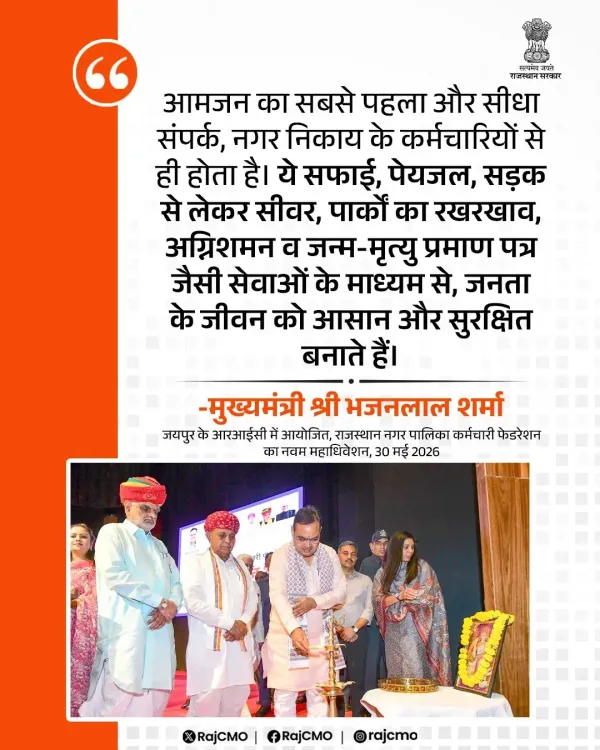
The Chief Minister's Office of Rajasthan on Sunday, 31 May 2026 shared a message from Chief Minister Bhajan Lal Sharma emphasising that municipal employees are the foremost and most direct point of contact between ordinary citizens and the government. The post, tagged under the campaign hashtag #आपणो_अग्रणी_राजस्थान ('Our Rajasthan, Leading Forward'), underscores the state administration's focus on grassroots urban governance.
Context
The post states, 'आमजन का सबसे पहला और सीधा संपर्क, नगर निकाय के कर्मचारियों से ही होता है' — translating to: 'The first and most direct contact of ordinary people is with the employees of the Nagar Nikay (urban local bodies).' By tagging CM Bhajan Lal Sharma directly, the Chief Minister's Office positions this as a statement of governance philosophy from the top of the state administration. The message places Nagar Nikay workers — those handling sanitation, civic maintenance, and citizen grievances at the street level — at the centre of public service delivery.
Policy Backdrop
Urban local bodies in Rajasthan draw their constitutional mandate from the 74th Constitutional Amendment Act of 1992, which devolved significant civic powers to municipalities across India. Rajasthan's Nagar Nikays — spanning municipal corporations, councils, and boards — serve as the primary interface between residents and government for services ranging from solid waste management to building permits and street lighting. Successive state governments have periodically pushed capacity-building initiatives for municipal staff to improve service quality and accountability.
The BJP administration, which took office in December 2023 under CM Bhajan Lal Sharma, has continued this emphasis on local governance efficiency as part of its broader state development agenda. Highlighting the role of frontline municipal workers aligns with a national pattern of recognising grassroots government employees as the visible face of administration for most urban residents.
Stakeholders and Impact
Municipal employees across Rajasthan's urban local bodies are the direct subject of this acknowledgement, and such public recognition from the Chief Minister's Office can carry weight in shaping institutional morale and public expectations. Urban residents — who interact with Nagar Nikay staff for everyday civic needs — stand to benefit if this messaging translates into concrete reforms in service delivery or employee accountability. The post's framing suggests the government views these workers not merely as administrative functionaries but as ambassadors of governance at the ground level.
What's Next
The messaging may be a precursor to announced initiatives around municipal employee training, performance-linked incentives, or urban service delivery reforms in Rajasthan. The campaign hashtag #आपणो_अग्रणी_राजस्थान signals a continuing communications push around the state's development identity. Observers will watch whether this public emphasis on Nagar Nikay staff is followed by policy measures — such as structured grievance redressal upgrades or workforce development programmes — that give institutional weight to the stated priority.
Point of View
Not the secretariat. It fits a broader BJP pattern of wrapping local governance messaging within aspirational state-branding campaigns, here the 'Aapno Agrani Rajasthan' frame. The practical test will be whether this rhetorical elevation of municipal workers is matched by structural investments in training, pay, or grievance systems. Without that follow-through, the post reads more as political positioning ahead of potential urban local body elections than as a governance commitment.
NationPress
16 Oct 2026
Frequently Asked Questions
What did Rajasthan CM Bhajanlal say about Nagar Nikay employees?
CM Bhajan Lal Sharma's office stated that Nagar Nikay (urban local body) employees are the first and most direct point of contact between ordinary citizens and the government, underlining their central role in public service delivery.
What is Nagar Nikay in Rajasthan?
Nagar Nikay refers to urban local bodies in Rajasthan — including municipal corporations, councils, and boards — responsible for civic services such as sanitation, waste management, and infrastructure at the city and town level.
What is the #AapnoAgrani Rajasthan campaign?
#आपणो_अग्रणी_राजस्थान translates to 'Our Rajasthan, Leading Forward' and is a branding campaign used by the Rajasthan government under CM Bhajan Lal Sharma to communicate the state's development agenda.
Who is Bhajan Lal Sharma?
Bhajan Lal Sharma is a BJP politician who has served as Chief Minister of Rajasthan since December 2023 , when the party won the state assembly elections.
What reforms are expected for Rajasthan municipal employees?
While no specific measures have been announced in this post, the government's focus on Nagar Nikay staff may signal upcoming initiatives such as employee training programmes, performance incentives, or urban service delivery reforms.