CM Bhajanlal Sharma Flags Agriculture, Animal Husbandry as Twin Pillars for Rajasthan Farmers
Synopsis
The Chief Minister's Office of Rajasthan, citing CM Bhajanlal Sharma, declared on 18 July 2026 that agriculture and animal husbandry are the two essential pillars of a farmer's life, reinforcing the state government's twin-sector rural welfare focus under the Aapno Agrani Rajasthan campaign.
Key Takeaways
The Chief Minister's Office of Rajasthan posted on 18 July 2026 reaffirming agriculture and animal husbandry as the twin pillars of farmer welfare.
CM Bhajanlal Sharma was directly tagged, signalling personal ownership of the rural development message.
The post was hashtagged under #AapnoAgrani Rajasthan , the BJP state government's flagship development campaign.
Rajasthan has a large agrarian base where livestock and crops together sustain household income for millions of small and marginal farmers.
The national PM-KISAN scheme provides Rs 6,000 per year in direct support to eligible farmer families, complemented by state-level livestock and dairy schemes.
Policy watchers will track upcoming Rajasthan budget allocations to see if the statement translates into new agriculture and animal husbandry funding.
The Chief Minister's Office of Rajasthan on Saturday, 18 July 2026, shared a message from Chief Minister Bhajanlal Sharma reaffirming that agriculture and animal husbandry are the two most vital foundations of a farmer's life in the state, under the banner of the government's Aapno Agrani Rajasthan (Our Frontline Rajasthan) vision.
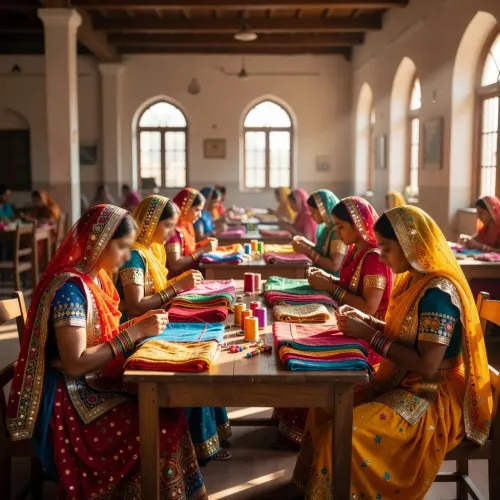
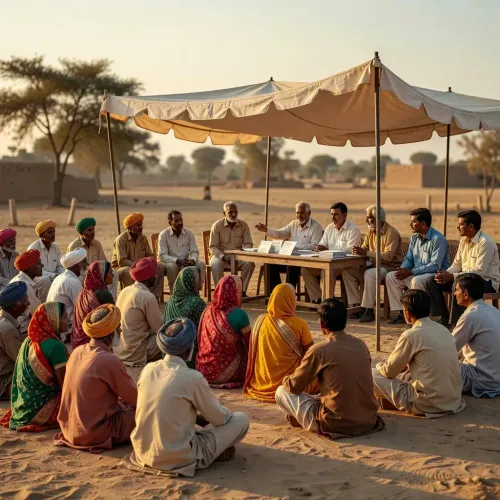
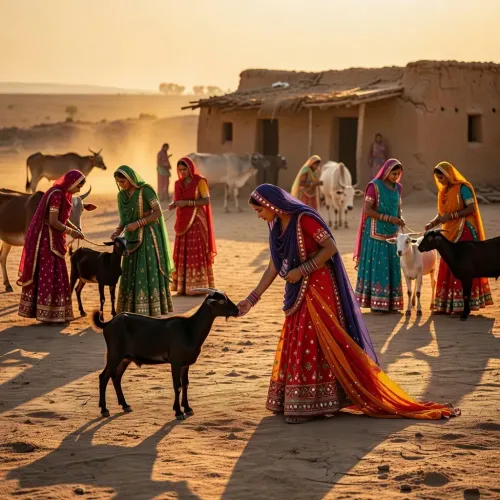
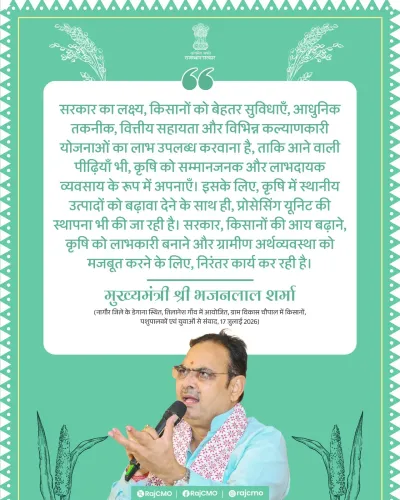
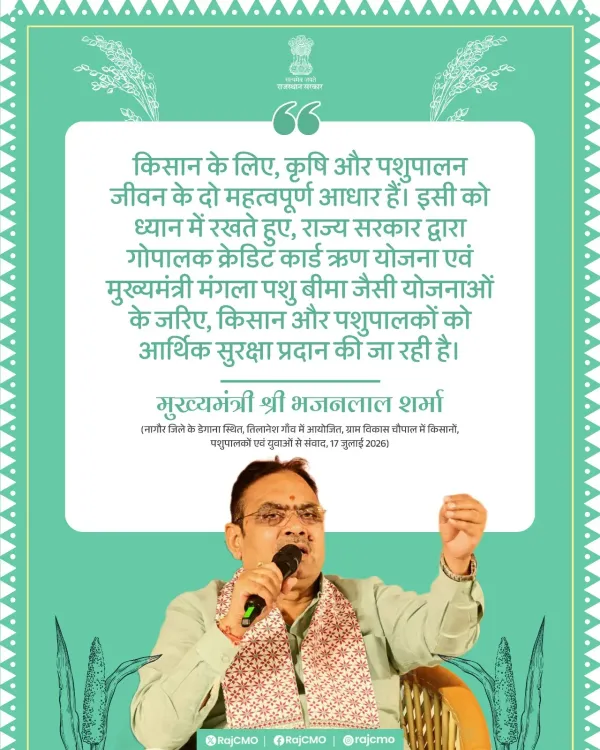
The post, shared on the official CMO handle and tagging @BhajanlalBjp, read: 'Kisan ke liye, krishi aur pashupaalan jeevan ke do mahatvapurn aadhar hain' — 'For the farmer, agriculture and animal husbandry are the two important pillars of life.' The message was accompanied by an image and carried the hashtag #AapnoAgrani Rajasthan, the BJP-led state government's overarching development campaign.
Context
Rajasthan is one of India's largest states by area, with a predominantly rural population whose livelihoods hinge on both crop cultivation and livestock rearing. The two sectors are deeply intertwined: cattle and small ruminants provide draught power, dairy income, and organic inputs for fields, making them inseparable in the household economy of a typical Rajasthani farmer.
The statement from the CMO signals a continuing emphasis by the Bhajanlal Sharma government on twin-sector support — a posture that has characterised BJP administrations in agrarian states where rural vote banks are decisive.
Policy Backdrop
At the national level, the Pradhan Mantri Kisan Samman Nidhi (PM-KISAN) scheme, launched in 2019, provides direct income support of Rs 6,000 per year in three instalments to eligible farmer families across India, including those in Rajasthan. State governments have layered additional support through subsidies, cooperative networks, and extension services targeting both crop and livestock sectors.
Rajasthan has historically run its own animal husbandry schemes — covering veterinary services, breed improvement, and dairy cooperatives — recognising that for many smallholder families, the sale of milk and livestock often provides more stable cash flow than seasonal crop income. The CMO's message fits within this long-standing policy lineage.
Stakeholders and Impact
The primary beneficiaries of policies anchored in this philosophy are Rajasthan's millions of small and marginal farmers, who depend on both their fields and their animals to sustain household income through the year. Landless agricultural labourers who maintain livestock also stand to benefit from any expanded state support in the animal husbandry space.
Dairy cooperatives, veterinary departments, and agri-input suppliers are secondary stakeholders whose operations are directly shaped by the level of government investment in these two sectors. A clear political signal from the Chief Minister's Office can translate into administrative priority-setting in the months ahead.
What's Next
Observers will watch the Rajasthan state budget and upcoming departmental guidelines to see whether this message is followed by concrete allocations for agriculture and animal husbandry in the next fiscal cycle. Any new schemes for dairy development, crop insurance enhancement, or livestock health infrastructure would give substantive weight to the CMO's stated priorities.
The Aapno Agrani Rajasthan campaign provides a political frame within which such announcements are likely to be packaged, making the coming months a key test of whether the twin-pillar commitment translates from messaging into measurable policy action.
Point of View
Values-laden, and tied to a campaign hashtag that keeps the ruling party's brand visible. For the BJP in Rajasthan, consistently foregrounding farmer welfare is both a governance priority and an electoral imperative, given the state's large rural electorate. The dual emphasis on agriculture and animal husbandry is also strategically inclusive, capturing both crop-dependent farmers and the substantial pastoral and dairy communities of the state. The real test will come when budget documents and scheme guidelines either validate or hollow out this rhetorical commitment.
NationPress
17 Oct 2026
Frequently Asked Questions
What did Rajasthan CM Bhajanlal Sharma say about farmers?
CM Bhajanlal Sharma, through the official Rajasthan CMO account on 18 July 2026, stated that agriculture and animal husbandry are the two most important pillars of a farmer's life, under the Aapno Agrani Rajasthan campaign.
What is the Aapno Agrani Rajasthan campaign?
Aapno Agrani Rajasthan, meaning 'Our Frontline Rajasthan,' is the BJP-led state government's overarching development and governance campaign used to frame policy messaging and achievements under CM Bhajanlal Sharma.
Why is animal husbandry important for Rajasthan farmers?
Animal husbandry provides Rajasthan's smallholder farmers with dairy income, draught power, and organic inputs, often delivering more stable cash flow than seasonal crop cultivation, making it inseparable from agricultural livelihoods.
What central scheme supports Rajasthan farmers financially?
The Pradhan Mantri Kisan Samman Nidhi (PM-KISAN) scheme, launched in 2019, provides eligible farmer families Rs 6,000 per year in three instalments, and Rajasthan farmers are among its beneficiaries.
What should we watch for after this Rajasthan CMO statement on farmers?
Policy watchers should track Rajasthan's upcoming state budget allocations and any new departmental guidelines for agriculture and animal husbandry to see if this message is backed by concrete funding and scheme launches.