CM Bhajanlal Says MGNREGA Failed to Fully Meet Rural Jobs Goal
Synopsis
Rajasthan Chief Minister Bhajanlal Sharma has stated that MGNREGA, the central scheme guaranteeing 100 days of rural wage employment, has not fully achieved its intended purpose — a pointed critique that signals the state may push for alternative or supplementary rural employment measures.
Key Takeaways
The Chief Minister's Office of Rajasthan quoted CM Bhajanlal Sharma on 3 July 2026 saying MGNREGA has not fully met its rural employment guarantee objective.
MGNREGA , enacted in 2005 , guarantees up to 100 days of wage employment annually to rural households across India.
Rajasthan is historically among the highest-utilising states under MGNREGA, given its large rural population and drought vulnerability.
The remark was posted under the hashtag #आपणो_अग्रणी_राजस्थान , the state government's development branding campaign.
No specific data, event, or new policy announcement was cited in the post as the immediate trigger.
Policy watchers will monitor state assembly proceedings and central-state meetings for any follow-up rural employment initiatives from the Rajasthan government .
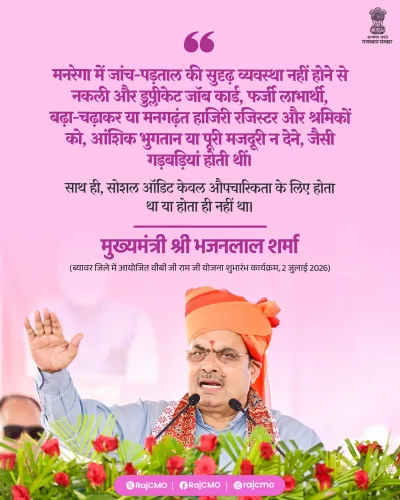
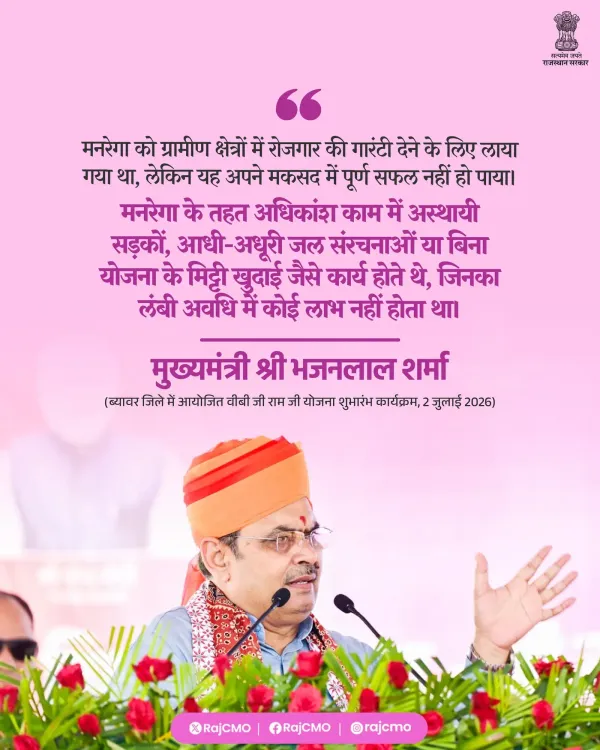
The Chief Minister's Office of Rajasthan posted on X on 3 July 2026, quoting Chief Minister Bhajanlal Sharma as stating that the Mahatma Gandhi National Rural Employment Guarantee Act (MGNREGA) was introduced to guarantee employment in rural areas but has not fully succeeded in its intended purpose. The remark was posted under the hashtag #आपणो_अग्रणी_राजस्थान ('Our Leading Rajasthan'), the branding campaign for the state government's development agenda.
Context
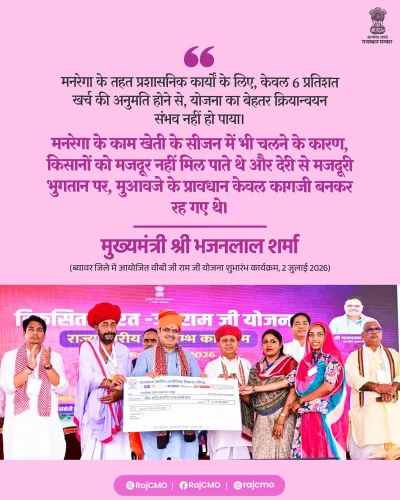
Sharma's statement, as shared by the CMO, reads in translation: 'मनरेगा को ग्रामीण क्षेत्रों में रोजगार की गारंटी देने के लिए लाया गया था, लेकिन यह अपने मकसद में पूर्ण सफल नहीं हो पाया।' ('MGNREGA was brought in to guarantee employment in rural areas, but it has not been fully successful in its purpose.'). The comment represents a direct critique of a flagship central scheme by a sitting state chief minister, and places the remark firmly within the ruling party's framing of rural development in Rajasthan.
The post did not cite a specific data point, event, or policy announcement as the immediate trigger for the remark. It was accompanied by one image and carried the hashtag associated with the state government's broader governance and development narrative.
Policy Backdrop
MGNREGA was enacted by Parliament in 2005 under the National Rural Employment Guarantee Act and later renamed. The scheme guarantees up to 100 days of wage employment annually to rural households willing to do unskilled manual work. It remains one of the largest public works programmes in the world by coverage.
Rajasthan, which has a large rural population and is prone to drought, has historically been one of the highest-utilising states under MGNREGA. The state government has, in previous years, added state-funded supplementary days or wage top-ups during drought conditions. Under CM Bhajanlal Sharma, who took office in December 2023, the state has positioned its own employment and skill-development initiatives as addressing gaps in centrally designed schemes.
Stakeholders and Impact
The primary beneficiaries of MGNREGA are rural households and agricultural labourers, particularly those without access to formal employment. Any shift in state policy or supplementary programming would most directly affect these groups across Rajasthan's vast rural belt.
Critiques of MGNREGA by state governments — including those from the same party as the central government — have typically focused on design rigidity, delays in wage payments, and limited local flexibility in choosing work types. Such federal bargaining over scheme guidelines and funding shares is a recurring feature of centre-state relations in welfare delivery.
What's Next
The remark signals that the Rajasthan government may be laying the groundwork for announcing supplementary rural employment measures or pushing for greater state autonomy in implementing MGNREGA. Observers will watch the state assembly sessions and upcoming central-state coordination meetings on the scheme for any concrete policy follow-through.
If the state does announce parallel or enhanced rural employment programmes, the framing of MGNREGA's limitations would serve as a political and administrative justification. The hashtag #आपणो_अग्रणी_राजस्थान suggests the critique is being embedded within a larger narrative of Rajasthan charting its own development path.
Point of View
Regardless of party alignment, seeking greater flexibility and credit-visibility in centrally sponsored welfare delivery. By embedding the critique within the 'Aapno Agrani Rajasthan' branding, the state is signalling that any corrective action will be framed as Rajasthan-led innovation. This sets the stage for potential state-level rural employment announcements that could define the government's welfare identity ahead of the next electoral cycle.
NationPress
1 Oct 2026
Frequently Asked Questions
What did Rajasthan CM Bhajanlal Sharma say about MGNREGA?
CM Bhajanlal Sharma stated that MGNREGA was introduced to guarantee employment in rural areas but has not been fully successful in achieving that purpose, as shared by the official Rajasthan CMO account on X on 3 July 2026.
What is MGNREGA and how does it work?
MGNREGA, or the Mahatma Gandhi National Rural Employment Guarantee Act, is a central government scheme enacted in 2005 that guarantees up to 100 days of unskilled wage employment annually to rural households across India.
Why is Rajasthan criticising MGNREGA?
The Rajasthan government under CM Bhajanlal Sharma has positioned its own employment and skill programmes as addressing gaps in centrally designed schemes. The critique focuses on MGNREGA's inability to fully deliver on its rural employment guarantee, though no specific data was cited in the post.
How has Rajasthan used MGNREGA in the past?
Rajasthan has historically been among the highest-utilising states under MGNREGA due to its large rural population and drought-prone geography, and has previously added state-funded supplementary days or wage top-ups during drought years.
What could follow Bhajanlal Sharma's MGNREGA remarks?
Observers expect the Rajasthan government may announce supplementary rural employment measures or seek greater state autonomy in MGNREGA implementation, with announcements possibly coming in state assembly sessions or central-state coordination meetings.