CM Bhajanlal Approves Rs 18.86 Cr for Rajasthan Mandi Upgrades
Synopsis
Chief Minister Bhajanlal Sharma has approved Rs 18.86 crore for physical infrastructure upgrades — mandi yards, approach roads, and road repairs — at six Agricultural Produce Market Committees across Rajasthan, aiming to boost farm arrivals and mandi revenue.
Key Takeaways
Rs 18 crore 86 lakh sanctioned by CM Bhajanlal Sharma for APMC infrastructure works across Rajasthan.
Works cover mandi yard construction , new approach roads , and repair of damaged roads .
Six mandis covered: Sojat City (Pali) , Palsana and Shrimadhopur (Sikar) , Anaj Mandi (Bikaner) , Merta City (Nagaur) , and Dudu (Jaipur) .
The approval is expected to increase crop arrivals at mandis and make it easier for farmers to sell their produce.
Mandi revenue growth is also cited as a direct anticipated outcome of the infrastructure improvements.
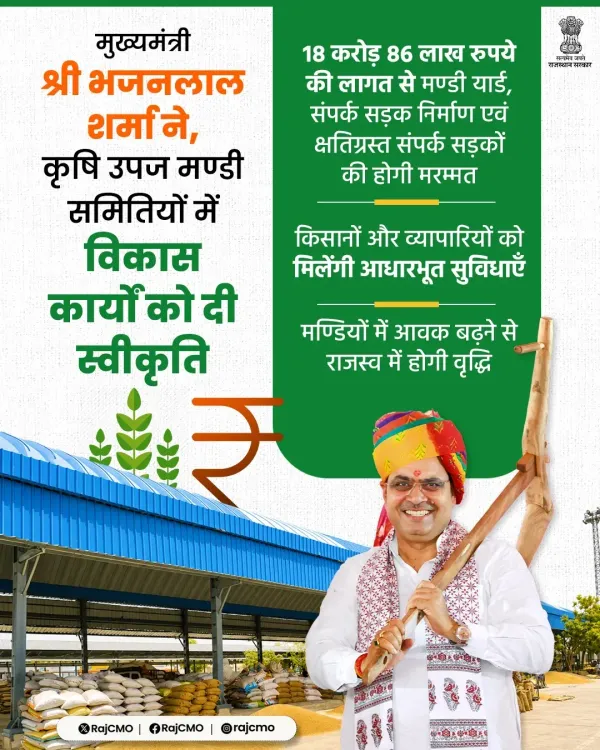
The Chief Minister's Office of Rajasthan announced on Thursday, 18 June 2026 that Chief Minister Bhajanlal Sharma has approved development works worth Rs 18 crore 86 lakh to strengthen the physical infrastructure of various Agricultural Produce Market Committees (APMCs) across the state.
Context
The official post stated: 'मुख्यमंत्री श्री भजनलाल शर्मा ने, राज्य की विभिन्न कृषि उपज मण्डी समितियों के आधारभूत ढाँचे को सुदृढ़ बनाने के लिए, 18 करोड़ 86 लाख रुपये की लागत के, विभिन्न विकास कार्यों के प्रस्ताव को, स्वीकृति प्रदान की है।' ('Chief Minister Bhajanlal Sharma has approved a proposal for various development works costing Rs 18 crore 86 lakh to strengthen the basic infrastructure of various agricultural produce market committees of the state.')
The approved works cover mandi yard construction, construction of approach roads, and repair of damaged roads at the identified mandi sites. These are foundational physical upgrades aimed at making it easier for farmers to bring their produce to market.
Policy Backdrop
APMCs are statutory bodies under Rajasthan's agricultural marketing department, responsible for regulating trade, collecting market fees, and maintaining mandi infrastructure. The six mandis covered under this approval are: Krishi Upaj Mandi Samiti Sojat City (Pali), Palsana and Shrimadhopur (Sikar), Anaj Mandi (Bikaner), Merta City (Nagaur), and Dudu (Jaipur).
Rajasthan has periodically directed budgetary resources toward physical APMC upgrades to reduce post-harvest losses and raise market arrivals. This approval continues that focus on basic infrastructure rather than regulatory or digital reforms alone. The central government's e-National Agriculture Market (e-NAM) platform, launched in 2016, has also sought to integrate physical mandis like these into a unified digital marketplace for better price discovery.
Stakeholders and Impact
The CMO stated that the approval will 'कृषि विपणन गतिविधियों को प्रोत्साहन मिलेगा' — ('boost agricultural marketing activities'). Specifically, it is expected to increase the arrival of crops at mandis, make it easier for farmers to sell their produce, and raise mandi revenue.
The primary beneficiaries are farmers in the catchment areas of these six mandis spread across Pali, Sikar, Bikaner, Nagaur, and Jaipur districts. Mandi traders and APMC revenue staff are also set to benefit from improved yard and road facilities. Similar state-level spending on APMC physical infrastructure has been observed in other BJP-governed states following the 2023 assembly elections.
What's Next
The tendering and execution process for these works will be the immediate next step, with physical progress across the six mandi sites to be watched closely. Any follow-up allocations for remaining mandis across Rajasthan in the next state budget will indicate whether this approval is part of a wider, phased infrastructure drive. The government's ability to translate sanctioned funds into completed yards and roads on schedule will be the key measure of impact for the farming communities involved.
Point of View
A pattern consistent with BJP-governed states post-2023 elections. By targeting yard construction and approach roads rather than regulatory or digital reform, the government is prioritising visible, on-ground improvements that directly affect farmers' daily experience at mandis. The geographic spread — spanning Pali, Sikar, Bikaner, Nagaur, and Jaipur — suggests a deliberate effort to distribute benefits across regions ahead of future electoral cycles. Whether this piecemeal allocation evolves into a comprehensive, state-wide APMC modernisation programme will be the critical question for agricultural policy watchers.
NationPress
22 Sept 2026
Frequently Asked Questions
What has CM Bhajanlal Sharma approved for Rajasthan mandis?
CM Bhajanlal Sharma has approved development works worth Rs 18 crore 86 lakh to strengthen the infrastructure of various Agricultural Produce Market Committees (APMCs) in Rajasthan, covering mandi yard construction, new approach roads, and repair of damaged roads.
Which mandis will benefit from this Rajasthan APMC infrastructure approval?
The six mandis covered are Sojat City (Pali) , Palsana and Shrimadhopur (Sikar) , Anaj Mandi (Bikaner) , Merta City (Nagaur) , and Dudu (Jaipur) .
How will Rajasthan farmers benefit from the mandi upgrade?
The upgrades are expected to increase the arrival of crops at mandis, make it easier for farmers to sell their produce, and boost overall mandi revenue, thereby improving agricultural marketing conditions.
What is an APMC and why does its infrastructure matter?
An Agricultural Produce Market Committee (APMC) is a statutory body that regulates the trade of agricultural produce, collects market fees, and maintains mandi yards. Better physical infrastructure means smoother logistics, reduced post-harvest losses, and more competitive price discovery for farmers.
Is this Rajasthan mandi spending linked to the central e-NAM scheme?
While the central government's e-NAM platform (launched 2016) seeks to integrate physical mandis digitally, the current Rajasthan approval focuses on physical infrastructure — yards and roads — which is a prerequisite for any effective digital integration at these mandi sites.