CM Bhajanlal Directs Training for Agri Supervisors on Natural Farming
Synopsis
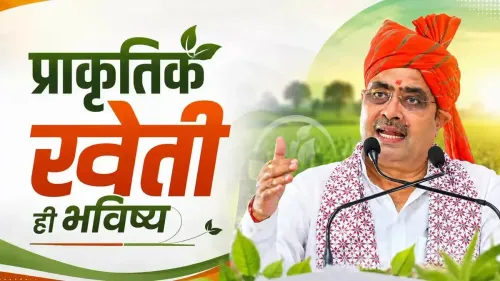
Chief Minister Bhajanlal Sharma has directed that agricultural supervisors in Rajasthan be trained to motivate farmers toward natural and organic farming, using the state's extension network as the primary driver of sustainable cultivation adoption.
Key Takeaways
The Chief Minister's Office of Rajasthan issued a directive on 15 June 2026 to train agricultural supervisors on natural and organic farming promotion.
Chief Minister Bhajanlal Sharma stated supervisors should be equipped to 'motivate farmers to adopt natural and organic farming.' The move leverages Rajasthan's existing agricultural extension network rather than introducing a new subsidy scheme.
The directive aligns with the central government's Paramparagat Krishi Vikas Yojana (launched 2015 ) and the National Mission for Sustainable Agriculture (launched 2010 ).
Key next steps include the state agriculture department releasing a formal training calendar and curriculum for supervisors across districts.
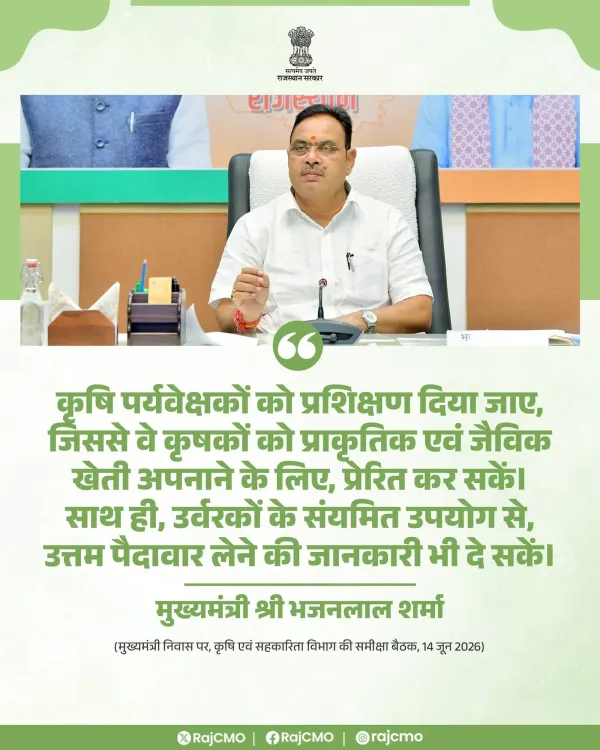
The Chief Minister's Office of Rajasthan, posting on behalf of Chief Minister Bhajanlal Sharma, on Monday, 15 June 2026, directed that agricultural supervisors in the state be trained to motivate farmers to adopt natural and organic farming methods.
The post, shared under the hashtag #आपणो_अग्रणी_राजस्थान ('Our Leading Rajasthan'), quoted the Chief Minister's instruction verbatim: 'Agricultural supervisors should be trained so that they can motivate farmers to adopt natural and organic farming.' The directive signals a push to use the existing agricultural extension network as the primary vehicle for driving a shift away from chemical-intensive cultivation.
Context
Rajasthan, a largely arid and semi-arid state, has faced growing concerns over soil degradation and rising input costs for farmers. Agricultural supervisors — field-level government functionaries posted across blocks and panchayats — are often the first point of contact between state policy and the farming community. Directing their training toward natural and organic methods positions them as change agents rather than mere administrative personnel. The Chief Minister's instruction comes as the state government has been branding its governance agenda under the 'Aapno Agrani Rajasthan' ('Our Leading Rajasthan') campaign, which emphasises forward-looking development across sectors including agriculture.Policy Backdrop
The directive fits squarely within a national policy framework that has been building for over a decade. The National Mission for Sustainable Agriculture, launched in 2010, sought to mainstream climate-resilient and low-chemical farming practices across Indian states. More directly, the Paramparagat Krishi Vikas Yojana (PKVY), introduced by the central government in 2015, provides a structured mechanism for forming organic farming clusters and funding training and certification support — a scheme under which Rajasthan has been an active participant. Training agricultural extension workers to serve as motivators rather than just information-providers mirrors an approach several other states have adopted. The logic is straightforward: certified organic acreage cannot scale through subsidies alone; sustained farmer behaviour change requires trusted, localised advocacy, which supervisors are uniquely placed to provide.Stakeholders and Impact
Agricultural supervisors across Rajasthan's districts stand at the centre of this directive. Once trained, they are expected to conduct awareness sessions, demonstrate natural farming techniques, and follow up with individual farmers on adoption. The immediate beneficiaries are farmers — particularly smallholders in dryland areas — who stand to reduce their dependence on chemical inputs and potentially access premium markets for organic produce. For the state agriculture department, the directive implies a mandate to design and roll out a structured training calendar for supervisors, likely in coordination with agricultural universities and krishi vigyan kendras operating in the state. The broader farming community in Rajasthan — one of India's largest states by area — could see meaningful shifts in cultivation practices if the training translates into sustained field outreach.What's Next
Attention will now turn to the state agriculture department for formal notifications detailing the training curriculum, timelines, and the number of supervisors to be covered. Observers will also watch whether the initiative is linked to existing central schemes such as PKVY for funding support, or whether the state deploys its own budgetary resources. Progress indicators to watch include reported increases in organic-certified acreage across Rajasthan's district agriculture reports in the coming crop seasons.Point of View
Positioning the state as a proactive partner in that national agenda. However, the real test will be implementation: training quality, supervisor motivation, and follow-through with farmers have historically been weak links in India's agricultural extension chain. If the state can demonstrate measurable uptake in organic acreage, this could become a replicable model; if it remains a policy statement without a robust rollout plan, it risks being absorbed into Rajasthan's long list of agricultural announcements that never reached the field.
NationPress
14 Sept 2026
Frequently Asked Questions
What did CM Bhajanlal Sharma say about organic farming in Rajasthan?
Chief Minister Bhajanlal Sharma directed that agricultural supervisors in Rajasthan be trained so they can motivate farmers to adopt natural and organic farming methods, as stated in a post by the Chief Minister's Office on 15 June 2026.
What is the role of agricultural supervisors in Rajasthan's farming system?
Agricultural supervisors are field-level government functionaries who act as the primary link between state agricultural policy and farmers at the block and panchayat level, making them key to driving adoption of new farming practices.
What is Paramparagat Krishi Vikas Yojana and how does it relate to Rajasthan?
Paramparagat Krishi Vikas Yojana is a central government scheme launched in 2015 to promote organic farming clusters, provide training, and support certification across Indian states, including Rajasthan, and is directly relevant to the state's latest organic farming push.
Why is natural farming being promoted in Rajasthan?
Rajasthan's largely arid and semi-arid farmland has experienced soil degradation and rising input costs, making the shift to natural and organic farming methods important for long-term agricultural sustainability in the state.
What happens next after CM Bhajanlal's organic farming training directive?
The state agriculture department is expected to issue formal notifications on training timelines and curriculum for supervisors, and progress will be measured through increases in organic-certified acreage in district agriculture reports.