CM Bhajanlal Pushes MSMEs via Aspirational Sub-Districts
Synopsis
The Rajasthan CMO announced that CM Bhajan Lal Sharma's government is providing a strong foundation for small, cottage, and traditional industries by incentivising aspirational sub-divisions, aligning with the state's 'Aapno Agrani Rajasthan' inclusive growth agenda.
Key Takeaways
The Rajasthan CMO announced on 23 June 2026 that aspirational sub-divisions are being incentivised to strengthen small, cottage, and traditional industries.
CM Bhajan Lal Sharma , in office since December 2023 , is driving this push under the #AapnoAgraniRajasthan branding.
The policy mirrors the vocabulary of NITI Aayog's Aspirational Districts Programme launched in 2018 , extended here to the sub-district level.
Key beneficiaries include traditional artisans, small-industry owners, and rural entrepreneurs in underserved subdivisions.
The approach builds on the Rajasthan MSME Policy 2019 and 2023-24 budget commitments to cottage and rural industry clusters.
State 2026-27 budget allocations and new cluster-development tenders will be the next indicators of policy depth.
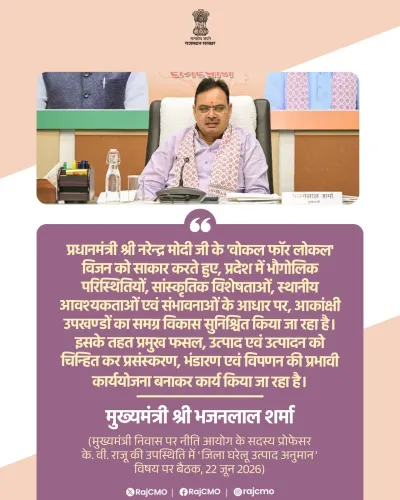
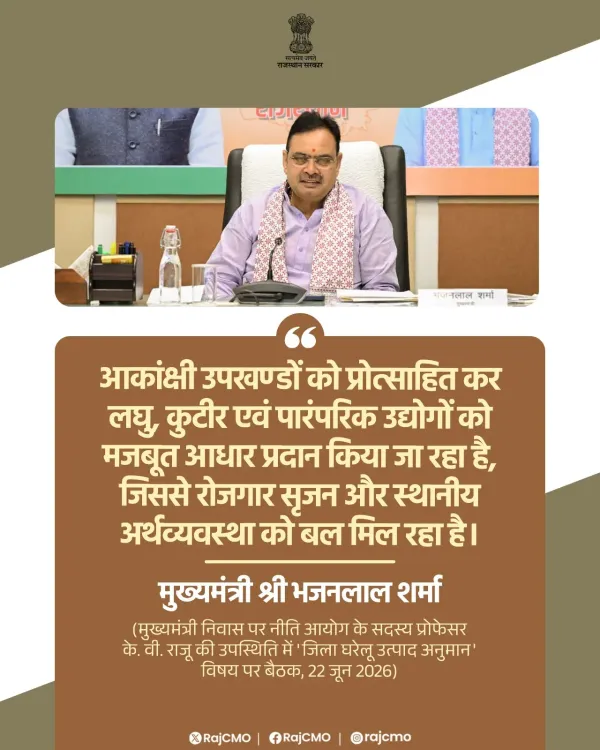
The Chief Minister's Office of Rajasthan announced on Tuesday, 23 June 2026 that the state government is strengthening small, cottage, and traditional industries by incentivising aspirational sub-divisions (aakankshi upkhand), as part of Chief Minister Bhajan Lal Sharma's push for inclusive rural economic growth under the #AapnoAgraniRajasthan initiative.
Context
The post, shared by the official Rajasthan CMO account and tagged to CM Bhajan Lal Sharma, states: 'Aakankshi upkhandon ko protsahit kar laghu, kutir evam paramparik udyogon ko mazboot aadhar pradan kiya ja raha hai' — meaning, 'By encouraging aspirational sub-divisions, a strong foundation is being provided for small, cottage, and traditional industries.' The hashtag #AapnoAgraniRajasthan (meaning 'Our Leading Rajasthan') signals this as part of the government's broader branding for equitable economic progress.
The term aakankshi upkhand mirrors the vocabulary of NITI Aayog's Aspirational Districts Programme, launched in 2018, which targets backward administrative units for accelerated development across health, education, and economic indicators. Rajasthan's adaptation extends this framework to the sub-district level.
Policy Backdrop
Rajasthan has a layered policy history of linking MSME growth with backward-area development. The Rajasthan MSME Policy 2019 offered targeted incentives for small-scale and traditional manufacturing clusters, while the 2023-24 state budget expanded support for cottage industries in rural subdivisions. These measures aim to create employment outside major urban centres by nurturing labour-intensive sectors such as handicrafts, handloom, and village industries.
CM Bhajan Lal Sharma, who took office in December 2023, has continued and deepened this approach, framing grassroots industrial support as central to the BJP government's economic agenda in the state. The current push aligns with national priorities around strengthening the informal and artisan economy.
Stakeholders and Impact
The primary beneficiaries of this policy direction are small-industry owners, traditional artisans, and rural entrepreneurs in Rajasthan's aspirational sub-divisions — areas historically underserved by formal economic infrastructure. Cottage industries such as block printing, blue pottery, leather craft, and handloom weaving — all significant to Rajasthan's cultural economy — stand to gain from improved institutional support and cluster-based development.
By anchoring industrial incentives at the sub-division level rather than only at the district level, the government aims to ensure that development reaches the most granular administrative units, reducing the urban-rural economic gap within the state.
What's Next
Observers will watch the 2026-27 state budget allocations and any new cluster-development tenders for cottage industries in selected sub-divisions as a measure of how substantively this policy direction is being funded. The government's ability to translate the aakankshi upkhand framework into measurable employment and output gains for traditional artisans will be the key test of its inclusive growth credentials.
Point of View
The BJP administration claims credit for granular inclusion without committing to verifiable targets. This is consistent with a broader pattern across BJP-governed states of bundling MSME and artisan support under identity-linked branding ('Aapno Rajasthan') to consolidate rural and OBC voter bases. The real test will come in budget allocations and cluster-tender data for 2026-27, which will reveal whether the policy has fiscal muscle or remains largely rhetorical. Until those numbers are public, the announcement reads as aspirational signalling ahead of the state's mid-term political cycle.
NationPress
23 Jun 2026
Frequently Asked Questions
What are aakankshi upkhand in Rajasthan?
'Aakankshi upkhand' refers to aspirational sub-divisions — sub-district administrative units in Rajasthan identified as economically backward and targeted for accelerated development, drawing on the model of NITI Aayog's Aspirational Districts Programme.
What is CM Bhajan Lal Sharma's policy for cottage industries?
CM Bhajan Lal Sharma's government is providing institutional support and incentives for small, cottage, and traditional industries in aspirational sub-divisions, building on the Rajasthan MSME Policy 2019 and 2023-24 budget commitments to rural industrial clusters.
What is the Aapno Agrani Rajasthan initiative?
'Aapno Agrani Rajasthan' — meaning 'Our Leading Rajasthan' — is a branding framework used by the Bhajan Lal Sharma-led BJP government to promote inclusive economic and social development across the state.
How does Rajasthan's aspirational sub-division scheme differ from NITI Aayog's programme?
While NITI Aayog's Aspirational Districts Programme targets backward districts, Rajasthan's approach extends the concept to the sub-division (upkhand) level, aiming to deliver industrial and economic support at a more granular administrative tier.
Who benefits from Rajasthan's small industry push in aspirational sub-divisions?
The primary beneficiaries are traditional artisans, small-industry owners, and rural entrepreneurs in underserved sub-divisions, particularly those engaged in handicrafts, handloom, leather craft, and other labour-intensive cottage industries.