Rajasthan CMO pushes Vocal for Local in aspirational sub-divisions
Synopsis
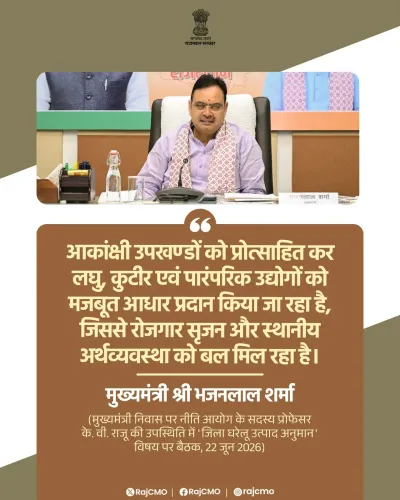
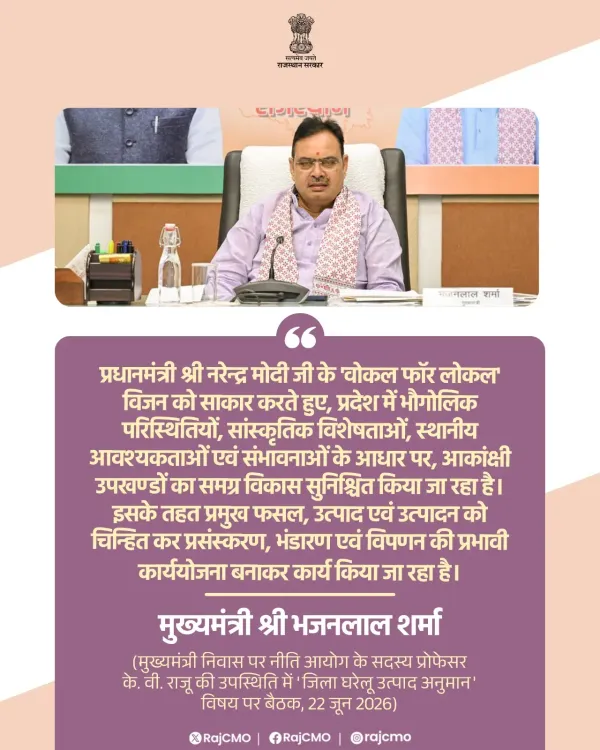
The Rajasthan CMO announced on 22 June 2026 that aspirational sub-divisions across the state are being developed by integrating local geography, cultural traits and community needs, directly aligning with PM Modi's Vocal for Local vision under the Atmanirbhar Bharat framework.
Key Takeaways
The Chief Minister's Office of Rajasthan announced on 22 June 2026 that aspirational sub-divisions are receiving holistic, place-sensitive development support.
The initiative is framed as a realisation of PM Narendra Modi 's Vocal for Local vision, first articulated in May 2020 under Atmanirbhar Bharat .
Development plans factor in each sub-division's geographical conditions, cultural characteristics, and local needs rather than applying a uniform template.
Chief Minister Bhajan Lal Sharma was directly tagged, indicating his personal ownership of the initiative.
The move extends the logic of NITI Aayog 's Aspirational Districts Programme (launched 2018 , covering 115 districts) to the sub-division tier in Rajasthan.
Key beneficiaries include local artisans, rural entrepreneurs , and farming communities in lagging sub-divisions.
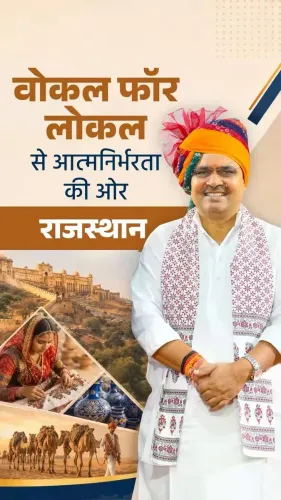
The Chief Minister's Office of Rajasthan announced on Monday, 22 June 2026 that the state is ensuring holistic development of aspirational sub-divisions (aakankshi upakhand) by factoring in local geography, cultural heritage, and community needs — framing the effort as a direct realisation of Prime Minister Narendra Modi's Vocal for Local vision.
Context
The post, shared from the official @RajCMO handle and tagging Chief Minister Bhajan Lal Sharma (@BhajanlalBjp), states that development of aspirational sub-divisions is being ensured 'on the basis of geographical conditions, cultural characteristics, local needs and possibilities' of each area. The message is hashtagged #AapnoAgraniRajasthan ('Our Pioneering Rajasthan'), the BJP-led state government's branding for its development agenda.
The announcement signals that Rajasthan is extending the place-based development logic — long applied at the district level nationally — down to the sub-division tier, tailoring interventions to micro-regional realities rather than applying a uniform template.
Policy Backdrop
The Vocal for Local theme was introduced by Prime Minister Modi in May 2020 as part of the Atmanirbhar Bharat economic package, urging citizens and governments to prioritise domestically produced goods and services. It has since been adopted as a planning lens by multiple state governments to promote indigenous crafts, local agriculture, and rural enterprise.
The broader architecture for targeting backward regions was laid by NITI Aayog's Aspirational Districts Programme, launched in January 2018, which covered 115 of India's most lagging districts with real-time monitoring and convergence of central schemes. Rajasthan's move to apply similar logic at the sub-division level represents a further granularisation of that framework, bringing targeted support closer to the grassroots.
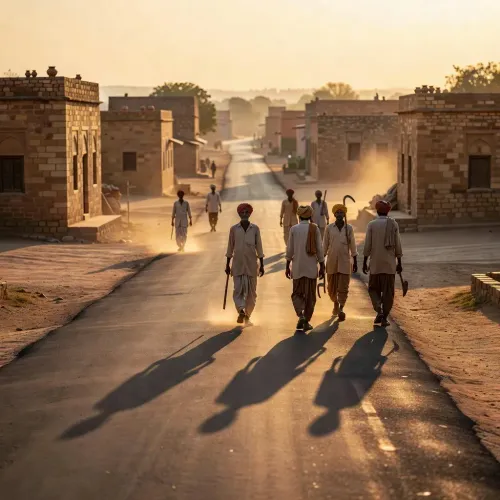
Rajasthan, with its vast arid geography, distinct regional cultures — from the Thar desert belt to the Hadoti plateau — and a rich tradition of handicrafts and folk arts, presents both the challenge and the opportunity that a geography-sensitive development model is designed to address.
Stakeholders and Impact
The primary beneficiaries of this initiative are residents of aspirational sub-divisions, particularly local artisans, rural entrepreneurs, and farming communities whose livelihoods are closely tied to local resources and traditions. By integrating cultural identity into the development blueprint, the approach aims to create economic opportunities that are both sustainable and rooted in community strengths.
For local artisans — weavers, potters, leather craftspeople, and block-print workers — a Vocal for Local-aligned sub-division plan could mean better market linkages, raw-material support, and branding that connects their produce to larger domestic and export channels. Rural entrepreneurs in these zones may also benefit from convergence of central and state schemes tailored to sub-divisional conditions.
What's Next
Observers will watch for the release of baseline indicators or progress dashboards for Rajasthan's designated aspirational sub-divisions, as well as state budget provisions or convergence guidelines that formally link local products to wider markets. The government's ability to operationalise this vision with measurable targets — mirroring the real-time monitoring discipline of the national Aspirational Districts Programme — will determine whether the initiative moves beyond messaging into structural change. A clear list of covered sub-divisions and selection criteria would be the next concrete milestone to track.
Point of View
The BJP-led state government is reinforcing ideological alignment with the Centre while simultaneously claiming credit for local execution, a dual-branding strategy common in BJP-governed states. The real test will be whether this translates into measurable socio-economic gains or remains a communication exercise ahead of electoral cycles. If Rajasthan publishes granular dashboards and convergence budgets, it could offer a replicable model for other states navigating the gap between national policy rhetoric and ground-level delivery.
NationPress
21 Sept 2026
Frequently Asked Questions
What are aspirational sub-divisions in Rajasthan?
Aspirational sub-divisions ( aakankshi upakhand ) are administrative sub-units in Rajasthan identified for targeted development based on lagging socio-economic indicators, extending the logic of NITI Aayog's national Aspirational Districts Programme to a more granular level within the state.
What is the Vocal for Local initiative?
Vocal for Local is a campaign launched by Prime Minister Narendra Modi in May 2020 under the Atmanirbhar Bharat package, encouraging Indians and governments to promote and purchase domestically produced goods, crafts, and services to boost self-reliance.
What is Rajasthan's Aapno Agrani Rajasthan scheme?
'Aapno Agrani Rajasthan' ('Our Pioneering Rajasthan') is the branding used by the BJP-led Rajasthan government under Chief Minister Bhajan Lal Sharma for its overall development agenda, used as a hashtag to link various governance announcements.
Who is Bhajan Lal Sharma?
Bhajan Lal Sharma is the Chief Minister of Rajasthan since December 2023 , leading the BJP state government and championing development initiatives aligned with central government priorities including Vocal for Local and Atmanirbhar Bharat.
How does NITI Aayog's Aspirational Districts Programme relate to Rajasthan's sub-division initiative?
NITI Aayog launched the Aspirational Districts Programme in January 2018 to uplift 115 backward districts through real-time monitoring and scheme convergence. Rajasthan's aspirational sub-divisions initiative applies a similar targeted, data-driven approach at the finer sub-division level within the state.