CM Bhajanlal: Tribal Areas Now Driving Rajasthan's GDP
Synopsis
The Chief Minister's Office of Rajasthan announced on June 23, 2026, that economic activities in the state's tribal regions are now reflected in Rajasthan's GSDP, underscoring the BJP government's inclusive-growth agenda under CM Bhajanlal Sharma.
Key Takeaways
The Chief Minister's Office of Rajasthan stated on June 23, 2026 , that tribal-area economic activities are contributing to the state's GSDP .
The post tagged Chief Minister Bhajanlal Sharma under the campaign hashtag #आपणो_अग्रणी_राजस्थान ('Our Leading Rajasthan').
Rajasthan's tribal belt — centred on Banswara, Dungarpur and Udaipur — is the primary geography referenced.
The state has operated a Tribal Sub-Plan since the mid-1970s to direct funds toward scheduled tribal blocks.
The BJP government , in power since December 2023 , has emphasised sectors such as minor forest produce, handicrafts and agri-allied activities in southern Rajasthan.
Upcoming GSDP estimates and annual economic survey data will be watched for disaggregated tribal-region figures.
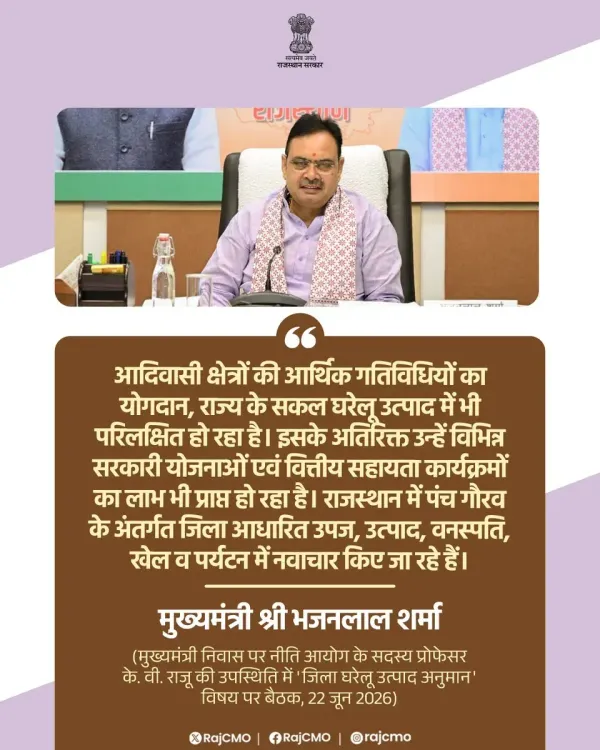
The Chief Minister's Office of Rajasthan, on Tuesday, June 23, 2026, highlighted that economic activities in the state's tribal regions are now visibly contributing to Rajasthan's Gross State Domestic Product (GSDP), tagging Chief Minister Bhajanlal Sharma in the post under the hashtag #आपणो_अग्रणी_राजस्थान ('Our Leading Rajasthan').
The post, in Hindi, states: 'आदिवासी क्षेत्रों की आर्थिक गतिविधियों का योगदान, राज्य के सकल घरेलू उत्पाद में भी परिलक्षित हो रहा है' — 'The contribution of economic activities from tribal areas is now being reflected in the state's gross domestic product as well.'
Context
Rajasthan's tribal belt is concentrated in its southern districts — Banswara, Dungarpur and Udaipur — which are home to significant Scheduled Tribe populations. These regions have historically lagged in economic output despite harbouring natural resources, forest produce and artisanal traditions. The state's official communication now positions this belt as an active contributor to aggregate economic output, not merely a recipient of welfare transfers. The hashtag #आपणो_अग्रणी_राजस्थान ('Our Leading Rajasthan') reflects the BJP government's broader branding of the state as a front-runner in inclusive development since it assumed office in December 2023.Policy Backdrop
Rajasthan has maintained a Tribal Sub-Plan since the mid-1970s, a mechanism rooted in the Fifth Five Year Plan period that earmarks dedicated funds for infrastructure and livelihoods in scheduled tribal blocks. Following the 2023 assembly elections, the Bhajanlal Sharma administration announced a renewed push on economic sectors operating in southern Rajasthan — including minor forest produce, handicrafts and agri-allied activities. This shift in emphasis — from welfare allocation to measurable economic output — mirrors a national trend among states with large Scheduled Tribe populations, which have increasingly sought to track and publicise the contribution of tribal-region activity to their GSDP as part of inclusive-growth narratives.Stakeholders and Impact
The primary beneficiaries of this policy direction are tribal communities in Rajasthan's southern districts, whose livelihoods span forest produce collection, small-scale mining, traditional crafts and agri-allied sectors. When such activity is formally captured in state domestic product accounts, it can strengthen the case for sustained or increased public investment in these regions. Beyond individual communities, the framing has implications for how Rajasthan presents its economic story — positioning tribal-region output as a structural pillar of GSDP rather than a marginal footnote. Tourism circuits running through the tribal belt, as well as small-scale forest-based industries, are among the sectors that analysts have pointed to as growth levers in this geography.What's Next
Attention will now turn to Rajasthan's forthcoming annual economic survey and official GSDP estimates, which may contain disaggregated data on tribal-region contributions. Implementation updates on livelihood schemes operating in scheduled area blocks during 2024-25 will serve as a practical test of whether the economic momentum cited by the Chief Minister's Office is reflected in verifiable output data. If the state publishes granular GSDP breakdowns that isolate tribal-region activity, it would mark a significant step toward evidence-based inclusive-growth accounting — and could set a template for other states with comparable tribal geographies.Point of View
The communication ties the BJP government's identity to measurable development outcomes in a demographic that has historically been contested electoral territory. The use of the hashtag 'Our Leading Rajasthan' signals an effort to build a cohesive brand narrative around the state's economic trajectory. Until disaggregated GSDP data is publicly released, however, the claim remains a policy aspiration as much as a statistical fact.
NationPress
23 Jun 2026
Frequently Asked Questions
How are tribal areas contributing to Rajasthan's GDP?
The Chief Minister's Office of Rajasthan stated on June 23, 2026, that economic activities in tribal regions — including minor forest produce, handicrafts and agri-allied sectors — are now being reflected in the state's Gross State Domestic Product.
Which districts make up Rajasthan's tribal belt?
Rajasthan's tribal belt is primarily concentrated in the southern districts of Banswara, Dungarpur and Udaipur, which have significant Scheduled Tribe populations.
What is the Tribal Sub-Plan in Rajasthan?
The Tribal Sub-Plan is a central and state mechanism dating to the Fifth Five Year Plan period in the mid-1970s that allocates dedicated funds for infrastructure and livelihood development in scheduled tribal blocks across Rajasthan.
What is CM Bhajanlal Sharma's policy focus on tribal development?
Since taking office in December 2023, Chief Minister Bhajanlal Sharma's BJP government has announced a renewed focus on economic sectors in southern Rajasthan, including minor forest produce, handicrafts and agri-allied activities in tribal areas.
What does the hashtag Aapno Agrani Rajasthan mean?
The hashtag #आपणो_अग्रणी_राजस्थान translates to 'Our Leading Rajasthan' and is used by the BJP state government as a branding slogan for its inclusive development agenda.