CM Bhajanlal's Rajasthan Maps Panchayat-Level Roadmap for 2047
Synopsis
The Rajasthan government under CM Bhajanlal Sharma is preparing development roadmaps for every gram panchayat and urban local body, aligning grassroots planning with the Viksit Bharat 2047 and Viksit Rajasthan 2047 visions — one of the most granular decentralised planning exercises in the state's recent history.
Key Takeaways
The Chief Minister's Office of Rajasthan announced on 26 July 2026 that development roadmaps are being prepared for every gram panchayat and urban local body in the state.
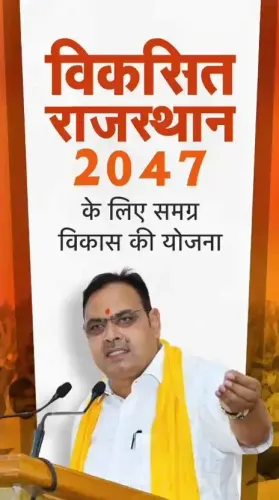
The exercise aligns local body planning with both the national Viksit Bharat 2047 and the state-level Viksit Rajasthan 2047 frameworks.
CM Bhajanlal Sharma has led the BJP government in Rajasthan since December 2023 and has consistently anchored state policy to the 2047 national vision.
The constitutional basis for such decentralised planning lies in the 73rd and 74th Constitutional Amendments of 1992 , which empowered panchayati raj institutions and urban local bodies.
Progress on the roadmaps is expected to be reviewed through annual budget cycles, with mid-term assessments anticipated by 2027–28 .
Rajasthan's approach mirrors a broader national pattern of states linking sub-state planning to the Viksit Bharat framework since 2023.
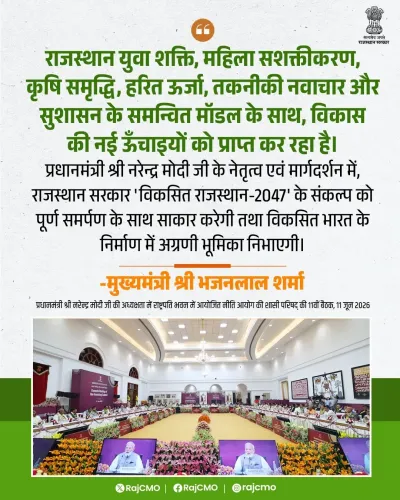
The Chief Minister's Office of Rajasthan announced on Sunday, 26 July 2026 that the state government is preparing development roadmaps for every gram panchayat and urban local body, aligning local planning with the national Viksit Bharat 2047 and state-level Viksit Rajasthan 2047 visions.
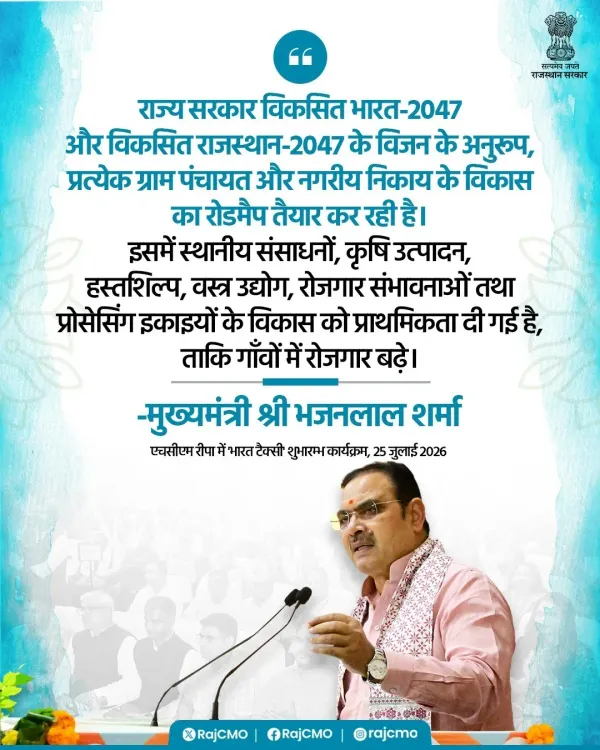
Posting on X, the Chief Minister's Office stated: 'राज्य सरकार विकसित भारत-2047 और विकसित राजस्थान-2047 के विजन के अनुरूप, प्रत्येक ग्राम पंचायत और नगरीय निकाय के विकास का रोडमैप तैयार कर रही है।' ('The state government is preparing a development roadmap for every gram panchayat and urban local body in alignment with the vision of Viksit Bharat-2047 and Viksit Rajasthan-2047.')
Context
Chief Minister Bhajanlal Sharma, who has led the BJP government in Rajasthan since December 2023, has consistently framed state policy around the twin pillars of national and state-level long-term development goals. The hashtag #आपणो_अग्रणी_राजस्थान ('Our Pioneering Rajasthan') accompanying the post reflects the administration's branding of Rajasthan as a front-runner in implementing the Viksit Bharat 2047 framework at the grassroots level. The post signals a structured push to move beyond state-level planning and embed the 2047 vision into the smallest administrative units — gram panchayats in rural areas and urban local bodies in towns and cities.Policy Backdrop
The constitutional foundation for this exercise dates to the 73rd and 74th Constitutional Amendments of 1992, which mandated decentralised planning through panchayati raj institutions and urban local bodies. These amendments gave local bodies the mandate to prepare development plans for economic development and social justice. Prime Minister Narendra Modi articulated the Viksit Bharat@2047 vision — targeting India's emergence as a fully developed nation by the centenary of independence — in national addresses around 2023, directing state governments to align their own planning frameworks accordingly. Rajasthan's roadmap exercise is part of a broader pattern visible across Indian states since 2023, where sub-state planning is being anchored to this national long-term framework while simultaneously integrating Sustainable Development Goal localisation efforts.Stakeholders and Impact
The most direct beneficiaries of this exercise are rural communities across Rajasthan's gram panchayats and residents of urban local body areas. By requiring each local body to have its own roadmap, the government is in effect committing to granular, place-specific targets rather than state-wide aggregates. This approach also has implications for how central scheme funds — including programmes such as the Aspirational Blocks Programme — are channelled and monitored at the block and panchayat level. Local elected representatives, panchayat officials, and municipal commissioners are expected to be central actors in translating these roadmaps into annual plans and budget allocations.What's Next
The roadmaps are expected to feed into Rajasthan's annual budget cycle and inform departmental allocations across infrastructure, health, education, and economic development. Progress reporting mechanisms and potential mid-term reviews are anticipated by 2027–28, which would serve as the first substantive checkpoint for this bottom-up planning exercise. If implemented with fidelity, the gram panchayat and urban local body roadmaps could serve as a replicable model for other states aligning local governance with the Viksit Bharat 2047 framework — making Rajasthan a test case for decentralised long-term planning at national scale.Point of View
The Sharma administration is attempting to institutionalise accountability structures that outlast individual budgets. This fits a broader arc in which BJP-governed states have competed to position themselves as the most aligned with Prime Minister Modi's 2047 vision, using local body planning as a visible demonstration of federal loyalty. The real test, however, will be whether these roadmaps translate into measurable outcomes or remain aspirational documents — a distinction that mid-term reviews in 2027–28 will begin to clarify.
NationPress
26 Jul 2026
Frequently Asked Questions
What is the Viksit Rajasthan 2047 vision?
Viksit Rajasthan 2047 is the Rajasthan state government's long-term development framework aligned with the national Viksit Bharat 2047 goal, which envisions India becoming a fully developed nation by 2047, the centenary of independence. The state framework translates this national ambition into Rajasthan-specific planning targets.
What is the gram panchayat roadmap announced by the Rajasthan government?
The Rajasthan government, under CM Bhajanlal Sharma, is preparing individual development roadmaps for every gram panchayat and urban local body in the state, setting place-specific long-term targets in alignment with the Viksit Bharat 2047 and Viksit Rajasthan 2047 visions.
Who is CM Bhajanlal Sharma?
Bhajanlal Sharma is the Chief Minister of Rajasthan, leading the BJP government in the state since December 2023 following the party's victory in the state assembly elections held that year.
What are urban local bodies in Rajasthan?
Urban local bodies in Rajasthan are municipal institutions — including municipal corporations, municipal councils, and nagar panchayats — responsible for civic administration and local development planning in towns and cities across the state.
How does Viksit Bharat 2047 affect state governments?
The Viksit Bharat 2047 framework, articulated by Prime Minister Narendra Modi around 2023, directs state governments to align their own development planning with the national goal of becoming a developed country by India's centenary of independence in 2047. States are expected to cascade this vision down to local bodies through roadmaps and annual budgets.