CM Bhupendra Patel Backs Gujarat's 24th Shala Praveshotsav
Synopsis
Gujarat CM Bhupendra Patel marked the 24th edition of the Gyan Yagna campaign on 24 June 2026, sharing a personal article that connects the ongoing Shala Praveshotsav and Kanya Kelavani drives to PM Modi's Viksit Bharat vision — a journey that began in Gujarat in 2003.
Key Takeaways
Gujarat CM Bhupendra Patel shared a personal article on 24 June 2026 reflecting on the state's annual school-enrollment and girls'-education campaign.
The Gyan Yagna campaign, now in its 24th edition , was originally launched by Narendra Modi as Gujarat Chief Minister in 2003 .
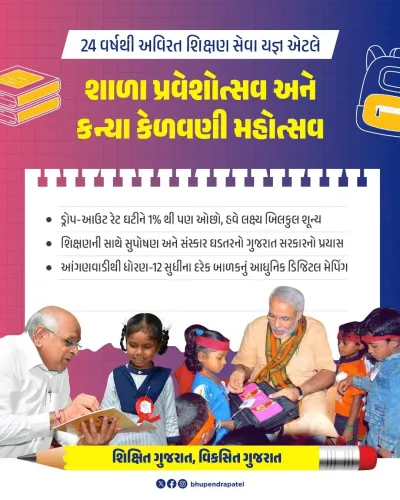
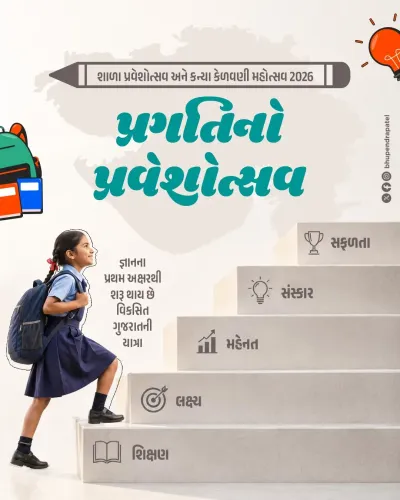
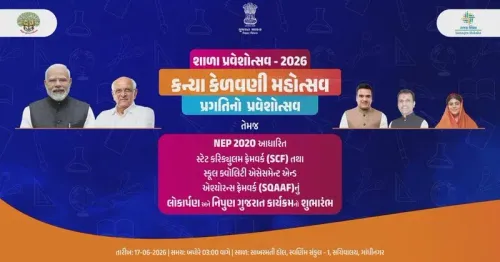
The campaign encompasses two key drives: Shala Praveshotsav (school-enrollment festival) and Kanya Kelavani (girls' education programme).
CM Patel linked the initiative to PM Modi's vision of Viksit Bharat , quoting him as saying children's dreams must be empowered to build a developed India.
The drives target universal primary enrollment and gender parity , with a focus on rural and marginalised communities across Gujarat .
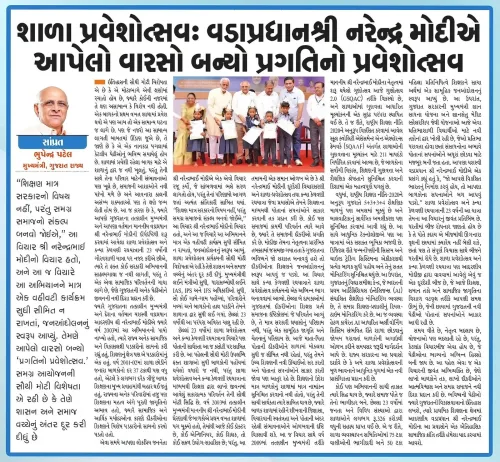
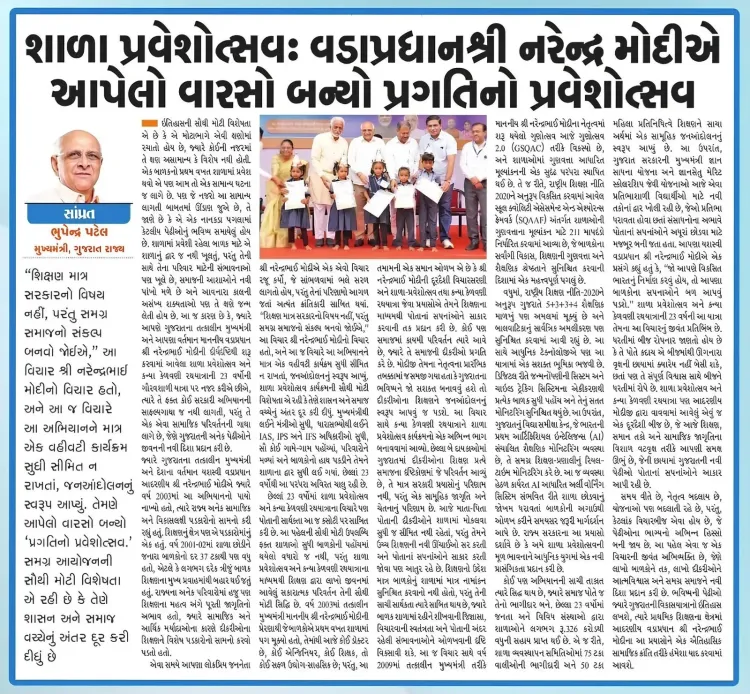
Gujarat Chief Minister Bhupendra Patel on Wednesday, 24 June 2026, shared a personal article on X reflecting on the 24th edition of Gujarat's Gyan Yagna campaign, which encompasses the annual Shala Praveshotsav and Kanya Kelavani drives currently under way across the state. Invoking a quote attributed to Prime Minister Narendra Modi — 'If we want to build a Viksit Bharat, we must empower the dreams of our children' — the Chief Minister framed the initiative as the living expression of that vision.
Context
In his post, written in Gujarati, CM Patel described the ongoing Gyan Yagna as the '24mī kaḍī' (24th link) of an unbroken journey that began over two decades ago. He noted that the idea finds its fulfilment in initiatives like Shala Praveshotsav and Kanya Kelavani, and said he had shared his thoughts on 'more than two decades of this continuous journey' in a written article. The post tagged PM Modi's official handle, signalling the Chief Minister's intent to connect the state-level drive to the broader national vision of Viksit Bharat.
Policy Backdrop
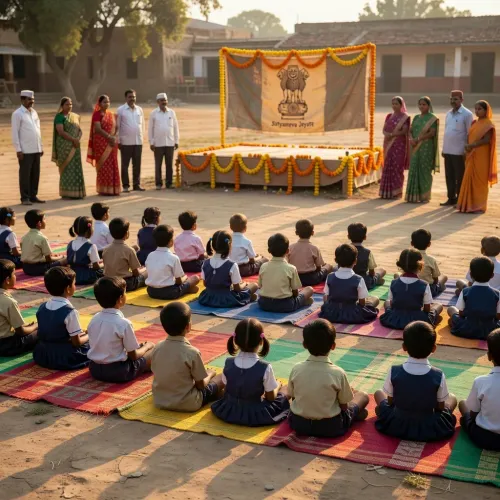
Shala Praveshotsav is Gujarat's annual school-enrollment festival, held at the start of the academic year to encourage families — particularly in rural and tribal belts — to admit children, especially girls, to primary school. Kanya Kelavani is the companion programme focused specifically on enrolling and retaining girl students. Both were launched in 2003 by Narendra Modi during his tenure as Gujarat Chief Minister, under the umbrella of the Gyan Yagna ('knowledge sacrifice') campaign. Successive BJP governments in the state have maintained and expanded these drives as core education policy, framing them as steps toward universal primary enrollment and gender parity.
Stakeholders and Impact
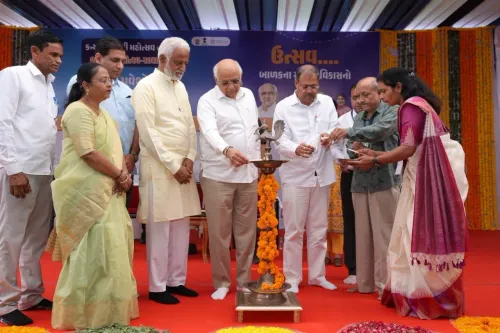
The primary beneficiaries of the twin drives are school-age children and, in particular, girl students from economically weaker and socially marginalised communities across Gujarat. Community leaders, teachers, and local government officials typically participate in the Shala Praveshotsav ceremonies, making the event as much a public mobilisation exercise as an administrative one. The Gujarat model has been cited by BJP-led state governments elsewhere as a template for grassroots education outreach.
What's Next
Observers will watch for participation figures and gender-disaggregated enrollment data from the 2026 round of Shala Praveshotsav to assess whether the 24-year-old initiative continues to move the needle on school access. State budget allocations for education schemes linked to the Gyan Yagna campaign will also be closely tracked. As the Viksit Bharat narrative gains salience ahead of national policy reviews, Gujarat's education drives are likely to be presented as a proof-of-concept for the broader goal of universal, gender-inclusive schooling.
Point of View
Patel signals that the BJP intends to use Gujarat's education record as an electoral and ideological asset. The move also reflects the party's broader strategy of presenting state-level welfare continuity as evidence of governance credibility. Whether enrollment and retention data from the 2026 edition will substantiate these claims remains the real test.
NationPress
24 Jun 2026
Frequently Asked Questions
What is Shala Praveshotsav in Gujarat?
Shala Praveshotsav is Gujarat's annual school-enrollment festival held at the start of the academic year to encourage families, especially in rural areas, to admit children to primary school. It was launched in 2003 under the Gyan Yagna campaign by then Chief Minister Narendra Modi.
What is Kanya Kelavani?
Kanya Kelavani is a Gujarat government programme focused on enrolling and retaining girl students in schools. It runs alongside Shala Praveshotsav as part of the broader Gyan Yagna education campaign.
Who started the Gyan Yagna campaign in Gujarat?
The Gyan Yagna campaign was started in 2003 by Narendra Modi when he was the Chief Minister of Gujarat. The initiative is now in its 24th edition in 2026.
What did Gujarat CM Bhupendra Patel say about Shala Praveshotsav 2026?
CM Bhupendra Patel shared a personal article on 24 June 2026 reflecting on more than two decades of the Gyan Yagna campaign, connecting it to PM Modi's vision of building a Viksit Bharat by empowering children's dreams.
What is the Viksit Bharat vision and how does it relate to Gujarat's education drives?
Viksit Bharat ('Developed India') is PM Modi's long-term national development goal. Gujarat's Shala Praveshotsav and Kanya Kelavani drives are being framed by the state government as grassroots contributions to this vision through universal, gender-inclusive primary education.