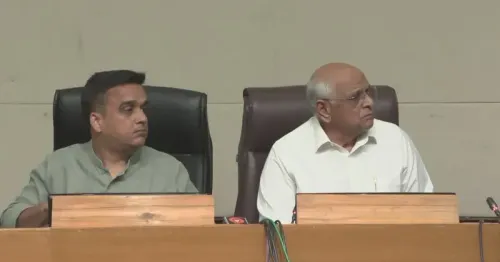
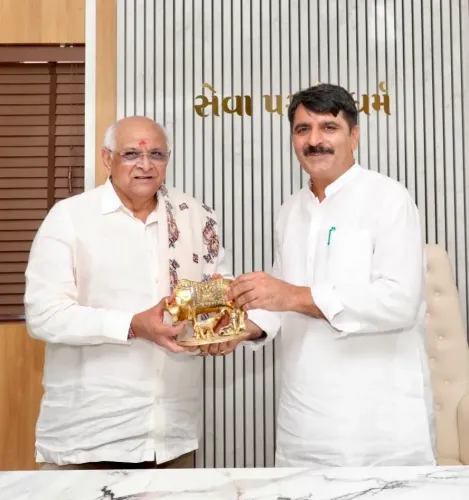
CM Bhupendra Patel hails BJP's landslide in Gujarat local polls
Synopsis
Gujarat CM Bhupendra Patel celebrated a sweeping BJP victory in Gandhinagar, Okha and Thara local body elections on 14 October 2026, crediting PM Modi's 25-year development legacy and Amit Shah's guidance, and reaffirming the 'Viksit Gujarat se Viksit Bharat' vision.
Key Takeaways
BJP won decisively in local body elections held in Gandhinagar , Okha , and Thara , according to CM Bhupendra Patel's post on 14 October 2026 .
CM Patel credited PM Narendra Modi's two-and-a-half decades of leadership for Gujarat's transformation as the bedrock of the party's electoral trust.
Union Home Minister Amit Shah was specifically thanked for 'constant guidance and good wishes,' underlining his continued organisational role in Gujarat.
The BJP has held uninterrupted power in Gujarat since the 1995 state assembly elections, repeatedly leveraging the 'Gujarat model' of development.
CM Patel reaffirmed the party's commitment to 'Viksit Gujarat se Viksit Bharat' — linking local electoral outcomes to PM Modi's national Viksit Bharat 2047 agenda.
Patel publicly honoured BJP's grassroots party workers, calling them 'devtulya karyakarta' (godlike workers), signalling organisational motivation ahead of future contests.
Three municipal battlegrounds — Gandhinagar, Okha, and Thara — delivered a decisive verdict for the BJP in Gujarat's local body elections, and Gujarat Chief Minister Bhupendra Patel wasted no time framing it as something bigger than a routine civic contest. On Wednesday, 14 October 2026, he declared the sweep a public seal of approval on more than two decades of development politics in the state.
Posting in Hindi on X, CM Patel credited Prime Minister Narendra Modi for the 'historic transformation' of Gujarat over the past two and a half decades, calling Modi's leadership the foundation of the party's 'unshakeable public trust.' He offered 'heartfelt gratitude' to Union Home and Cooperation Minister Amit Shah for his 'constant guidance and good wishes' — a nod to the senior Gujarat-rooted BJP strategist whose backing carries enormous organisational weight in the state.
From Vibrant Gujarat to local-body landslide
The BJP's Gujarat story stretches back to 1995, when the party first captured the state assembly and has not relinquished power since. The template sharpened dramatically when Narendra Modi became Chief Minister in October 2001 and launched the Vibrant Gujarat investor summits from 2003 onward — building an industrial and infrastructure narrative that became the party's single most durable electoral asset. Every subsequent Gujarat election, from assembly contests to local body polls, has been fought at least partly on the claim that this 'Gujarat model' keeps delivering.
CM Patel's post consciously draws that line from Modi's era through to today. The phrase 'adig jan-vishwas' — 'unshakeable public trust' — is not incidental; it is the argument that electoral continuity equals developmental endorsement.
Amit Shah's role and what the gratitude signals
The specific mention of Amit Shah alongside Modi is a window into BJP's Gujarat machinery. Shah, who serves as Union Home and Cooperation Minister in the central government, has long been the state's master organiser — the person who turns booth-level loyalty into vote-share. A public thank-you from the sitting Chief Minister signals that the victory was not merely administrative but deeply coordinated at the party's national level.
'Viksit Gujarat se Viksit Bharat' — a slogan with national ambition
CM Patel closed his post with a commitment to realising the vision of 'Viksit Gujarat se Viksit Bharat' — 'Developed Gujarat to Developed India' — framing the local results as a stepping stone to the BJP's national developmental promise. The formulation deliberately mirrors Prime Minister Modi's Viksit Bharat 2047 agenda, tying municipal wins in Gujarat directly into a pan-India aspirational narrative. That linkage is not accidental: it elevates a local-body contest into a piece of evidence for a governing philosophy that spans from the panchayat to Parliament.
For BJP's cadre on the ground — the 'devtulya karyakarta' (godlike workers), as Patel called them — the tribute is also a mobilisation signal: the party's grassroots machinery is being publicly credited and, by extension, energised for the next contest.
Gujarat has long been the BJP's laboratory. When that lab returns results this emphatic, the party does not keep them local for long.
Point of View
Okha and Thara to a 25-year development arc stretching from Modi's Chief Ministership to the Viksit Bharat 2047 vision. The deliberate double-acknowledgement of both Modi and Shah reinforces the dual-engine framing the party uses to present central and state leadership as a seamless continuum. With Gujarat being the BJP's oldest and most reliable laboratory, emphatic local-body outcomes here tend to be deployed as proof-of-concept messaging for national audiences. The 'Viksit Gujarat se Viksit Bharat' formulation is increasingly functioning less as a state slogan and more as a bridge connecting Gujarat's brand equity directly to the party's pan-India electoral positioning.
NationPress
14 Oct 2026
Frequently Asked Questions
Which elections did BJP win in Gujarat in October 2026?
According to CM Bhupendra Patel, the BJP won decisively in local body elections held in Gandhinagar , Okha , and Thara in Gujarat, as announced on 14 October 2026 .
What did Gujarat CM Bhupendra Patel say about the election results?
CM Patel described the wins as a 'resounding victory' and a 'public seal' on development and good governance politics, crediting PM Modi's leadership, Amit Shah's guidance, and the hard work of BJP's grassroots workers.
What is the 'Viksit Gujarat se Viksit Bharat' slogan?
'Viksit Gujarat se Viksit Bharat' means 'Developed Gujarat to Developed India' — a BJP formulation that links Gujarat's developmental track record to the national Viksit Bharat 2047 vision promoted by PM Modi.
How long has the BJP been in power in Gujarat?
The BJP has held uninterrupted power in Gujarat since winning the 1995 state assembly elections, making it one of the party's longest-running state-level governments.
Why did CM Patel thank Amit Shah in his post?
CM Patel thanked Union Home and Cooperation Minister Amit Shah for his 'constant guidance and good wishes,' reflecting Shah's central organisational and strategic role within the BJP's Gujarat machinery.