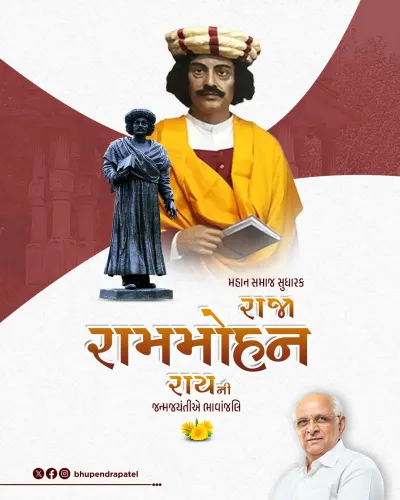
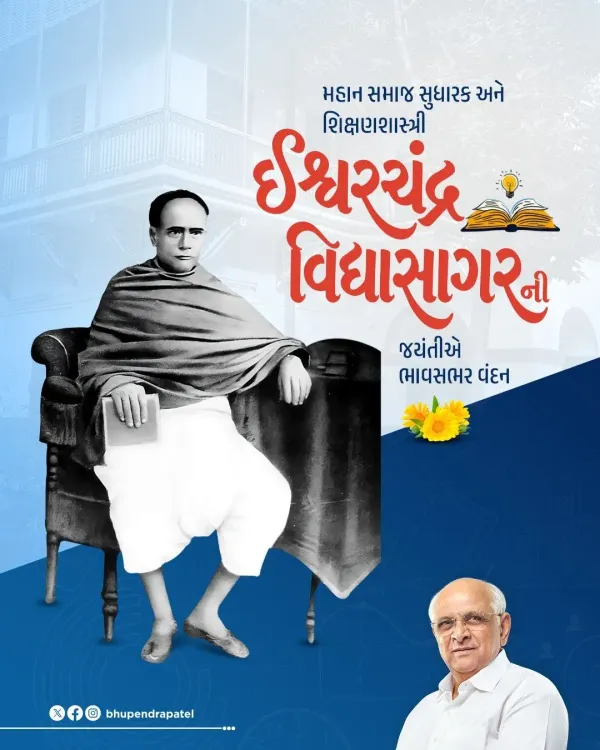
CM Bhupendra Patel pays tribute to Ishwar Chandra Vidyasagar on jayanti
Synopsis
Gujarat Chief Minister Bhupendra Patel paid tribute to Ishwar Chandra Vidyasagar on his birth anniversary, honouring the 19th-century reformer's campaigns for women's education and widow remarriage that shaped modern India's social fabric.
Key Takeaways
Gujarat Chief Minister Bhupendra Patel posted a tribute to Ishwar Chandra Vidyasagar on his birth anniversary, 26 September 2026 .
The post, written in Gujarati, praised Vidyasagar as a great social reformer and ardent advocate of women's education.
Vidyasagar's advocacy led directly to the Hindu Widows' Remarriage Act of 1856 , a landmark social legislation.
The commemorations occur annually across Indian states, with BJP leaders frequently invoking themes of education and equality on such occasions.
Vidyasagar is also celebrated for expanding girls' formal education and bridging Sanskrit scholarship with Bengali vernacular literature.
On the birth anniversary of one of India's most consequential 19th-century reformers, Gujarat Chief Minister Bhupendra Patel offered a heartfelt tribute to Ishwar Chandra Vidyasagar on Saturday, 26 September 2026, saluting the scholar's lifelong crusade against ignorance and inequality.
In his post, CM Patel wrote — translated from Gujarati — 'Heartfelt salutation on the birth anniversary of the great social reformer, ardent advocate of women's education and distinguished educationist Ishwar Chandra Vidyasagarji. The life of this epoch-defining man, who dispelled the darkness of ignorance and inequality from society and spread the light of education and equality, will forever remain a source of inspiration.'
The reformer who rewrote widow remarriage law
Ishwar Chandra Vidyasagar was a Bengali polymath whose campaigns in the mid-19th century reshaped the social and legal landscape of the Indian subcontinent. His relentless advocacy directly led to the passage of the Hindu Widows' Remarriage Act of 1856 — a landmark legislation that gave legal recognition to widow remarriage at a time when the practice was socially condemned across large parts of the country.
Beyond legal reform, Vidyasagar devoted enormous energy to expanding access to formal education for girls, establishing schools and challenging the orthodoxies that kept women from learning. His work bridged Sanskrit scholarship and Bengali vernacular literature, making him a rare figure who commanded respect from both traditionalists and modernisers of his era.
Annual commemorations and BJP's reform-narrative thread
Vidyasagar's birth anniversary on 26 September is marked across multiple Indian states each year, with political leaders from across the spectrum invoking his legacy. State-level BJP leaders have increasingly used such commemorations to underscore themes of education access and social equality — values that dovetail with several central and state government programmes targeting literacy and women's empowerment.
CM Patel's tribute carries that same thematic current: the framing of education as the antidote to darkness, and equality as the measure of a reformed society. Whether the Gujarat government follows this commemoration with any concrete announcements on women's education or welfare remains to be watched in subsequent official communications.
A 19th-century scholar's ideas still frame 21st-century political vocabulary — that, in itself, is the measure of how far Vidyasagar's light has travelled.
Point of View
Making him a strategically safe figure for tributes that project inclusivity without political controversy. The Gujarati-language framing of the post signals a regional, vernacular outreach rather than a national statement, keeping the message rooted in state identity. Whether any Gujarat-specific policy announcement follows will determine if this is a standalone commemoration or the opener to a larger welfare communication.
NationPress
26 Sept 2026
Frequently Asked Questions
Who was Ishwar Chandra Vidyasagar?
Ishwar Chandra Vidyasagar was a 19th-century Bengali scholar, social reformer and educationist best known for advocating widow remarriage and girls' education in colonial India. His efforts directly led to the Hindu Widows' Remarriage Act of 1856.
When is Ishwar Chandra Vidyasagar's birth anniversary?
Vidyasagar's birth anniversary falls on 26 September and is commemorated annually across India, particularly in West Bengal and by political leaders of various parties.
What did Bhupendra Patel say about Vidyasagar?
Gujarat Chief Minister Bhupendra Patel described Vidyasagar as 'a great social reformer, ardent advocate of women's education and distinguished educationist' whose life will 'forever remain a source of inspiration' for dispelling ignorance and spreading equality.
What is the Hindu Widows' Remarriage Act 1856?
The Hindu Widows' Remarriage Act of 1856 was a landmark colonial-era legislation that gave legal recognition to widow remarriage in India. It was passed largely due to Vidyasagar's sustained advocacy and petitioning campaigns.
Why do BJP leaders tribute 19th-century reformers?
State-level BJP leaders periodically pay public tribute to 19th-century reformers on their birth anniversaries to highlight themes of education access and social equality, which align with both historical reform movements and current government welfare programmes.