CM Bhupendra Patel Welcomes MSP Hike for Rabi Crops 2027-28
Synopsis
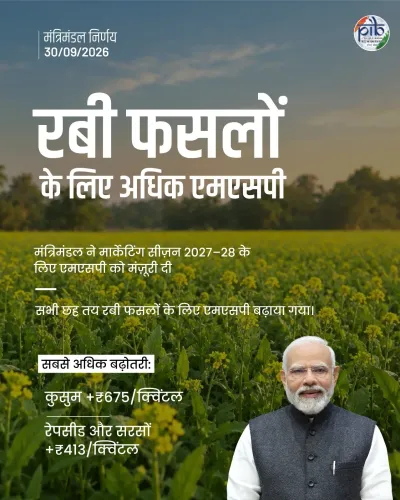
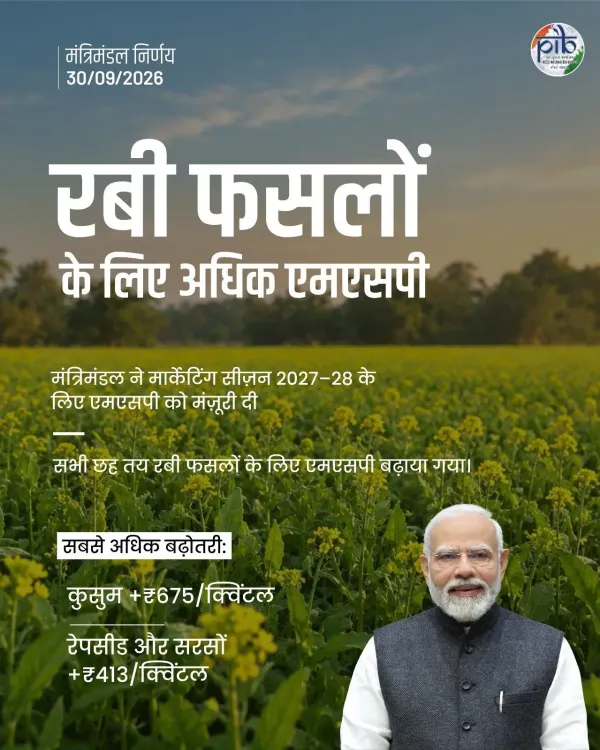
Gujarat Chief Minister Bhupendra Patel welcomed the Union Cabinet's decision, chaired by PM Narendra Modi, to raise Minimum Support Prices for all designated Rabi crops for marketing season 2027-28, calling it a vital step toward farmer prosperity.
Key Takeaways
The Union Cabinet, chaired by PM Narendra Modi , approved higher MSP for all designated Rabi crops for marketing season 2027-28 .
Gujarat CM Bhupendra Patel publicly endorsed the decision on 30 September 2026 , ahead of the October sowing window.
MSP is the government-fixed floor price that protects farmers from open-market price volatility.
Key Rabi crops covered include wheat, barley, gram, mustard, and lentils.
Procurement and payment timelines through FCI and state agencies will be the next measure of the policy's ground-level impact.
A Cabinet decision for India's farmers — and Gujarat Chief Minister Bhupendra Patel wasted no time acknowledging it. On Wednesday, 30 September 2026, Patel took to X to welcome the Union Cabinet's approval of higher Minimum Support Prices for all designated Rabi crops for the marketing season 2027-28, a move he described as central to ensuring better returns for the country's food-producers.
Writing in Hindi, Patel credited Prime Minister Narendra Modi with steering the decision, calling it a significant step toward farmer prosperity. 'Annadataon ki samridhi aur krishi kshetra ki mazbooti' — ('the prosperity of food-givers and the strengthening of the agricultural sector') — was how he framed the government's intent, expressing gratitude to the Prime Minister and extending congratulations to farmers across the nation.
What the MSP revision means for Rabi growers
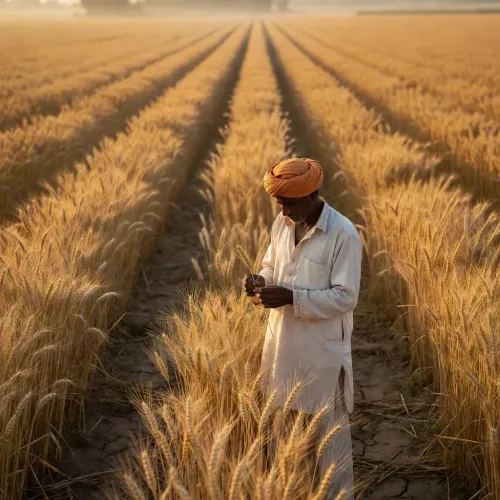
The Minimum Support Price is the government-fixed floor price that shields farmers from the volatility of open markets. Every year, the Union Cabinet approves revised MSP rates for both Kharif and Rabi crops — a cycle that forms the backbone of India's agricultural procurement framework. Rabi crops, sown in October and November and harvested in spring, include key staples: wheat, barley, gram, mustard, and lentils. By locking in a guaranteed floor price before the sowing season, the government gives farmers the confidence to invest in inputs without betting everything on market sentiment.
The revision for 2027-28 follows the established annual pattern administered through the Food Corporation of India (FCI) and state procurement agencies. The Cabinet's approval covers all designated Rabi crops for the upcoming marketing season, though the post does not specify crop-wise percentage increases.
Patel's endorsement and what it signals
As Gujarat's Chief Minister and a senior BJP leader, Patel's public endorsement of central agricultural policy carries both a governance and a political dimension. Gujarat's agri-economy depends significantly on Rabi cultivation, and farmers remain a critical constituency. His post arrives just as the October sowing window opens — maximising the announcement's reach among farmers planning their inputs right now.
The broader pattern is consistent: successive central cabinets have used annual MSP revisions to signal farmer-first intent. The real test — procurement coverage, timely payment, and farmer registration rates — plays out in the months after the harvest. Those metrics, for the 2027-28 season, are what to watch as the Rabi cycle gets under way.
Price guarantee on paper matters. Getting the payment to every registered farmer before the next sowing season — that is where policy becomes reality.
Point of View
Particularly in agriculturally significant states like Gujarat. The real policy test lies downstream: procurement coverage and payment speeds under FCI and state agencies remain the most consequential part of the MSP architecture. Until those metrics are made routinely public, the gap between floor-price announcement and farmer income realisation stays the story worth watching.
NationPress
1 Oct 2026
Frequently Asked Questions
What is MSP and why does it matter for Rabi farmers?
MSP, or Minimum Support Price, is a government-guaranteed floor price for designated crops. It ensures that even if open-market prices fall, farmers selling to government agencies receive at least the declared rate — reducing income risk during the Rabi harvest season.
Which crops are covered under the Rabi MSP hike for 2027-28?
The Union Cabinet approved MSP increases for all designated Rabi crops, which typically include wheat, barley, gram, mustard, and lentils. The post does not specify crop-wise rupee amounts or percentage increases.
Why did Gujarat CM Bhupendra Patel comment on a central cabinet decision?
As Chief Minister of an agriculturally significant state and a senior BJP leader, Patel routinely amplifies central policy decisions affecting farmers, signalling alignment between state and central governments on farmer welfare.
When does the Rabi sowing season begin in India?
Rabi sowing typically starts in October and November, making a late-September MSP announcement strategically timed — farmers can factor the guaranteed floor price into their input and crop-choice decisions before planting begins.
Who implements MSP procurement after the cabinet approves rates?
The Food Corporation of India (FCI) and various state government procurement agencies are responsible for actual purchases from farmers at the declared MSP, managing registration, payment, and storage logistics.