CM Samrat Choudhary Shares Modi's Vision on Digital India
Synopsis
Bihar Chief Minister Samrat Choudhary amplified PM Narendra Modi's words on Digital India, highlighting how placing the mobile phone at the centre of the campaign transformed technology from a privilege into a democratic right for millions of Indians.
Key Takeaways
Bihar CM Samrat Choudhary shared a PM Narendra Modi quote on X on October 8, 2026 , focused on the Digital India mission.
PM Modi described modern technology as becoming a 'privilege' before Digital India was launched.
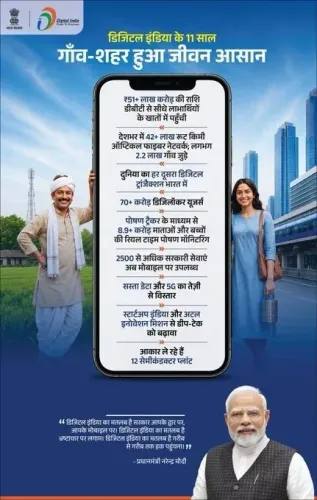
The Digital India programme, launched in 2015 , placed the mobile phone at the centre of its access strategy.
Modi's quote frames the initiative as an effort at the 'democratisation of technology' rather than a market-driven outcome.
Bihar , historically among India's digitally underserved states, has been a key target of Digital India-linked schemes such as BharatNet .
CM Choudhary's amplification positions Bihar's development story as evidence of the national programme's ground-level impact.
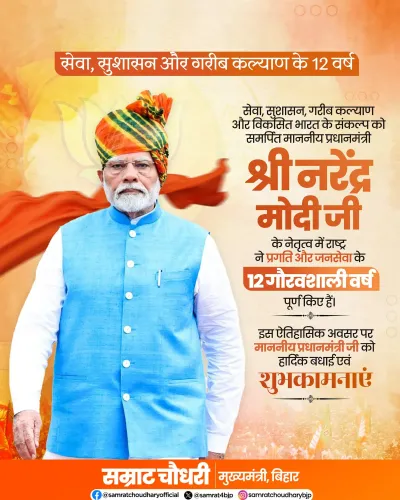
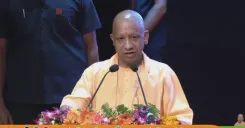
A decade ago, owning a smartphone in rural India was a privilege — not a tool. Bihar Chief Minister Samrat Choudhary on Thursday, October 8, 2026, shared a pointed quote from Prime Minister Narendra Modi on X, spotlighting how the Digital India mission fundamentally reframed that reality by placing the mobile phone at the centre of technological access.
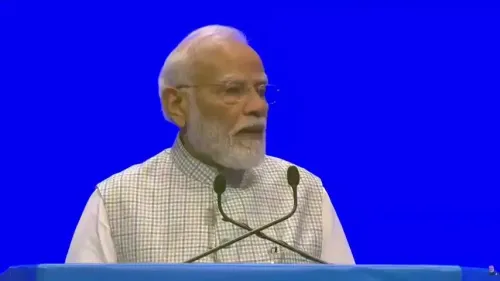
Quoting the Prime Minister directly, CM Choudhary posted: 'एक दशक पहले तक भारत में डिजिटल ड्राइव बहुत बड़ी चुनौती थी।' — 'Until a decade ago, the digital drive in India was a massive challenge. Modern technology was becoming a privilege. Through the Digital India campaign, we resolved to change this situation and brought the mobile phone to its centre. This was a very significant effort at the democratisation of technology.'
From Privilege to Public Good: The Mobile-First Shift
The phrase PM Modi uses — 'democratisation of technology' — is not rhetorical decoration. Before the Digital India programme was launched in 2015, internet penetration in India was concentrated in urban, English-speaking, higher-income populations. The mobile phone, especially the budget Android handset, became the vehicle through which that gap was systematically targeted.
By centering the mobile device — not the desktop, not the broadband cable — the programme acknowledged the infrastructure reality of a billion-person nation where leapfrogging fixed-line internet was not just possible but necessary. The result was a policy architecture built around mobile-first services: from digital payments and e-governance to health records and direct benefit transfers.
Why a Bihar CM is Amplifying This Message
Bihar sits at the sharp end of India's digital divide story. Historically one of the states with lower digital literacy and infrastructure, it has been among the most direct beneficiaries of schemes that flowed from the Digital India umbrella — whether rural broadband under BharatNet, or mobile-linked delivery of welfare subsidies. CM Choudhary's decision to amplify this quote positions Bihar's own development arc as proof of the national programme's reach.
The share also lands at a moment when India's digital economy narrative is being actively projected internationally. Framing technology access as a democratic right — not a market outcome — is a recurring BJP governance argument, and Choudhary's post reinforces that ideological thread from a state-level platform.
One decade. One device. A policy that bet on the phone in every hand rather than the terminal in every office — and Bihar's chief minister wants voters and watchers to remember exactly how that bet was placed.
Point of View
The messaging draws a sharp before-and-after line that is difficult for opponents to contest without sounding anti-technology. It also signals that digital access — not just physical infrastructure — is now a live electoral argument in states like Bihar where first-generation internet users have entered the voter base.
NationPress
8 Oct 2026
Frequently Asked Questions
What is the Digital India campaign?
Digital India is a flagship government programme launched in 2015 to ensure digital infrastructure, digital literacy, and digital delivery of services to citizens across India, with the mobile phone as its primary vehicle.
Why did Bihar CM Samrat Choudhary share PM Modi's quote?
CM Choudhary shared the quote to amplify the Digital India mission's narrative, positioning Bihar's development as evidence of the programme's reach and reinforcing the BJP's governance record on technology access.
What did PM Modi say about Digital India?
PM Modi stated that until a decade ago, the digital drive in India was a massive challenge and technology was becoming a privilege; the Digital India campaign was designed to change that by centering the mobile phone as a tool for democratising technology.
How did Digital India affect states like Bihar?
Bihar, historically underserved in digital infrastructure, benefited from Digital India-linked schemes such as BharatNet for rural broadband and mobile-linked welfare delivery systems like direct benefit transfers.
What does 'democratisation of technology' mean in the Digital India context?
It refers to making digital tools — especially the mobile phone — accessible to all citizens regardless of income, location, or literacy level, rather than limiting technology to urban or affluent populations.