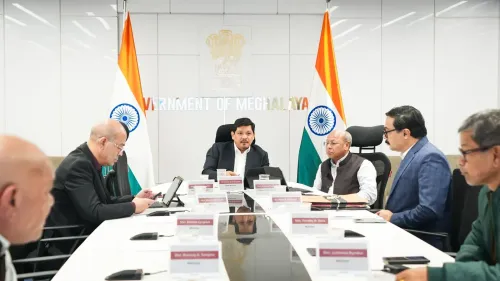
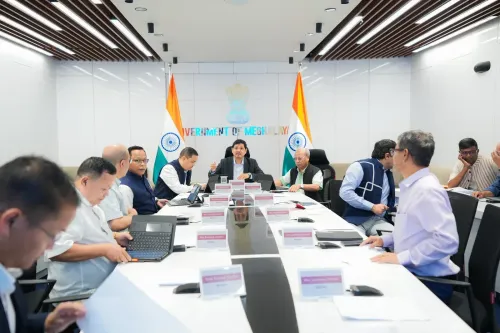
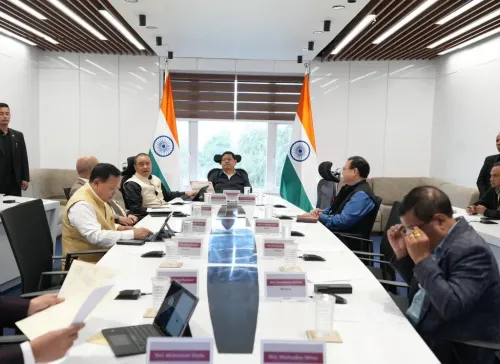
CM Conrad Sangma promulgates MSME ordinance for Meghalaya
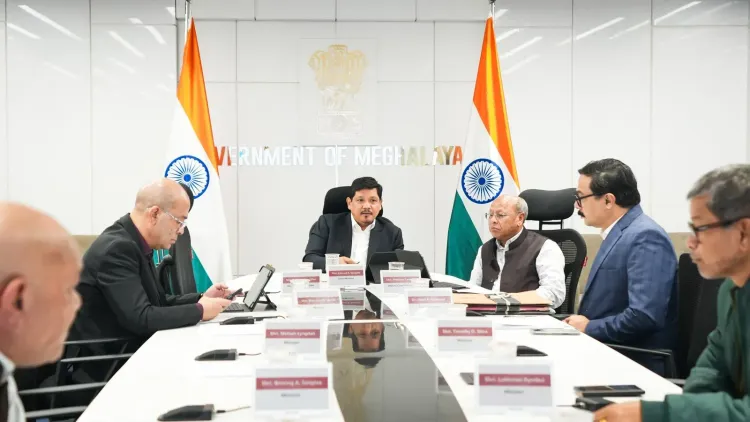
Synopsis
Meghalaya CM Conrad Sangma has promulgated an ordinance to streamline licences, NOCs, and registrations for MSMEs, starting with white-category industries exempt from Pollution Control Board consents — accelerating the state's Ease of Doing Business agenda.
Key Takeaways
Meghalaya Cabinet approved the MSME (Facilitation of Establishment and Operation) Ordinance, 2026 on October 13, 2026 .
The ordinance simplifies and speeds up the process for MSMEs to obtain licences, clearances, NOCs, and registrations.
Initial coverage is restricted to white-category industries that do not require CTE or CTO from the Meghalaya Pollution Control Board .
All existing regulatory requirements remain in force — the ordinance facilitates process, not compliance exemption.
The move aligns with India's broader Ease of Doing Business reforms and risk-based industry categorisation adopted by multiple states.
The ordinance must be converted into legislation at the next Meghalaya Assembly session to remain in effect.
Meghalaya's Cabinet has cleared a significant regulatory reset for small businesses: Chief Minister Conrad Sangma announced on Tuesday, October 13, 2026, the promulgation of the Meghalaya Micro, Small and Medium Enterprises (Facilitation of Establishment and Operation) Ordinance, 2026 — a move designed to strip away procedural bottlenecks that have long slowed down entrepreneurs in the state.
What the ordinance actually changes
At its core, the ordinance rewires how MSMEs obtain licences, clearances, no-objection certificates, and registrations. Applications will now move through a streamlined pipeline, eliminating the layered back-and-forth that routinely added weeks — sometimes months — to a business's launch timeline. The state government frames this squarely within its Ease of Doing Business commitment, a benchmark that Indian states have competed on fiercely since national reforms began in 2014.
White-category industries: the first beneficiaries
The ordinance rolls out in phases. Initially, coverage is limited to white-category industries — units that do not require a Consent to Establish (CTE) or Consent to Operate (CTO) from the Meghalaya Pollution Control Board. These are, by definition, the least environmentally intrusive businesses: think small food-processing units, handicraft workshops, IT-enabled services, and similar low-footprint enterprises. The risk-based approach — exempting clean industries from environmental consent while keeping the framework intact for others — mirrors a regulatory model already adopted by several Indian states to balance growth against ecological safeguards.
Crucially, Sangma was explicit that the ordinance does not dissolve existing regulatory obligations. 'All applicable regulatory requirements continue to be met,' he posted — a line clearly aimed at reassuring environmental watchdogs that the facilitation window is not a compliance escape hatch.
Meghalaya's MSME push in a wider Northeast context
Meghalaya's MSME sector is the backbone of its non-agrarian economy, with clusters in agro-processing, bamboo products, and tourism-linked services. The national Micro, Small and Medium Enterprises Development Act, 2006 established the legal scaffolding for state-level promotion regimes, but the real compliance weight has always lived in state-level licences and NOCs — precisely what this ordinance targets. For a state still building out its industrial infrastructure, reducing time-to-operate for white-category units could meaningfully accelerate formal enterprise creation.
The ordinance route — rather than a standard legislative bill — signals urgency. Ordinances in India take effect immediately but must be converted into law by the legislature within six weeks of the Assembly's next sitting. That conversion process, and the publication of the detailed notification listing eligible white-category activities, will be the real test of implementation depth.
For Meghalaya's entrepreneurs, the clock on a faster, cleaner licensing era has now started — the question is how quickly the notification architecture follows the headline announcement.
Point of View
The Sangma government sidesteps environmental controversy while demonstrating momentum on Ease of Doing Business metrics that states are increasingly judged against. The ordinance route signals political urgency — and carries a legislative deadline that will reveal whether the push is sustained or symbolic. For the NPP, which governs a state heavily dependent on informal enterprise, formalising and accelerating MSME entry is both economic policy and electoral signalling ahead of the next assembly cycle. The broader arc here is Northeast India's integration into India's formal MSME ecosystem — a process that state-level facilitation ordinances can accelerate far faster than central policy alone.
NationPress
13 Oct 2026
Frequently Asked Questions
What is the Meghalaya MSME Ordinance 2026?
The Meghalaya Micro, Small and Medium Enterprises (Facilitation of Establishment and Operation) Ordinance, 2026 is a state government measure promulgated on October 13, 2026, to simplify and speed up the process for MSMEs to get licences, clearances, NOCs, and registrations in Meghalaya.
Which industries does the Meghalaya MSME ordinance cover first?
Initially, the ordinance covers white-category industries — businesses that do not require a Consent to Establish (CTE) or Consent to Operate (CTO) from the Meghalaya Pollution Control Board, meaning low-pollution or non-polluting enterprises.
What is a white-category industry in India?
White-category industries are industrial units classified as having negligible pollution potential. They are exempt from requiring environmental consents from state Pollution Control Boards, making them the lowest-risk category under India's risk-based regulatory framework.
Will the MSME ordinance remove regulatory requirements for businesses in Meghalaya?
No. CM Conrad Sangma clarified that all applicable regulatory requirements continue to be met. The ordinance streamlines the process of obtaining clearances — it does not eliminate compliance obligations.
What happens to the ordinance after it is promulgated?
Under Indian constitutional law, an ordinance must be tabled before the state legislature and converted into a formal law within six weeks of the Assembly's next sitting, or it lapses. The Meghalaya government will need to introduce and pass a bill to make the changes permanent.