CM Dhami: 75% Subsidy to Empower Women Under State Scheme
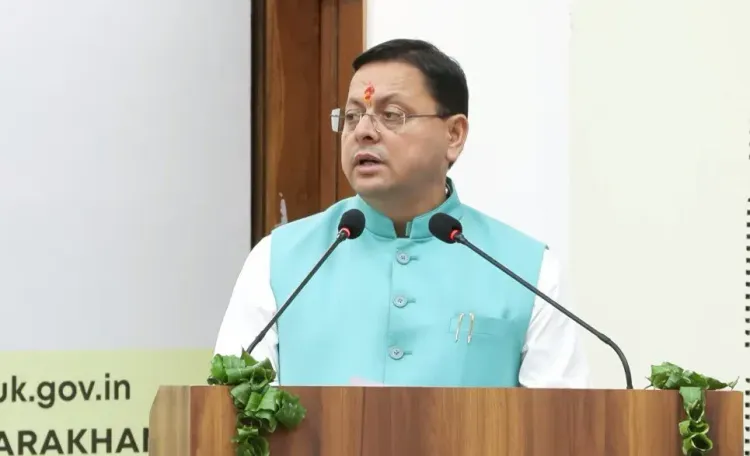
Synopsis
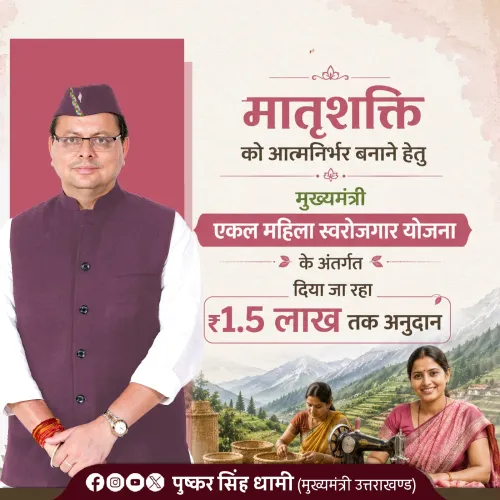
Chief Minister Pushkar Singh Dhami has announced that Uttarakhand is providing a 75 per cent subsidy under a women-focused welfare scheme aimed at making women self-reliant. The scheme targets rural women and women entrepreneurs across the state.
Key Takeaways
The Chief Minister's Office of Uttarakhand shared a statement from CM Pushkar Dhami on 22 July 2026 about a women-welfare scheme.
The scheme provides a 75 per cent subsidy on the total project or scheme amount for eligible women beneficiaries.
The stated objective is to make matrashakti — women as a collective force — self-reliant ( aatmanirbhar ).
Primary beneficiaries are rural women and women entrepreneurs in Uttarakhand.
The scheme fits within Uttarakhand's post-2021 expansion of women-focused subsidy and self-help group lending programmes.
Full scheme guidelines, eligibility criteria, and district-wise beneficiary data are yet to be publicly released.
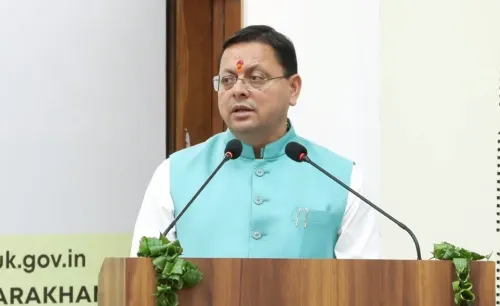
The Chief Minister's Office of Uttarakhand on Wednesday, 22 July 2026, shared a statement from Chief Minister Pushkar Singh Dhami announcing that a state welfare scheme is providing a 75 per cent subsidy to make women self-reliant, underscoring the government's focus on female economic empowerment.
Quoting CM Dhami directly, the post stated: 'Is yojana ka uddeshya matrashakti ko aatmanirbhar banana hai. Yojana ke antargat 75 pratishat rashi subsidy ke roop mein di ja rahi hai.' ['The objective of this scheme is to make the power of mothers self-reliant. Under the scheme, 75 per cent of the amount is being provided as a subsidy.']
Context
Uttarakhand, a northern Himalayan state with a significant rural and semi-urban population, has placed women's economic participation at the centre of its post-2021 policy agenda. The term matrashakti — literally 'the power of mothers' — is frequently used in Indian policy discourse to refer to women as a collective social and economic force. CM Dhami's statement frames the scheme explicitly around this concept of self-reliance, or aatmanirbharta.
Policy Backdrop
Since the 2021 state elections, the Uttarakhand government has expanded women-focused self-help group lending and subsidy programmes. A 75 per cent capital subsidy is notably higher than the national norm for many centrally sponsored schemes, which typically range between 25 and 50 per cent. This positions the state's intervention as a more aggressive push to lower the financial barrier for women entering self-employment.
Across Indian states, particularly in hill and north-eastern regions, high-subsidy credit schemes have been deployed as tools to boost female labour-force participation and household income. Such measures have also been framed as part of broader post-pandemic economic recovery efforts aimed at closing gender gaps in entrepreneurship and self-employment.
Stakeholders and Impact
Rural women and women entrepreneurs in Uttarakhand are the primary beneficiaries of this scheme. For households in hill districts — where male out-migration is high and women often serve as de facto heads of household — access to subsidised capital can be transformative. A 75 per cent subsidy means a beneficiary needs to arrange only 25 per cent of the project cost from her own resources or through institutional credit.
The scheme aligns with the national Aatmanirbhar Bharat framework, which encourages states to design programmes that reduce dependence on wage labour and promote asset creation at the household level, particularly among women in underserved geographies.
What's Next
Detailed scheme guidelines, district-wise beneficiary lists, and any supplementary budget allocation are expected to be taken up in the next Uttarakhand state assembly session. The government's communication of the 75 per cent subsidy figure publicly signals intent to scale outreach, and implementation details — including eligibility criteria and disbursement timelines — will be closely watched by women's groups and rural development stakeholders. Broader uptake will depend on administrative capacity at the block and district level to process applications and disburse funds efficiently.
Point of View
Tapping into a culturally resonant framing that has proven effective in mobilising political goodwill among women voters in north Indian states. The announcement fits a broader pattern of hill states competing to offer higher subsidy floors to attract women beneficiaries and demonstrate governance credentials. However, the scheme's real impact will hinge on ground-level administrative capacity — a perennial challenge in Uttarakhand's dispersed, mountainous geography.
NationPress
22 Jul 2026
Frequently Asked Questions
What is the Uttarakhand women scheme with 75% subsidy announced by CM Dhami?
Chief Minister Pushkar Dhami announced that a state welfare scheme is offering a 75 per cent subsidy to women beneficiaries, with the aim of making women self-reliant. Full scheme details, including its official name and eligibility criteria, are yet to be publicly released.
Who benefits from the Uttarakhand women self-employment subsidy scheme?
The primary beneficiaries are rural women and women entrepreneurs in Uttarakhand. The high subsidy is designed to lower the financial barrier for women entering self-employment or starting small enterprises.
What does matrashakti mean in the context of Uttarakhand's scheme?
Matrashakti literally means 'the power of mothers' and is used in Indian policy discourse to refer to women as a collective social and economic force. CM Dhami used the term to describe the target group of the subsidised welfare scheme.
How does Uttarakhand's 75% subsidy compare to other Indian state schemes for women?
A 75 per cent capital subsidy is notably higher than the typical 25 to 50 per cent range seen in many centrally sponsored schemes. It places Uttarakhand among the more aggressive state-level interventions aimed at boosting female self-employment.
When will the full details of CM Dhami's women welfare scheme be available?
Detailed scheme guidelines, district-wise beneficiary lists, and supplementary budget allocations are expected to be addressed in the next Uttarakhand state assembly session. No official launch date has been specified in the post.