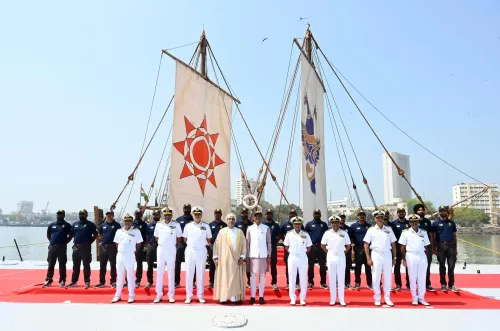
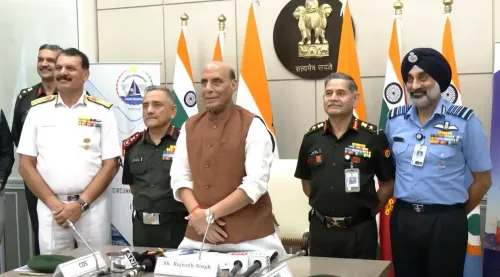
Rajnath Singh hails IASV Triveni's global circumnavigation
Synopsis
Defence Minister Rajnath Singh praised the IASV Triveni's historic global circumnavigation on 22 July 2026, calling it a testament to India's courage, capability, and the growing jointness of its Army, Navy, and Air Force — a milestone in India's ongoing tri-service integration drive.
Key Takeaways
Rajnath Singh publicly lauded IASV Triveni's circumnavigation on 22 July 2026 , calling it a historic voyage.
He described the expedition as proof of India's courage, capability, confidence, and tri-service Jointness .
The Chief of Defence Staff post, created in December 2019 , underpins the institutional drive toward jointness among the Army, Navy, and Air Force .
Maritime expeditions involving multi-service personnel have been a recurring public symbol of India's defence integration agenda.
Progress on proposed theatre commands remains the key structural measure of how deep the jointness agenda runs.
The Minister's statement elevates the voyage from an operational achievement to a national-level statement of military confidence.
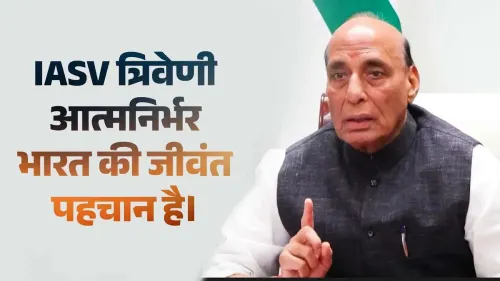
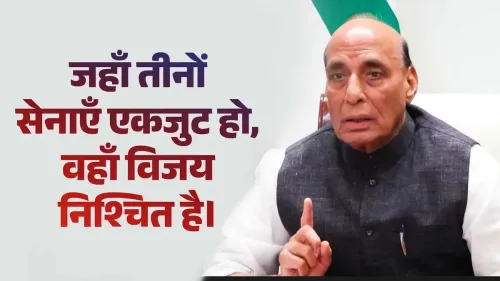
Union Defence Minister Rajnath Singh on Wednesday, 22 July 2026 lauded the voyage of IASV Triveni, calling it a historic journey that stands as powerful proof of India's courage, capability, confidence, and the jointness of its three armed services.
Context
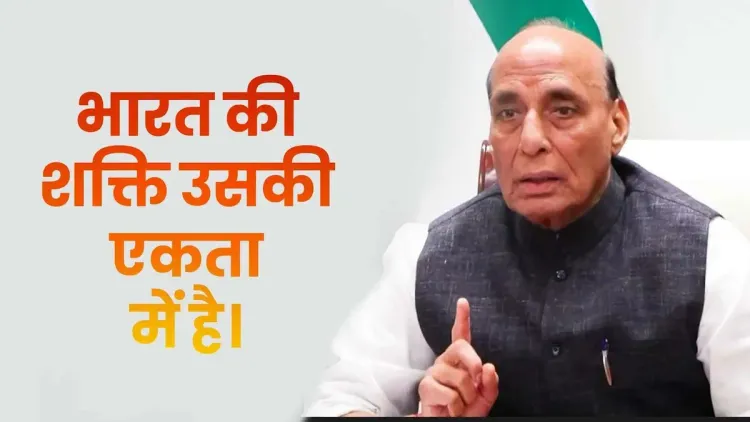
Posting on X, Rajnath Singh wrote in Hindi: 'IASV त्रिवेणी की यह ऐतिहासिक यात्रा केवल समुद्र की परिक्रमा नहीं, बल्कि भारत के साहस, सामर्थ्य, आत्मविश्वास और तीनों सेनाओं की Jointness का सशक्त प्रमाण है।' — translated: 'This historic voyage of IASV Triveni is not merely a circumnavigation of the seas, but a powerful testament to India's courage, capability, confidence, and the Jointness of all three armed forces.'
The statement places the expedition firmly within the broader narrative of tri-service integration that has been a defining theme of India's defence reforms since 2019. Maritime expeditions of this nature serve a dual purpose: demonstrating operational endurance and signalling inter-service cohesion to both domestic and international audiences.
Policy Backdrop
The concept of 'Jointness' among the Indian Army, Navy, and Air Force gained institutional momentum with the creation of the Chief of Defence Staff (CDS) post in December 2019. The CDS was mandated to reduce service-specific silos and drive interoperability across domains — land, sea, air, space, and cyber.
Since then, the Ministry of Defence has launched a series of tri-service training initiatives and joint exercises designed to operationalise the new integrated command structure. Adventure and maritime expeditions involving personnel from multiple services have been a visible, public-facing element of this integration agenda, reinforcing the message of a unified fighting force.
The naming of the vessel — Triveni, evoking the sacred confluence of three rivers — itself carries symbolic weight, aligning with the idea of three services flowing together toward a common purpose.
Stakeholders and Impact
The primary stakeholders are the tri-service personnel aboard IASV Triveni, whose voyage embodies the practical expression of jointness at the individual and unit level. For the Indian Armed Forces as an institution, such expeditions build esprit de corps and demonstrate to the world that India's military can operate in concert across extended, demanding environments.
At the strategic level, the voyage carries a message for India's neighbours and global partners: that the country's defence establishment is moving decisively away from siloed, single-service operations toward a cohesive, multi-domain force. Rajnath Singh's public endorsement amplifies that signal at the highest political level.
What's Next
Progress on the proposed theatre commands — the structural centrepiece of India's jointness agenda — remains the most closely watched legislative and administrative development in defence circles. Any parliamentary update or cabinet decision on theatre command timelines will be a direct measure of how far the integration agenda has advanced beyond symbolism into structural reality.
The successful completion of the IASV Triveni circumnavigation is likely to be cited as evidence of readiness for deeper integration, potentially lending political momentum to those proposals in the months ahead.
Point of View
The Minister is doing something precise: converting an operational milestone into a narrative asset for the theatre-command agenda, which still awaits full legislative and bureaucratic clearance. The choice of the word 'Jointness' in English within an otherwise Hindi post is telling — it signals an audience beyond the domestic public, reaching defence attaches, strategic partners, and regional rivals who track India's military modernisation closely. If theatre commands do advance in the coming parliamentary session, moments like this will be cited as part of the political groundwork that made them possible.
NationPress
22 Jul 2026
Frequently Asked Questions
What is IASV Triveni and what voyage did it complete?
IASV Triveni is an Indian Armed Services Vessel that undertook a circumnavigation of the globe, involving personnel from India's Army, Navy, and Air Force as a demonstration of tri-service jointness and national capability.
What did Rajnath Singh say about IASV Triveni?
On 22 July 2026, Defence Minister Rajnath Singh said the voyage of IASV Triveni is not merely a circumnavigation of the seas but a powerful testament to India's courage, capability, confidence, and the Jointness of all three armed forces.
What does 'Jointness' mean in the context of India's defence forces?
'Jointness' refers to the integration and interoperability of India's Army, Navy, and Air Force, an agenda institutionalised through the creation of the Chief of Defence Staff post in December 2019 to enable combined, multi-domain military operations.
What is the Chief of Defence Staff and how does it relate to tri-service integration?
The Chief of Defence Staff is a post created in December 2019 to drive integration among India's three armed services, reduce service-specific silos, and lay the groundwork for unified theatre commands.
What are India's proposed theatre commands?
Theatre commands are a planned structural reform to reorganise India's military into geographically unified joint commands — rather than separate Army, Navy, and Air Force commands — to improve combined operational effectiveness. They are the next major step in the Jointness agenda.