CM Dhami: 80% Subsidy on Apple, Kiwi for Uttarakhand Farmers
Synopsis
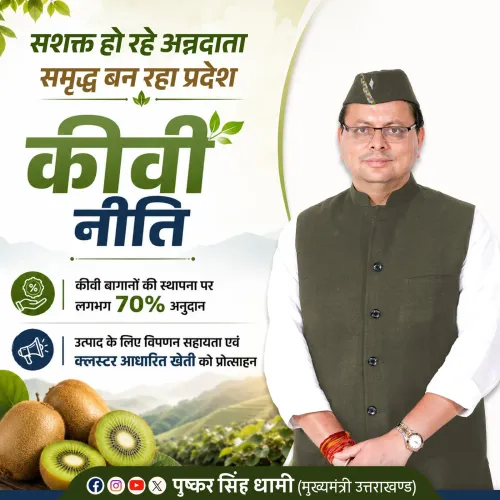
Chief Minister Pushkar Singh Dhami announced an 80 per cent subsidy on apple and kiwi crop production for Uttarakhand farmers on 26 June 2026, alongside a state-wide drive to establish cold storage facilities to reduce post-harvest losses for hill horticulturists.
Key Takeaways
The Uttarakhand government is providing an 80 per cent subsidy on apple and kiwi crop production to farmers.
Cold storage units are being established at multiple locations across the state to cut post-harvest losses.
The announcement was made by Chief Minister Pushkar Singh Dhami on 26 June 2026 .
Apple cultivation is concentrated in hill districts including Almora , Chamoli , and Pauri , with kiwi emerging as a complementary high-value crop.
The policy aligns with the centrally sponsored Mission for Integrated Development of Horticulture (MIDH) and broader national goals of reducing food loss.
The measures aim to raise rural incomes and reduce seasonal migration from Uttarakhand's hill districts.
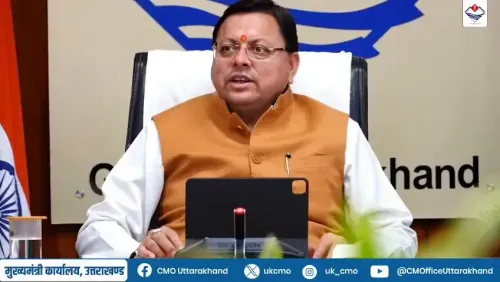
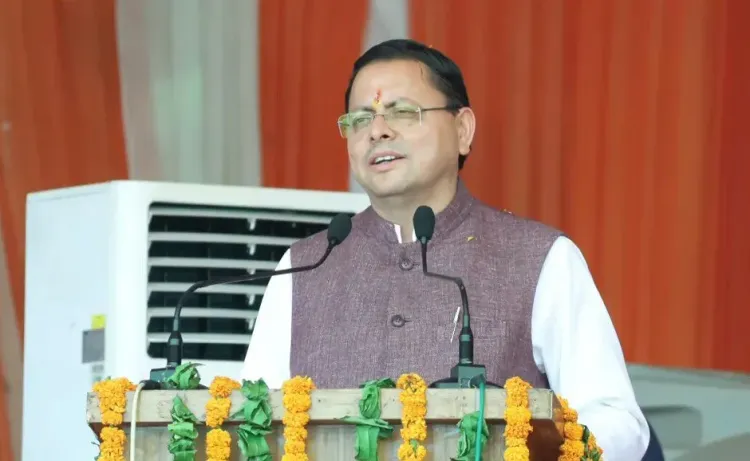
The Chief Minister's Office of Uttarakhand announced on Friday, 26 June 2026 that the state government is providing an 80 per cent subsidy on apple and kiwi crop production to farmers, alongside a push to establish cold storage facilities across the hill state. The announcement was attributed directly to Chief Minister Pushkar Singh Dhami.
Context
Quoting CM Dhami, the official post stated: 'Aaj kisanon ko seb, kiwi fasal utpadan mein 80 pratishat ki subsidy di ja rahi hai' ('Today, farmers are being given an 80 per cent subsidy on apple and kiwi crop production'). The statement added that cold storage units are being set up at multiple locations across Uttarakhand. The announcement underscores the state government's focus on high-value temperate horticulture as a driver of rural incomes in the hills.
Policy Backdrop
Uttarakhand has long pursued horticulture diversification to suit its agro-climatic zones, with apple cultivation concentrated in districts such as Almora, Chamoli, and Pauri, and kiwi orchards emerging as a complementary high-value crop. The centrally sponsored Mission for Integrated Development of Horticulture (MIDH), operational since 2014, has provided subsidies and technical support for fruit crops including apples and kiwi in hilly states. State horticulture policies since the early 2010s have also included support for cold-chain infrastructure to cut post-harvest losses, building on the earlier National Horticulture Mission launched in 2005-06.
The push for cold storage expansion mirrors approaches taken in neighbouring Himachal Pradesh and Jammu and Kashmir, where post-harvest infrastructure has been central to reducing perishable crop wastage and stabilising farm incomes.
Stakeholders and Impact
The primary beneficiaries are apple farmers, kiwi growers, and hill horticulturists who face high input costs and limited post-harvest options in remote Himalayan terrain. An 80 per cent subsidy on production inputs represents a substantial reduction in financial risk for smallholders, many of whom operate on marginal landholdings. Cold storage access is particularly critical for perishable fruit crops, where delays in market linkage can wipe out an entire season's returns.
Broader state objectives include curbing seasonal migration from hill districts by making farm-based livelihoods more viable and remunerative. Strengthened agricultural supply chains in mountainous regions also align with national goals of minimising food loss.
What's Next
Details on subsidy disbursal timelines and the specific locations of cold storage units being commissioned are expected to emerge through the state horticulture department's progress reports and the next Uttarakhand assembly session or budget announcement. The pace of cold-chain rollout will be a key indicator of whether the policy translates into on-ground infrastructure for farming communities. Analysts will also watch whether kiwi, still a relatively nascent crop in the state, receives targeted extension support alongside the subsidy.
Point of View
A strategy that has political salience ahead of future state elections. Pairing the subsidy with cold storage expansion addresses the perennial weak link in hill horticulture — the gap between production and market — which has historically eroded the gains of input support. The move fits into a broader national pattern of BJP-governed hill states competing to attract and retain farming communities through visible, high-subsidy schemes. Whether the cold-chain rollout keeps pace with expanded production will determine if this becomes a durable income story or a short-term political signal.
NationPress
25 Sept 2026
Frequently Asked Questions
What subsidy is Uttarakhand giving to apple and kiwi farmers?
The Uttarakhand government is providing an 80 per cent subsidy on apple and kiwi crop production to farmers, as announced by Chief Minister Pushkar Singh Dhami on 26 June 2026.
Where are cold storages being set up in Uttarakhand?
Cold storage units are being established at multiple locations across Uttarakhand, though the state government has not yet specified the exact sites publicly.
Which scheme supports apple and kiwi farmers in Uttarakhand?
The centrally sponsored Mission for Integrated Development of Horticulture (MIDH), operational since 2014, provides subsidies and technical support for fruit crops including apples and kiwi in hilly states like Uttarakhand.
Which districts in Uttarakhand grow apples?
Apple cultivation in Uttarakhand is primarily concentrated in hill districts such as Almora, Chamoli, and Pauri, with kiwi orchards also emerging as a high-value crop in suitable agro-climatic zones.
Why is cold storage important for Uttarakhand fruit farmers?
Cold storage is critical for perishable fruit crops like apples and kiwi because delays in reaching markets can result in heavy losses; expanded cold-chain infrastructure helps stabilise farm incomes and reduce post-harvest wastage.