CM Dhami invokes Deendayal Upadhyay's Antyodaya on I-Day
Synopsis
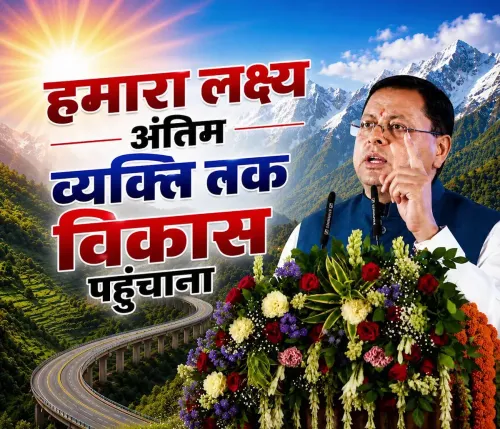
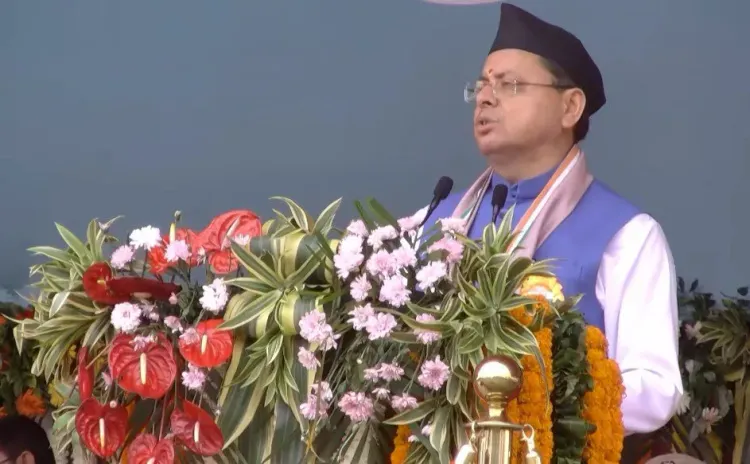
On Independence Day 2026, Uttarakhand CM Pushkar Singh Dhami quoted BJP ideologue Deendayal Upadhyay's Antyodaya standard — that development is only real when it reaches the last person — and cited PM Modi's welfare schemes as its contemporary fulfilment.
Key Takeaways
CM Pushkar Singh Dhami invoked Pandit Deendayal Upadhyay's Antyodaya principle on Independence Day, 15 August 2026 .
Upadhyay's test: development is genuine only when its benefits reach the weakest, last person in society.
Dhami credited PM Narendra Modi's welfare schemes with operationalising this philosophy for marginalised households.
Key central schemes cited in this ideological tradition include PM Garib Kalyan Anna Yojana and Ujjwala Yojana .
BJP-ruled states routinely anchor official communications in Upadhyay's philosophy to reinforce ideological continuity with the party's founding vision.
Uttarakhand's mountainous terrain makes last-mile delivery a literal governance challenge, not just a rhetorical one.
On Independence Day, 15 August 2026, the measure of a nation's progress was framed not in GDP figures but in a single moral question: has development reached the very last person? Uttarakhand Chief Minister Pushkar Singh Dhami answered it by reaching back six decades to the philosophy of Pandit Deendayal Upadhyay — and connecting it directly to the welfare architecture of Prime Minister Narendra Modi.
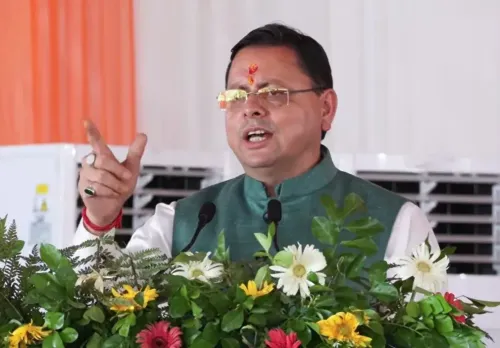
Quoting the BJP's founding ideologue, CM Dhami said: 'Vikas ki kasauti is baat se tay hoti hai ki samaj ke antim vyakti tak vikas ka labh pahuncha ya nahin' — 'The true test of development is whether its benefits have reached the last person in society.' He then declared that under PM Modi's leadership, welfare schemes are today ensuring exactly that outcome for those standing on the lowest rung.
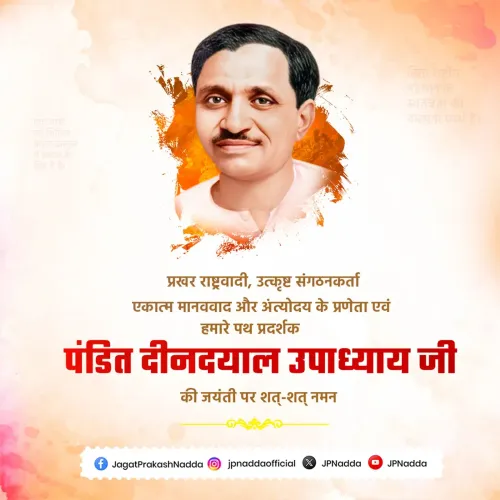
Antyodaya: a philosophy that predates the party
Pandit Deendayal Upadhyay articulated the concept of Antyodaya — literally 'rise of the last' — through his doctrine of Integral Humanism in the 1950s and 1960s, first as a Jana Sangh document and later as a foundational text for Indian right-of-centre politics. The core argument was simple and radical: no economic model deserves the name 'development' unless it demonstrably improves the condition of the weakest member of society. That standard, Upadhyay insisted, is the only honest metric. The philosophy long pre-dates any electoral calculation. But it has found its most explicit institutional expression under the Modi government post-2014, which framed flagship programmes — from the PM Garib Kalyan Anna Yojana (free foodgrain for the poor) to the Ujjwala Yojana (LPG connections for below-poverty-line households) — explicitly around last-mile delivery to the most marginalised.Uttarakhand as a delivery test-bed for central schemes
For Uttarakhand, a state defined by difficult mountain terrain and dispersed populations, 'last-mile' is not a metaphor — it is a logistical reality. Remote villages in districts like Pithoragarh, Chamoli, and Uttarkashi have historically been among the hardest to reach with government services. CM Dhami's Independence Day message signals the state BJP government's continued alignment with New Delhi's welfare delivery framework as a political and administrative priority. BJP-ruled states have made it a consistent practice to anchor official communications in Upadhyay's philosophy, reinforcing ideological continuity between the party's founding thinker and its current national leadership. The Independence Day timing amplifies that signal: this is not routine scheme communication but a statement of governing intent on the nation's most symbolic date. The real test, of course, lies in district-level coverage data — how many households in Uttarakhand's remotest blocks have actually received benefits under these schemes. Those numbers will define whether the Antyodaya promise remains philosophy or becomes provable fact.Point of View
Insulating scheme communication from purely transactional political optics. For Uttarakhand specifically, where central scheme penetration in remote Himalayan districts remains uneven, the statement sets a philosophical benchmark the state government will eventually be measured against. The broader pattern — BJP state governments amplifying Antyodaya messaging on high-visibility national dates — points to a coordinated effort to own the 'development for the poorest' narrative ahead of legislative cycles. Whether the rhetoric translates into verifiable last-mile data remains the live question that analysts and opposition alike will press.
NationPress
30 Sept 2026
Frequently Asked Questions
Who was Pandit Deendayal Upadhyay and what is Antyodaya?
Pandit Deendayal Upadhyay was an Indian political thinker and Jana Sangh leader who developed the philosophy of Integral Humanism in the 1950s-60s. Antyodaya — 'rise of the last' — is its central test: development is real only when it benefits the weakest person in society.
What did CM Pushkar Singh Dhami say on Independence Day 2026?
CM Dhami quoted Upadhyay's Antyodaya principle and stated that under PM Narendra Modi's leadership, various government schemes are ensuring development reaches those on the lowest rung of society.
Which PM Modi schemes are linked to the Antyodaya philosophy?
Schemes such as PM Garib Kalyan Anna Yojana, which provides free foodgrain to poor households, and Ujjwala Yojana, which gives LPG connections to below-poverty-line families, have been framed by the central government around the Antyodaya principle of last-mile welfare delivery.
Why does the BJP frequently reference Deendayal Upadhyay in governance statements?
Upadhyay is the BJP's founding ideological ancestor. Referencing his philosophy reinforces continuity between the party's intellectual origins and its current governance agenda, particularly on welfare and inclusion.
What is the governance challenge for last-mile delivery in Uttarakhand?
Uttarakhand's mountainous terrain and dispersed village populations in districts like Pithoragarh, Chamoli, and Uttarkashi make physical delivery of government services genuinely difficult, making last-mile coverage a concrete logistical challenge rather than just a political slogan.