CM Dhami Calls for Population Awareness on World Population Day
Synopsis
On World Population Day, 11 July 2026, Uttarakhand CM Pushkar Singh Dhami urged citizens to pledge awareness of population challenges, calling balanced demography and effective resource management the foundation of a secure future for coming generations.
Key Takeaways
Uttarakhand Chief Minister Pushkar Singh Dhami posted a World Population Day message on 11 July 2026 .
He called for public awareness about the social, economic, and environmental impact of rising population.
World Population Day has been observed annually on 11 July since 1989 under the UN framework.
India's National Population Policy 2000 targets population stabilisation at replacement fertility levels by 2045 through voluntary measures.
Uttarakhand faces specific demographic pressures tied to migration and ecological fragility in its Himalayan geography.
The post signals potential alignment of Uttarakhand 's governance agenda with population and family welfare policy ahead of the next census.
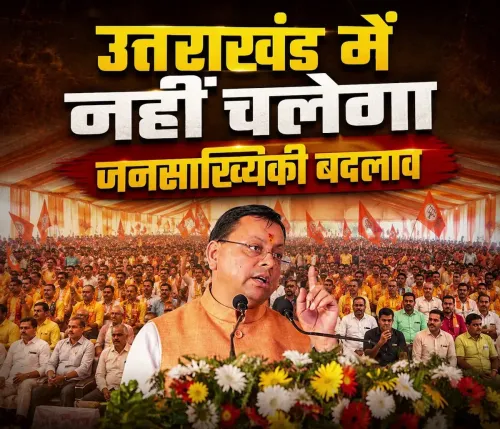
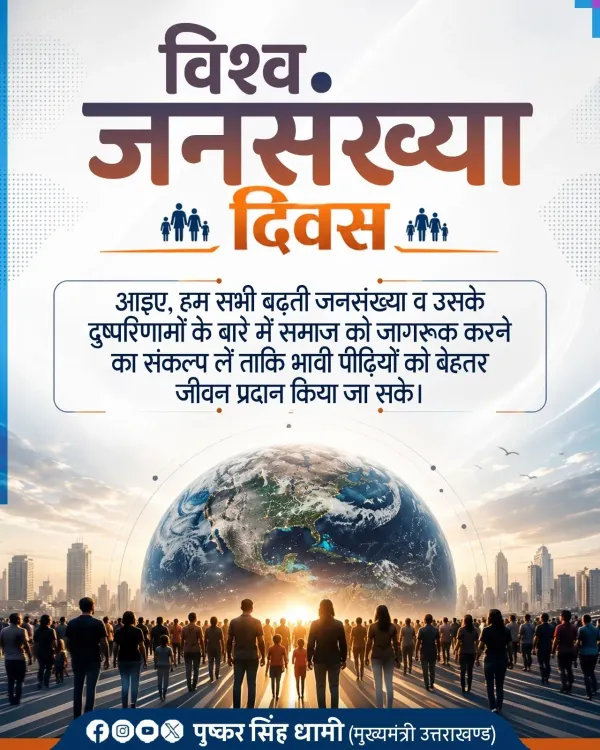
Uttarakhand Chief Minister Pushkar Singh Dhami on Saturday, 11 July 2026, marked World Population Day by urging citizens to build awareness about the social, economic, and environmental challenges posed by rising population, calling balanced demography the foundation of a healthy and prosperous future for coming generations.
In his post, CM Dhami wrote: 'Santulit jansankhya, sansaadhanon ka prabhavi prabandhan aur jagruk nagarik sahbhagita hi bhaavi peedhiyon ke liye swasth, samriddh aur surakshit bhavishy ki mazboot neenv hai' — meaning, 'Balanced population, effective management of resources, and aware civic participation are the strong foundation of a healthy, prosperous, and secure future for coming generations.' He called on all citizens to pledge, on this occasion, to spread public awareness about the challenges linked to growing population and their social, economic, and environmental impact.
Context
World Population Day is observed every year on 11 July since 1989 under the United Nations framework, to draw global attention to population-related issues and sustainable development. The day serves as an annual platform for governments and civil society to reinforce demographic messaging and policy commitments. CM Dhami's post is consistent with the broader national and state-level observance of the occasion.
Policy Backdrop
India adopted the National Population Policy 2000, which marked a decisive shift away from coercive family planning methods toward voluntary, rights-based reproductive health services, with a target of stabilising population at replacement fertility levels by 2045. Himalayan states such as Uttarakhand have consistently framed population awareness within the context of ecological conservation, given the state's sensitivity to resource strain and environmental pressures. Uttarakhand faces particular challenges from migration patterns and demographic pressures on its fragile mountain ecosystem, making population management a recurring governance concern.
Stakeholders and Impact
The message is directed at Uttarakhand's residents and, by extension, citizens across India, emphasising civic participation as a pillar of demographic balance. For a state whose development planning is deeply tied to natural resource sustainability, public awareness on population dynamics has direct implications for forest cover, water resources, and urban planning. Future generations are explicitly named as the primary stakeholders in CM Dhami's framing, linking demographic responsibility to intergenerational equity.
What's Next
Observers will watch whether Uttarakhand translates this awareness messaging into formal policy action, such as a dedicated state population framework or integration with family welfare and maternal health schemes. The next national census exercise will also be a key moment for states like Uttarakhand to assess demographic trends and align development planning accordingly. CM Dhami's track record on governance reform — including the state's Uniform Civil Code — suggests population policy could emerge as a structured agenda item in the coming months.
Point of View
Consistent with the BJP's broader framing of population as a shared social obligation rather than a purely state-driven concern. Coming from a CM who has already legislated the Uniform Civil Code, this messaging could be a precursor to more structured population-related policy in Uttarakhand. It also positions the state government as aligned with sustainable development goals ahead of the next national census.
NationPress
9 Oct 2026
Frequently Asked Questions
Why did CM Dhami post about World Population Day?
CM Pushkar Singh Dhami posted on World Population Day, observed on 11 July every year, to urge citizens to raise awareness about the challenges of rising population and their social, economic, and environmental consequences.
What is World Population Day and when is it observed?
World Population Day is a global observance held annually on 11 July since 1989, established to highlight population-related challenges and promote sustainable development goals.
What is India's National Population Policy?
India adopted the National Population Policy in 2000, shifting to voluntary and rights-based family planning approaches with a goal of stabilising population at replacement fertility levels by 2045.
What population challenges does Uttarakhand face?
Uttarakhand, as a Himalayan state, faces ecological pressures from population growth, migration patterns, and strain on natural resources such as forests and water, making demographic management a key governance concern.
Does Uttarakhand have its own population policy?
As of July 2026, Uttarakhand does not have a standalone state population policy, but observers are watching whether CM Dhami's awareness messaging will lead to a formal policy framework integrated with family welfare schemes.