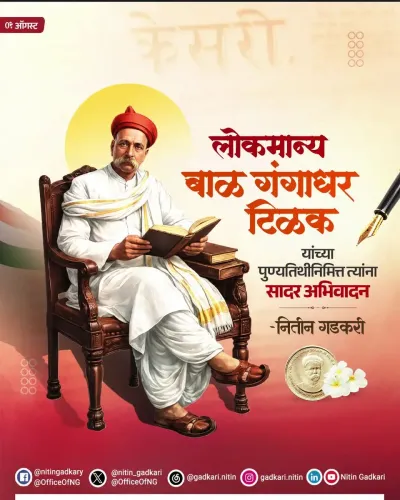
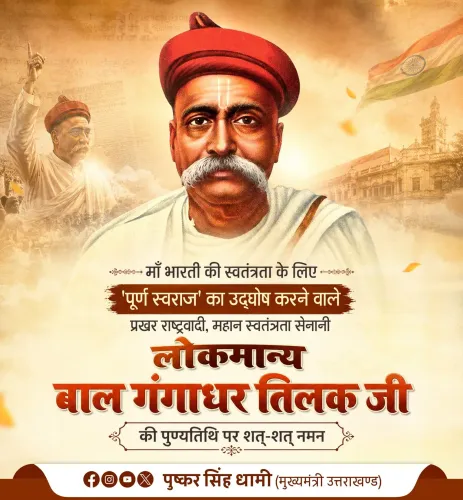
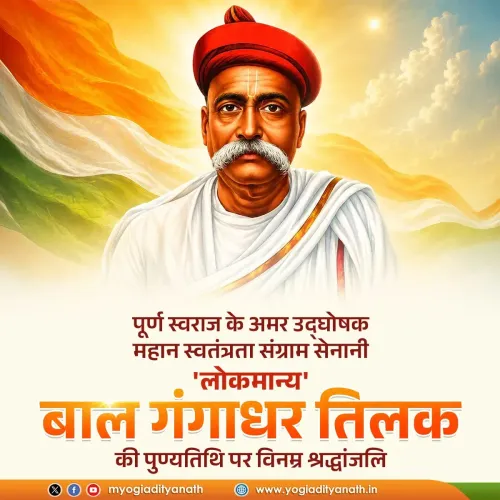
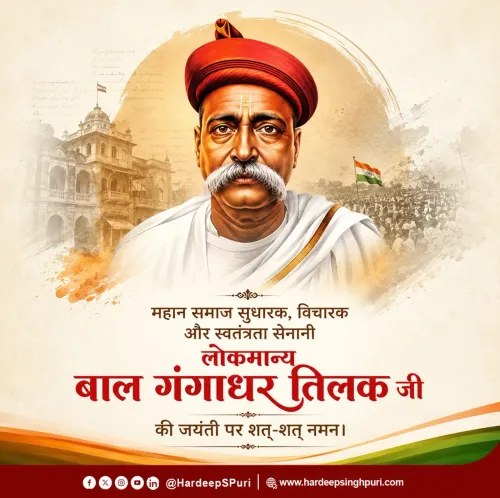
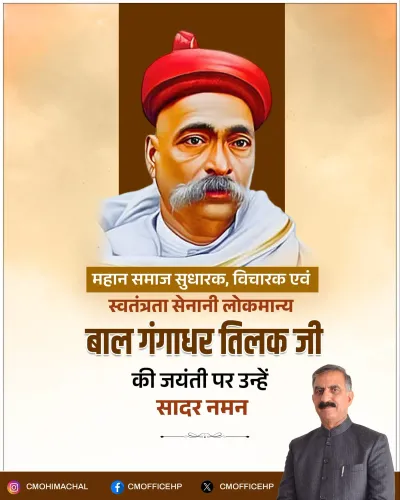
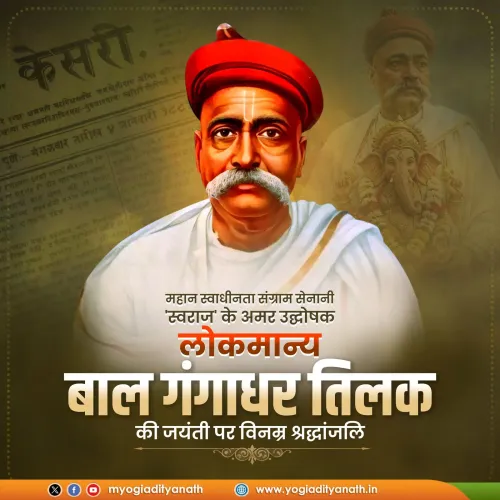
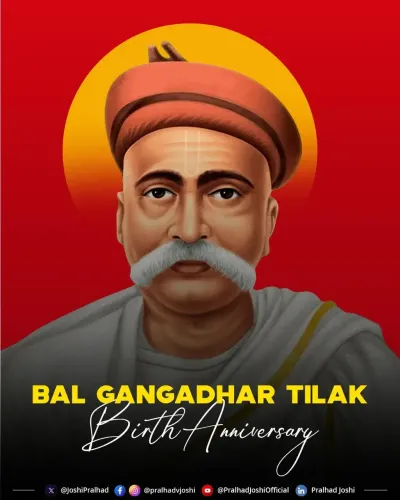
CM Dhami pays tribute to Bal Gangadhar Tilak on death anniversary
Synopsis
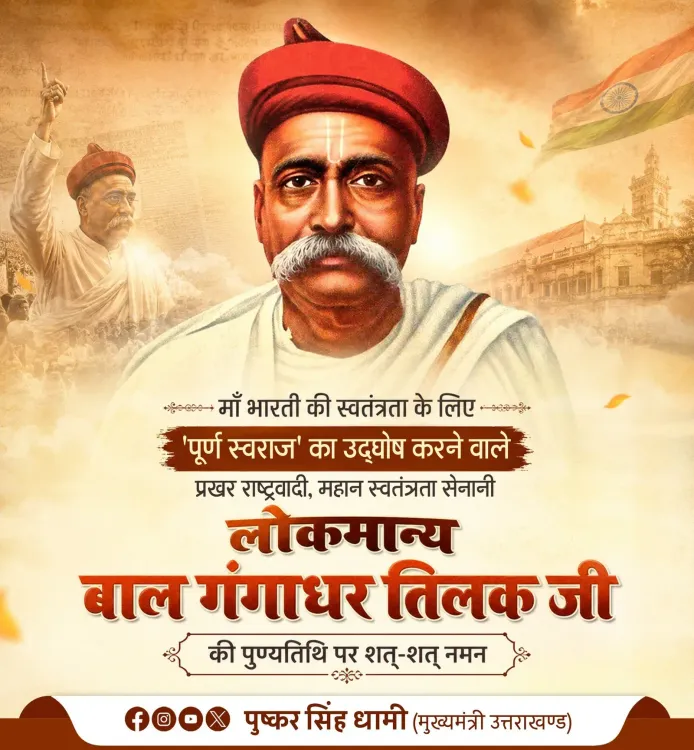
Uttarakhand Chief Minister Pushkar Singh Dhami marked the death anniversary of Lokmanya Bal Gangadhar Tilak on 1 August 2026, saluting the freedom fighter's immortal 'Swaraj is my birthright' declaration and his legacy of nationalism, self-respect, and public awakening.
Key Takeaways
CM Pushkar Singh Dhami paid tribute to Lokmanya Bal Gangadhar Tilak on his death anniversary, 1 August 2026 .
Dhami invoked Tilak's iconic slogan 'Swaraj mera janmasiddh adhikar hai' — 'Swaraj is my birthright' — in his post.
Tilak died on 1 August 1920 , making this the 106th death anniversary of the freedom fighter.
Tilak is credited with popularising Ganesh Chaturthi and Shivaji Jayanti as instruments of mass nationalist mobilisation.
The tribute comes a fortnight before Independence Day on 15 August, a peak period for nationalist commemoration in India.
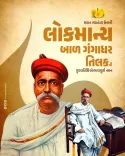
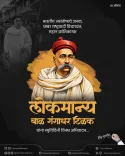
A declaration that echoed across a colonised subcontinent — 'Swaraj is my birthright, and I shall have it' — rang out again on Saturday, 1 August 2026, as Uttarakhand Chief Minister Pushkar Singh Dhami paid homage to Lokmanya Bal Gangadhar Tilak on his death anniversary, calling him an ardent nationalist, great freedom fighter, social reformer, and pioneer of public awakening.
In his post, CM Dhami wrote: 'Swaraj mera janmasiddh adhikar hai' ['Swaraj is my birthright'] — invoking Tilak's immortal declaration — and offered shat-shat naman ['a hundredfold salute'] to the leader. He added that Tilak's unparalleled message of patriotism, self-respect, and public awakening would continue to inspire Indians to serve the nation.
The man behind the immortal slogan
Bal Gangadhar Tilak, born on 23 July 1856 in Ratnagiri, Maharashtra, died on 1 August 1920 — making each 1 August his death anniversary. A mathematician, lawyer, journalist, and mass mobiliser, Tilak was among the first Indian leaders to call for complete self-rule rather than gradual reform under British oversight. His slogan, first delivered around 1897, became one of the most galvanising phrases of the independence movement.
Tilak founded and popularised the public celebration of Ganesh Chaturthi and Shivaji Jayanti as tools of mass political organisation — turning cultural festivals into forums for nationalist consciousness at a time when large political gatherings were restricted. He also edited the Marathi newspaper Kesari and the English-language Mahratta, using journalism as a weapon against colonial rule. The British imprisoned him twice, including a six-year sentence in Mandalay, Burma, beginning in 1908.
Tilak's place in BJP's nationalist lineage
For the Bharatiya Janata Party and its ideological ecosystem, Tilak occupies a specific and prominent place: a Hindu nationalist who fused cultural pride with political resistance. His emphasis on Hindutva-adjacent cultural symbols and his uncompromising demand for Swaraj make him a figure both mainstream nationalists and the broader Hindu right claim as an ancestor. CM Dhami's tribute — framing Tilak as a beacon of rashtrabhakti ['patriotism'] and swabhiman ['self-respect'] — fits squarely within this tradition.
Across India's political spectrum, death and birth anniversaries of independence-era icons are marked with social media tributes, state ceremonies, and sometimes policy announcements tied to the leader's legacy. Tilak's anniversary on 1 August falls just a fortnight before Independence Day on 15 August, making the period a concentrated season of nationalist commemoration.
A century after his death, Tilak's most famous sentence remains one of the most quoted lines in Indian political life — proof that some declarations outlast the empires they were aimed at.
Point of View
Linking the party's nationalism to a pre-Independence lineage that predates the Congress-dominated freedom movement narrative. By foregrounding Tilak's themes of swabhiman and rashtrabhakti, CM Dhami reinforces a BJP cultural grammar that frames governance as an extension of the nationalist project. The timing — a fortnight before Independence Day — amplifies the resonance. In a media environment saturated with such tributes, the political value lies less in the individual post and more in the cumulative signal of ideological continuity.
NationPress
1 Aug 2026
Frequently Asked Questions
When is Bal Gangadhar Tilak's death anniversary?
Bal Gangadhar Tilak's death anniversary falls on 1 August every year. He died on 1 August 1920 in Mumbai.
What is Bal Gangadhar Tilak famous for?
Tilak is best known for the slogan 'Swaraj is my birthright, and I shall have it.' He was a leading Indian nationalist, journalist, mathematician, and social reformer who popularised Ganesh Chaturthi and Shivaji Jayanti as tools of mass political mobilisation against British rule.
Why did CM Dhami post about Bal Gangadhar Tilak?
Uttarakhand Chief Minister Pushkar Singh Dhami posted a tribute to mark Tilak's death anniversary on 1 August 2026 , saluting his legacy of nationalism, self-respect, and public awakening.
What does 'Swaraj is my birthright' mean?
'Swaraj is my birthright, and I shall have it' — originally declared in Hindi as 'Swaraj mera janmasiddh adhikar hai' — was Tilak's demand for complete Indian self-rule, rejecting any gradual or partial autonomy offered by British colonial authorities.
Who was Lokmanya Tilak?
Lokmanya Bal Gangadhar Tilak (1856–1920) was one of India's foremost freedom fighters and the first mass leader of the independence movement. He edited the Marathi newspaper Kesari , was imprisoned twice by the British, and is regarded as the 'Father of the Indian Independence Movement' by many historians.