CM Dhami Pays Tribute to Deendayal Upadhyay in Khatima
Synopsis
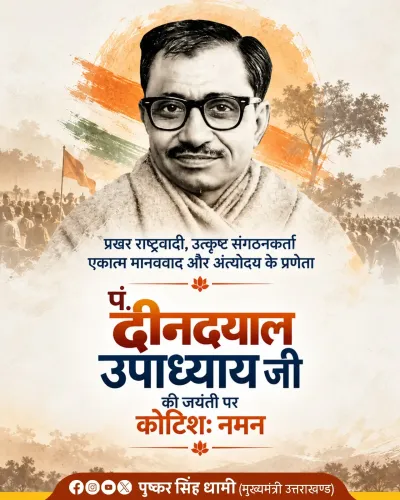
Chief Minister Pushkar Singh Dhami paid tribute to Pandit Deendayal Upadhyay in Khatima on his birth anniversary, invoking the Antyodaya philosophy to reaffirm the Uttarakhand government's commitment to reaching the poorest sections of society through welfare schemes.
Key Takeaways
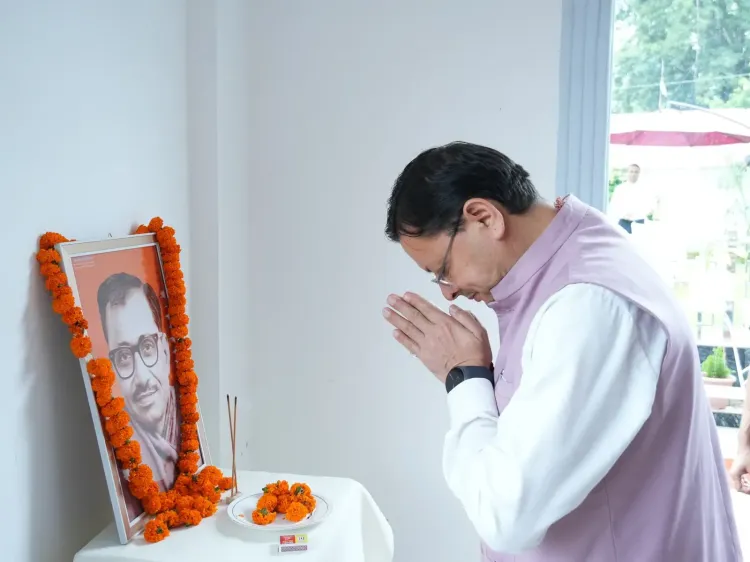
CM Pushkar Singh Dhami garlanded Pandit Deendayal Upadhyay's portrait at Khatima, Udham Singh Nagar on 25 September 2026 , his birth anniversary.
Dhami described Upadhyay's Antyodaya principle as the guiding framework for the Uttarakhand government's welfare approach.
The government committed to delivering development scheme benefits to the poor, farmers, women, and youth — the 'last person in society.' Pandit Deendayal Upadhyay was the ideologue who developed Integral Humanism and Antyodaya , philosophies that continue to shape BJP governance.
The Antyodaya Anna Yojana , launched in 2000 , was directly named after his principle and remains a major central welfare scheme.
No new scheme or allocation was announced; the event reinforced existing policy commitments within an established BJP ceremonial-governance tradition.
On the birth anniversary of one of India's most influential political thinkers, Chief Minister Pushkar Singh Dhami travelled to Khatima, Udham Singh Nagar on Friday, 25 September 2026, to garland the portrait of Pandit Deendayal Upadhyay — and used the occasion to stake the Uttarakhand government's claim to his most enduring idea: that development must begin at the very bottom of society.
The Chief Minister's Office of Uttarakhand shared the tribute on X, quoting Dhami as saying that 'Pandit Deendayal Upadhyay ka jeevan darshan pratyek jansevak ke liye preranasrot hai' — 'Pandit Deendayal Upadhyay's life philosophy is a source of inspiration for every public servant.' He described Upadhyay's Antyodaya principle — the insistence on placing the upliftment of the last person in society at the heart of governance — as a compass that would 'always guide society toward comprehensive and inclusive development.'
The Idea That Outlasted Its Architect
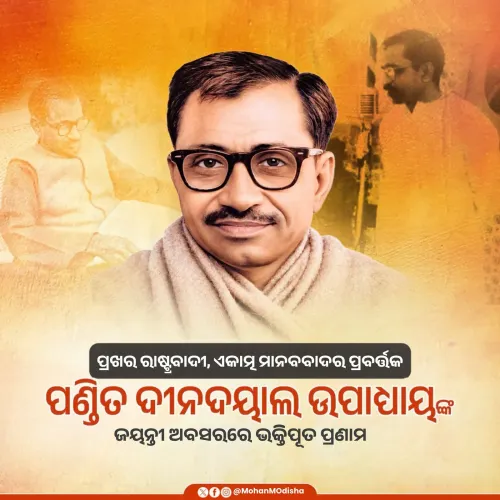
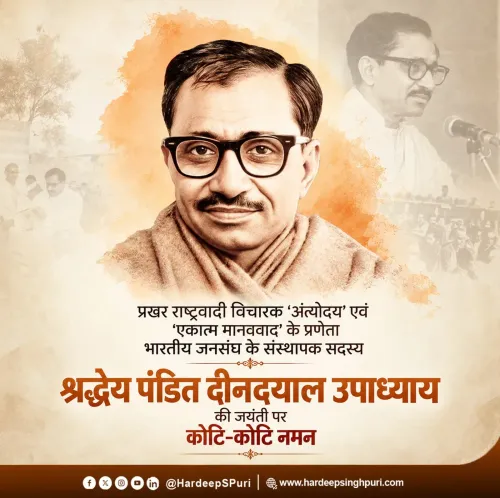
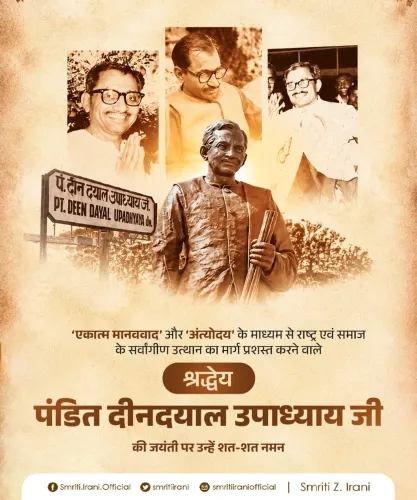
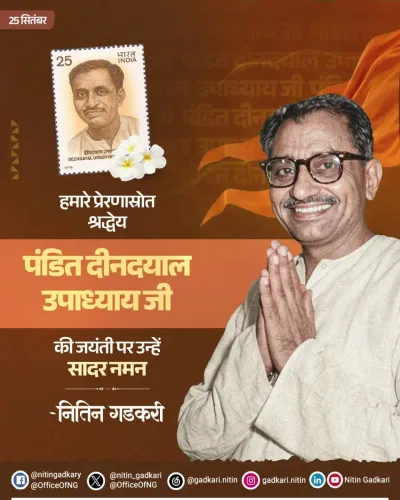
Pandit Deendayal Upadhyay, born on 25 September 1916, was the chief ideologue of the Bharatiya Jana Sangh, the precursor to today's BJP. He built two interlocking frameworks — Integral Humanism (Ekatma Manavvad) and Antyodaya — that rejected both Western capitalism and Soviet-style collectivism in favour of a civilisational model rooted in Indian thought, with the poorest citizen as its moral benchmark. He died in 1968, but his ideas never left the BJP's policy vocabulary.
The most direct institutional expression came in 2000, when the central government launched the Antyodaya Anna Yojana, explicitly named after his philosophy, to deliver heavily subsidised foodgrains to the poorest households in India. Successive BJP administrations at the centre and in the states have continued to invoke his name when framing welfare outreach — turning his birth anniversary into a recurring policy statement rather than a purely ceremonial occasion.
Dhami's Antyodaya Pledge for Uttarakhand
At Khatima, Dhami went beyond ceremonial tribute. He declared that the state government is 'committed to working for the welfare of the poor, farmers, women, youth, and every section of society' by internalising Upadhyay's Antyodaya vision. The government's stated priority, he said, is ensuring that the benefits of development schemes and public welfare programmes 'reach the person standing at the last end of society.'
The event drew local administration and elected representatives, giving the tribute a formal, institutional character. Khatima — a constituency in the Terai belt of Udham Singh Nagar — holds personal significance for Dhami, who has strong political roots in the region, making the choice of venue deliberate rather than incidental.
No new scheme or budget allocation was announced at the event. The occasion follows a well-established BJP-governance pattern: anchor welfare intent in Upadhyay's moral framework, reinforce existing programme commitments, and signal that the party's ideological and administrative identities are one. The next real test of that pledge will come in how Uttarakhand's budget allocations translate Antyodaya language into specific targets for its most marginalised households — and whether the 'last person' rhetoric moves the needle on the state's poverty and welfare indices.
Point of View
Holding the event in Khatima, his home political territory, reinforces both personal roots and the state's welfare narrative ahead of future electoral cycles. The Antyodaya frame is politically durable precisely because it is measurable only in the long run, allowing governments to claim alignment with it while deferring concrete accountability. The real scrutiny will land when Uttarakhand's budget cycle tests whether 'last person' rhetoric translates into targeted, verifiable allocations.
NationPress
25 Sept 2026
Frequently Asked Questions
Who was Pandit Deendayal Upadhyay and why is he remembered?
Pandit Deendayal Upadhyay was born on 25 September 1916 and was the chief ideologue of the Bharatiya Jana Sangh. He is remembered for developing Integral Humanism and the Antyodaya principle, which places the welfare of the poorest person at the centre of governance and development.
What is the Antyodaya principle?
Antyodaya is a development philosophy coined by Deendayal Upadhyay that holds the upliftment of the last and most marginalised person in society as the true measure of progress. It has inspired welfare schemes like the Antyodaya Anna Yojana launched in 2000.
Why did CM Dhami go to Khatima for this tribute?
Khatima is a town in Udham Singh Nagar district of Uttarakhand and holds strong political significance for Chief Minister Pushkar Singh Dhami, who has deep roots in the region. The annual tribute event was held there on Upadhyay's birth anniversary.
What did CM Dhami announce at the Deendayal Upadhyay birth anniversary event?
CM Dhami did not announce any new scheme at the event. He reaffirmed the Uttarakhand government's commitment to ensuring welfare scheme benefits reach the poor, farmers, women, and youth — framing this as the state's practical application of the Antyodaya philosophy.
What is the Antyodaya Anna Yojana?
The Antyodaya Anna Yojana is a central government scheme launched in 2000 that provides heavily subsidised foodgrains to the poorest households in India. It was explicitly named after Pandit Deendayal Upadhyay's Antyodaya principle.