CM Dhami pays tribute to Nobel laureate Dr. C.V. Raman on birth anniversary
Synopsis
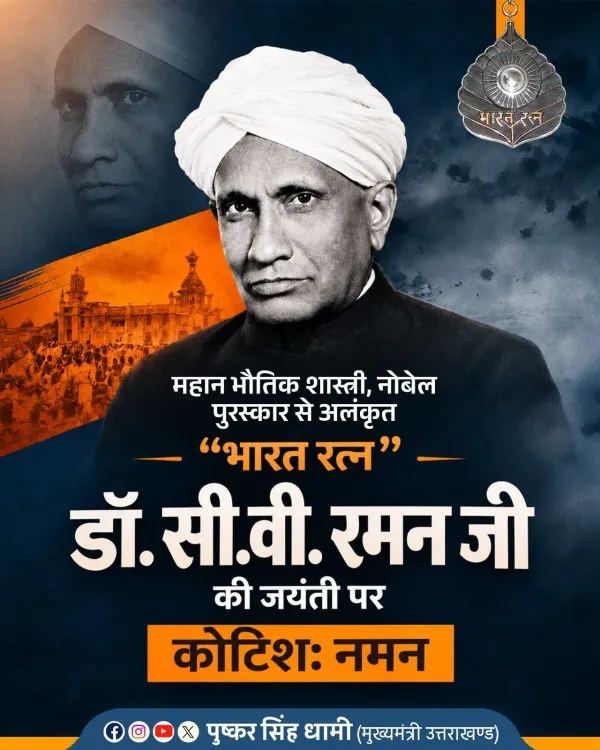
Uttarakhand Chief Minister Pushkar Singh Dhami saluted Nobel laureate and Bharat Ratna Dr. C.V. Raman on his birth anniversary, calling the physicist's life rooted in knowledge, research and innovation an enduring source of national inspiration.
Key Takeaways
CM Pushkar Singh Dhami posted a tribute to Dr.
Raman on his birth anniversary, 7 November 2026 .
Raman was born on 7 November 1888 in Tiruchirapalli, Tamil Nadu.
He won the Nobel Prize in Physics in 1930 for the discovery of the Raman Effect , becoming the first Asian to win a science Nobel.
He was awarded the Bharat Ratna in 1954 , India's highest civilian honour.
His discovery date, 28 February 1928 , is observed as National Science Day in India.
Dhami described Raman's life as 'full of knowledge, research and innovation' and a source of inspiration for all Indians.
A scientist who bent light and changed physics forever turns 137 this Saturday — and Uttarakhand Chief Minister Pushkar Singh Dhami marked the occasion with a heartfelt tribute to Nobel laureate Dr. C.V. Raman, saluting the physicist as a pioneer of modern Indian science.
Posting on 7 November 2026, CM Dhami wrote in Hindi: 'महान वैज्ञानिक और आधुनिक भारतीय विज्ञान के अग्रदूत नोबेल पुरस्कार से अलंकृत भारत रत्न डॉ. सी.वी. रमन जी की जयंती पर कोटिशः नमन' — 'Countless salutes on the birth anniversary of the great scientist and pioneer of modern Indian science, Nobel Prize-winning Bharat Ratna Dr. C.V. Raman.' He called Raman's life, 'full of knowledge, research and innovation,' a source of inspiration for all.
The discovery that made India's name in physics
Dr. Chandrasekhara Venkata Raman was born on 7 November 1888 in Tiruchirapalli, Tamil Nadu. His landmark discovery — the Raman Effect, which describes how light scatters when it passes through a transparent medium — earned him the Nobel Prize in Physics in 1930, making him the first Asian and first non-white scientist to win a science Nobel. The discovery was made on 28 February 1928, a date India now observes as National Science Day.
In 1954, the Government of India awarded Raman the Bharat Ratna, the country's highest civilian honour, cementing his place alongside the founders of the modern Indian state. He also established the Indian Academy of Sciences in Bangalore and spent decades building the institutional scaffolding that Indian physics still rests on.
A tradition of remembering India's scientific giants
CM Dhami's tribute follows a well-established pattern: every 7 November, political leaders across the spectrum — from state capitals to Raisina Hill — pause to honour Raman's legacy on social media. It is a small but consistent ritual that keeps the scientist's name alive in public discourse, particularly for younger audiences scrolling through their feeds.
The gesture carries quiet weight at a time when India is investing heavily in science and research infrastructure, positioning Raman not merely as a historical figure but as a benchmark for homegrown excellence. A man who did world-changing physics with modest equipment in Calcutta is a powerful argument for what ambition and rigour can produce — with or without the resources of the West. That story does not age.
Point of View
Invoking Raman — a figure above partisan contest — offers a moment of soft nation-building that links state leadership to a pan-Indian pride in indigenous intellectual achievement. The ritual also arrives in a broader context where India's science and technology ambitions are on the global radar, making Raman's story of world-class discovery with limited resources a rhetorically useful frame. It is ceremonial, but ceremonial choices are rarely accidental.
NationPress
7 Nov 2026
Frequently Asked Questions
When is C.V. Raman's birth anniversary?
Dr. C.V. Raman was born on 7 November 1888 , and his birth anniversary is observed on 7 November every year.
What did C.V. Raman win the Nobel Prize for?
Dr. C.V. Raman won the Nobel Prize in Physics in 1930 for the discovery of the Raman Effect, which describes the scattering of light as it passes through a transparent material.
Was C.V. Raman awarded the Bharat Ratna?
Yes. The Government of India conferred the Bharat Ratna , the country's highest civilian honour, on Dr. C.V. Raman in 1954 .
Why is 28 February celebrated as National Science Day in India?
National Science Day is observed on 28 February to commemorate Dr. C.V. Raman's announcement of the Raman Effect on that date in 1928 .
What did Uttarakhand CM Dhami say about CV Raman?
CM Pushkar Singh Dhami described Dr. Raman as a 'great scientist and pioneer of modern Indian science' and said his life, full of knowledge, research and innovation, is a source of inspiration for all.