CM Dhami Pushes Master Plan for Mahasu Temple Hanol
Synopsis
Uttarakhand CM Pushkar Singh Dhami has announced that Mahasu Temple Hanol in the Jaunsar-Bawar region is being developed under a master plan, combining heritage conservation with modern pilgrim facilities — continuing a state-wide policy of planned religious-site redevelopment.
Key Takeaways
CM Pushkar Singh Dhami announced on 23 June 2026 that Mahasu Temple Hanol is being developed under a master plan.
The temple, dedicated to Mahasu Devta , is one of the most significant pilgrimage centres in the Jaunsar-Bawar tribal belt of Uttarakhand.
The development aims to preserve the temple's cultural and spiritual heritage while adding modern pilgrim amenities.
The master-plan model for Uttarakhand temples was institutionalised after the 2013 Kedarnath floods and has since been extended to regional shrines.
The national PRASAD scheme (2014-15) provides a policy framework for such pilgrimage-site development across India, including in Uttarakhand.
Key stakeholders include pilgrims, Jaunsar communities , local traders, and heritage conservation groups.
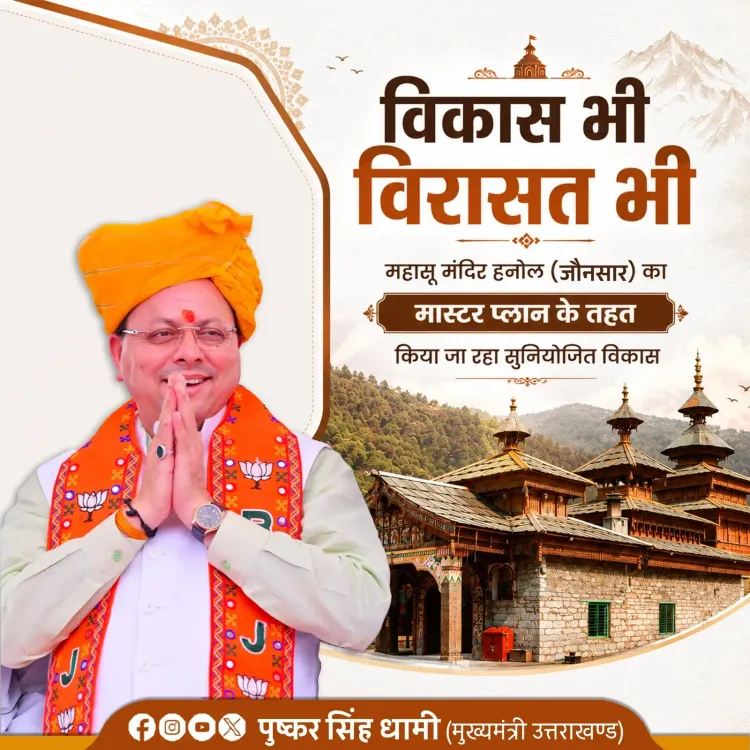
Uttarakhand Chief Minister Pushkar Singh Dhami on Tuesday, 23 June 2026, reaffirmed his government's commitment to developing the state's religious heritage sites by highlighting the ongoing master-plan-driven redevelopment of Mahasu Temple Hanol, one of the most revered pilgrimage centres in the Jaunsar-Bawar region.
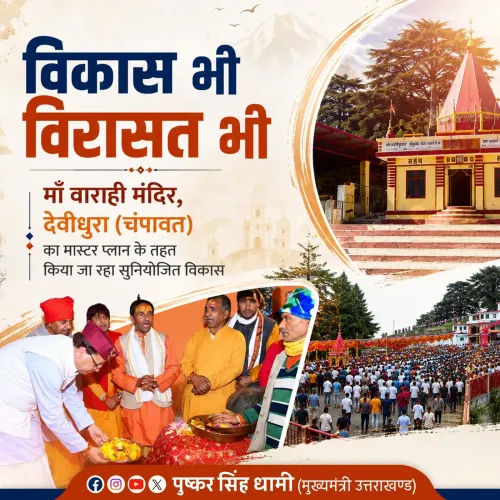
Posting in Hindi on X, CM Dhami wrote: 'देवभूमि उत्तराखंड की समृद्ध सांस्कृतिक और आध्यात्मिक धरोहरों को संरक्षित करते हुए उन्हें आधुनिक सुविधाओं से जोड़ने का कार्य निरंतर आगे बढ़ रहा है।' ('The work of preserving the rich cultural and spiritual heritage of Devbhoomi Uttarakhand while connecting it with modern facilities is continuously moving forward.') He added that Mahasu Temple Hanol, a principal centre of faith, is being developed in a planned manner under a master plan.
Context
Mahasu Temple, located in Hanol village in the Dehradun district of Uttarakhand, is dedicated to Mahasu Devta — a deity worshipped across the Jaunsar-Bawar tribal belt. The temple is considered one of the oldest and most architecturally significant shrines in the western Himalayan region, attracting pilgrims from Uttarakhand, Himachal Pradesh, and beyond. Uttarakhand is officially recognised as Devbhoomi — 'Land of Gods' — owing to its extraordinary density of Hindu temples and spiritual sites.
Policy Backdrop
The master-plan approach to temple development in Uttarakhand gained institutional momentum after the 2013 Kedarnath floods, when large-scale reconstruction of the Kedarnath complex introduced a model combining heritage conservation with modern pilgrim infrastructure. Since then, successive state administrations have extended similar frameworks to both major and smaller regional shrines across hill districts. At the national level, the PRASAD scheme — launched in 2014-15 by the Ministry of Tourism — provides a policy scaffold for integrated development of pilgrimage sites, including several locations in Uttarakhand, focusing on access roads, sanitation, accommodation and visitor management.
The Dhami government has continued and accelerated this pattern, framing temple redevelopment as a dual-purpose investment: preserving traditional architecture and rituals while boosting religious tourism, which is a significant economic driver for hill communities in the state.
Stakeholders and Impact
The primary beneficiaries of the Mahasu Temple Hanol master plan are pilgrims who travel to the remote Jaunsar-Bawar belt, often navigating difficult mountain terrain with limited facilities. Local Jaunsar communities, for whom Mahasu Devta holds deep cultural and social significance beyond formal religion, stand to gain from improved access infrastructure and the economic activity that increased footfall generates. Artisans, priests, and small traders dependent on the temple economy are also key stakeholders.
Environmental and heritage conservation groups will watch closely to ensure that modernisation does not compromise the temple's ancient architectural character — a tension that has surfaced at other Uttarakhand redevelopment sites in the past.
What's Next
The immediate milestones to watch include the release of detailed project tenders, confirmation of funding allocations, and the commencement of construction or restoration phases under the Mahasu Temple Hanol master plan. If the project proceeds on schedule, it could serve as a template for extending similar planned development to other lesser-known but culturally significant shrines across Uttarakhand's hill districts. CM Dhami's public communication signals that the state government intends to keep religious heritage development prominent on its political and administrative agenda ahead of upcoming electoral cycles.
Point of View
The government signals that its temple-development ambitions reach beyond marquee sites such as Kedarnath and Badrinath into the tribal Jaunsar-Bawar belt, potentially broadening its political base. This also aligns with the national PRASAD scheme's logic of converting pilgrimage infrastructure into a vehicle for rural economic development. The real test will be in implementation: whether tenders are issued, budgets released, and construction begun without compromising the temple's ancient architectural integrity.
NationPress
22 Sept 2026
Frequently Asked Questions
What is the Mahasu Temple Hanol master plan?
The Mahasu Temple Hanol master plan is a government-approved development framework aimed at upgrading pilgrim infrastructure at the ancient Mahasu Devta temple in Hanol village, Uttarakhand, while preserving its cultural and architectural heritage. Specific components and budget details have not yet been officially disclosed.
Where is Mahasu Temple Hanol located?
Mahasu Temple Hanol is located in Hanol village in the Jaunsar-Bawar region of Dehradun district , Uttarakhand. It is dedicated to Mahasu Devta and is one of the oldest temples in the western Himalayan belt.
What is the PRASAD scheme and does it apply to Uttarakhand temples?
The PRASAD (Pilgrimage Rejuvenation and Spiritual, Heritage Augmentation Drive) scheme was launched in 2014-15 by the Ministry of Tourism for integrated development of pilgrimage sites across India. Several locations in Uttarakhand fall under its ambit, making it a relevant funding and policy framework for temple redevelopment in the state.
Why is Uttarakhand called Devbhoomi?
Uttarakhand is called Devbhoomi , meaning 'Land of Gods', because of its exceptionally high concentration of Hindu temples, shrines, and sacred rivers, including Char Dham sites such as Kedarnath, Badrinath, Gangotri and Yamunotri.
What has CM Dhami said about Uttarakhand temple development?
CM Pushkar Singh Dhami has consistently emphasised preserving Uttarakhand's cultural and spiritual heritage while modernising facilities for pilgrims. His 23 June 2026 post specifically highlighted the master-plan-based development of Mahasu Temple Hanol as part of this ongoing effort.