CM Dhami Vows to Lift Uttarakhand in Tourism, Yoga, Health
Synopsis
Chief Minister Pushkar Singh Dhami, through the official CMO handle on 24 July 2026, reaffirmed the Uttarakhand government's commitment to advancing tourism, pilgrimage, yoga, wellness, sports, education, and health — the seven pillars of the state's development agenda.
Key Takeaways
CM Pushkar Singh Dhami stated on 24 July 2026 that the Uttarakhand government is continuously working across seven sectors : tourism, pilgrimage, yoga, wellness, sports, education, and health.
Uttarakhand , formed in 2000 , has historically anchored its economy on tourism and pilgrimage given geographic limits on industrialisation.
The state hosts the International Yoga Festival in Rishikesh annually, a flagship initiative positioning it as a global wellness hub.
AYUSH infrastructure and sports facilities have been integrated into hill development plans since 2010 .
Ongoing Char Dham connectivity projects remain a key plank of the state's pilgrimage-linked infrastructure agenda.
The statement signals policy continuity under the BJP-led government, which has held power in the state since 2017 .
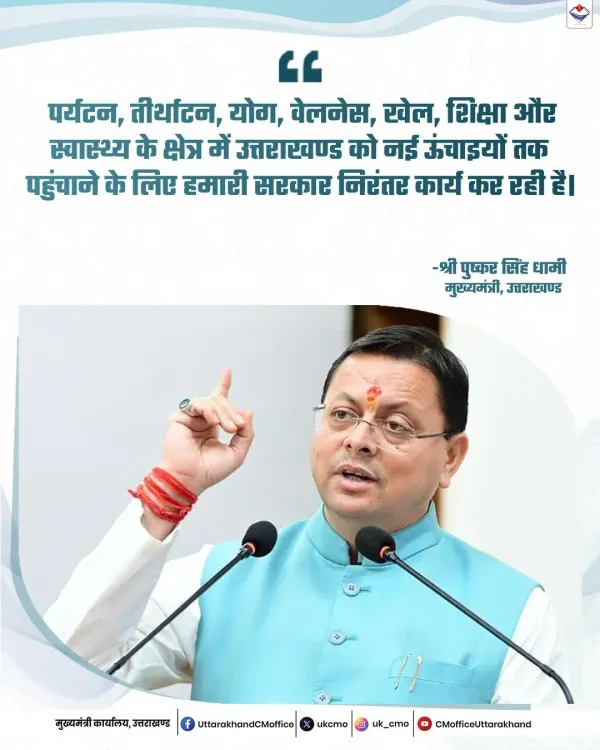
The Chief Minister's Office of Uttarakhand, on behalf of Chief Minister Pushkar Singh Dhami, reaffirmed on Friday, 24 July 2026 that the state government is continuously working to take Uttarakhand to new heights across tourism, pilgrimage, yoga, wellness, sports, education, and health.
Context
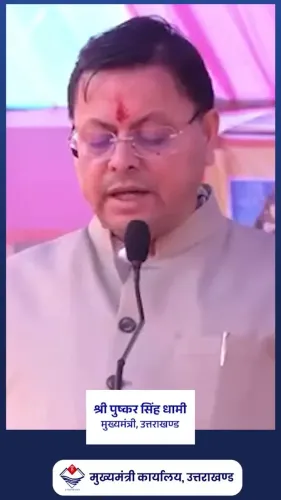
The statement, shared via the official CMO handle, quotes CM Dhami directly: 'paryatan, tirthaatan, yoga, wellness, khel, shiksha aur swasthya ke kshetra mein Uttarakhand ko nayi unchaaiyon tak pahunchane ke liye hamari sarkar nirantar karya kar rahi hai' — ('Our government is continuously working to take Uttarakhand to new heights in the fields of tourism, pilgrimage, yoga, wellness, sports, education, and health.'). The post signals the government's stated multi-sector development agenda for the hill state.
Uttarakhand, carved out as a separate state in 2000, has long anchored its economy around its Himalayan geography, sacred pilgrimage circuits, and natural assets. The seven sectors named by CM Dhami reflect a broad framing of the state's growth identity.
Policy Backdrop
Since statehood, successive Uttarakhand governments have identified tourism and pilgrimage as primary economic drivers, formalising this through dedicated development policies. The state hosts the International Yoga Festival in Rishikesh annually — a flagship event that has positioned the city as a global wellness destination since the early 2000s.
Post-2010, hill development plans began integrating AYUSH infrastructure and sports facilities alongside traditional tourism investment. The BJP-led government, in power in the state since 2017, has consistently aligned this multi-sector framing with national priorities around yoga, traditional medicine, and sustainable tourism as economic and soft-power levers.
Ongoing Char Dham connectivity projects — including road widening and all-weather access — remain a central plank of the state's pilgrimage-linked infrastructure push, with budget allocations under close watch by the sector.
Stakeholders and Impact
The sectors cited by CM Dhami touch a wide cross-section of the state's population and economy. Tourism and pilgrimage workers, yoga practitioners, wellness entrepreneurs, students, and healthcare workers all stand as direct stakeholders in the government's stated agenda.
Uttarakhand's geographic constraints limit large-scale industrialisation, making service-led sectors such as wellness tourism and education infrastructure especially significant for employment and revenue generation. Statements from the CMO on these themes typically signal policy continuity and intent rather than the launch of specific new schemes.
What's Next
Observers will look to the state's upcoming budget allocations for concrete numbers behind the government's stated priorities in tourism and health infrastructure. Rollout timelines for Char Dham-related connectivity upgrades and the next edition of the International Yoga Festival in Rishikesh will serve as near-term indicators of how the government translates this agenda into action.
For a state whose economic identity is inseparable from its Himalayan and spiritual heritage, the sustained political emphasis on these seven sectors underscores that Uttarakhand's development model will continue to be built around its natural and cultural strengths rather than conventional industrial growth.
Point of View
One that successive governments have employed to offset the state's industrial limitations with service-led growth. The explicit bundling of yoga, wellness, and pilgrimage alongside education and health reflects a BJP-era emphasis on cultural economy as a legitimate development model, mirroring New Delhi's own soft-power playbook. The statement signals continuity ahead of what will likely be a budget cycle where tourism and connectivity allocations face scrutiny. Without specific scheme launches or budget figures, the announcement functions as a political positioning marker rather than a policy inflection point.
NationPress
22 Oct 2026
Frequently Asked Questions
What sectors did CM Dhami say the Uttarakhand government is focusing on?
CM Pushkar Singh Dhami stated the government is working to advance seven sectors : tourism, pilgrimage, yoga, wellness, sports, education, and health.
What is Uttarakhand's main economic base?
Uttarakhand's economy is primarily anchored in tourism and pilgrimage, supported by its Himalayan geography and sacred sites such as the Char Dham circuit, given geographic constraints on large-scale industrialisation.
What is the International Yoga Festival in Rishikesh?
The International Yoga Festival is an annual event held in Rishikesh , Uttarakhand, that has positioned the city as a global wellness destination since the early 2000s.
When did Uttarakhand become a separate state?
Uttarakhand was carved out as a separate state in 2000 .
Who is the current Chief Minister of Uttarakhand?
Pushkar Singh Dhami is the Chief Minister of Uttarakhand, a post he has held since 2021 .