CM Dhami Pays Tribute to Himalayan Explorer Nain Singh Rawat
Synopsis
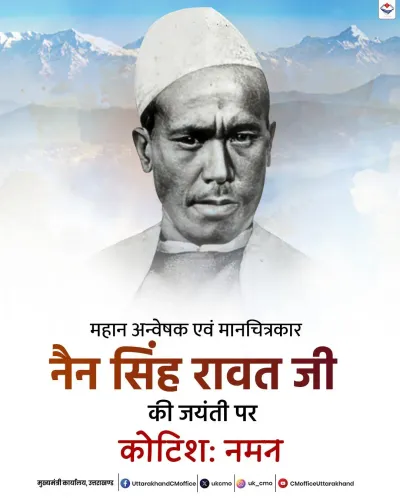
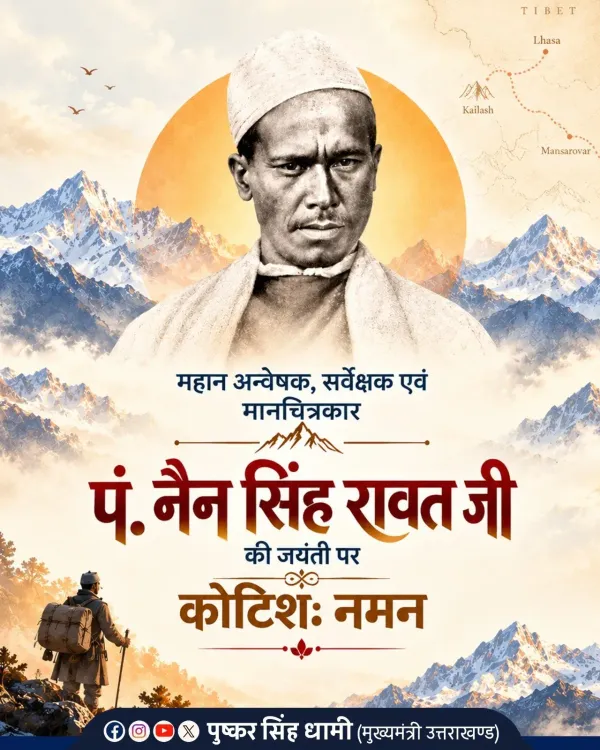
Uttarakhand CM Pushkar Singh Dhami honoured Pandit Nain Singh Rawat on his birth anniversary, saluting the 19th-century explorer and surveyor whose secret Himalayan and Tibetan expeditions for the Survey of India produced the first accurate maps of Lhasa and the Tsangpo River.
Key Takeaways
CM Pushkar Singh Dhami paid tribute to Pandit Nain Singh Rawat on his birth anniversary on October 21, 2026 .
Rawat was a 19th-century explorer from the Kumaon region of Uttarakhand , recruited by the Survey of India as a 'pundit' — an Indian explorer trained to survey closed territories in disguise.
He conducted clandestine expeditions into Tibet , producing the first accurate survey of Lhasa and tracing the course of the Tsangpo River .
The Royal Geographical Society awarded him its gold medal in 1877 for his extraordinary contributions to geographical knowledge.
Dhami called Rawat's achievements 'unparalleled' and an 'eternal source of inspiration', reflecting Uttarakhand's ongoing efforts to highlight indigenous Himalayan explorers.
Before satellite imagery and GPS, one man walked the roof of the world with a prayer wheel that secretly counted his steps — and mapped it all. On the birth anniversary of Pandit Nain Singh Rawat, Uttarakhand Chief Minister Pushkar Singh Dhami offered tribute to the legendary 19th-century surveyor, cartographer, and explorer whose clandestine journeys across the Himalayas and into Tibet shaped the geographical knowledge of an entire subcontinent.
Taking to X on Wednesday, October 21, 2026, CM Dhami wrote in Hindi, paying 'countless salutations' (kotishaḥ naman) to the great explorer on his birth anniversary, calling his achievements 'unparalleled' and his contributions 'an eternal source of inspiration for all of us.'
The Pundit Who Walked Tibet in Disguise
Pandit Nain Singh Rawat was born in the Kumaon region of what is today Uttarakhand. Recruited by the Survey of India in the 1860s, he became one of the most celebrated 'pundits' — a cadre of Indian explorer-spies trained to penetrate territories closed to British officers. His tool was ingenuity: a modified Buddhist prayer wheel with a strip of paper inside for noting data, and a rosary with fewer beads than standard to count his paces as distance measurements.
His most consequential expedition, conducted largely in disguise as a Buddhist pilgrim, traced the course of the Tsangpo River through Tibet and produced the first accurate survey of Lhasa — a city Europeans had barely glimpsed. He walked thousands of miles across high-altitude terrain under conditions that would defeat most trained soldiers, all while concealing his instruments from Tibetan authorities who would have arrested or executed him.
A Kumaoni Son the World Eventually Recognised
The Royal Geographical Society in London awarded Rawat its prestigious gold medal in 1877, one of the highest honours in the world of exploration at the time — a remarkable recognition for an Indian surveyor working deep within colonial structures. Yet for generations, his name remained far less celebrated at home than those of the European officers who commanded his missions.
Uttarakhand's state leadership has periodically sought to correct that imbalance. Public tributes by figures like CM Dhami form part of a broader regional effort to restore indigenous explorers to the centre of the Himalayan mapping story — a story that directly concerns the border landscapes Uttarakhand shares with Tibet and Nepal today.
A man who counted his steps to chart an empire's frontier deserves to be measured by more than a footnote. Dhami's tribute is a reminder that the most consequential journeys in history are not always the loudest ones.
Point of View
The Chief Minister signals both cultural pride and an implicit link between 19th-century indigenous geographical knowledge and contemporary border awareness. The tribute also reflects a wider national effort to centre Indian contributors within colonial-era scientific enterprises that were long told exclusively through British eyes. The question going forward is whether such commemorations translate into sustained educational and institutional investment in Himalayan heritage.
NationPress
21 Oct 2026
Frequently Asked Questions
Who was Pandit Nain Singh Rawat?
Pandit Nain Singh Rawat was a 19th-century explorer, surveyor, and cartographer from the Kumaon region of present-day Uttarakhand. He was recruited by the Survey of India as a 'pundit' — a trained indigenous explorer who conducted secret surveys of the Himalayas and Tibet, producing the first accurate maps of Lhasa and the Tsangpo River.
Why is Nain Singh Rawat famous?
Nain Singh Rawat is famous for his clandestine expeditions into Tibet, conducted in disguise as a Buddhist pilgrim. He used a modified prayer wheel and a custom rosary to secretly record distances and survey data, producing invaluable geographical intelligence at great personal risk. The Royal Geographical Society awarded him its gold medal in 1877.
What did CM Dhami say about Nain Singh Rawat?
Uttarakhand Chief Minister Pushkar Singh Dhami posted on X calling Rawat an 'unparalleled' explorer and saying his achievements and contributions are 'an eternal source of inspiration for all of us.' He paid tribute on the occasion of Rawat's birth anniversary.
What was the 'pundit' method used by Nain Singh Rawat?
The 'pundit' method involved Indian explorers trained by the Survey of India to survey territories closed to British officers. They used disguised instruments — prayer wheels to store notes, custom rosaries to count paces as distance measurements — and travelled as pilgrims or traders to avoid detection.
What award did Nain Singh Rawat receive from the Royal Geographical Society?
The Royal Geographical Society in London awarded Nain Singh Rawat its prestigious gold medal in 1877, recognising his extraordinary contributions to the geographical knowledge of the Himalayan and Tibetan regions.