CM Dhami pays tribute to Mahavir Chakra hero Jaswant Singh Rawat
Synopsis
Uttarakhand CM Pushkar Singh Dhami on 19 August 2026 honoured Rifleman Jaswant Singh Rawat — posthumous Mahavir Chakra recipient for his lone stand at Nuranang in the 1962 India-China War — calling his bravery an eternal inspiration for national service.
Key Takeaways
Uttarakhand CM Pushkar Singh Dhami paid tribute to Rifleman Jaswant Singh Rawat on his birth anniversary on 19 August 2026 .
Rawat served with the 4th Garhwal Rifles and fought in the 1962 Sino-Indian War at Nuranang, Arunachal Pradesh .
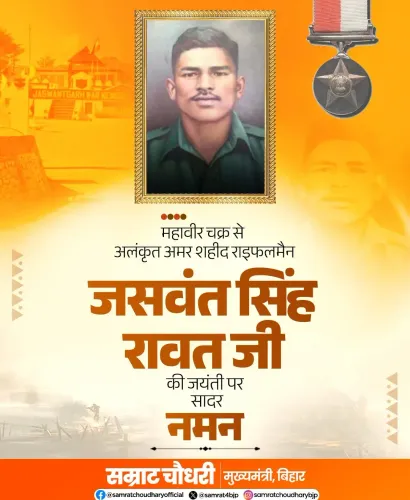
He was awarded the Mahavir Chakra — India's second-highest wartime gallantry award — posthumously for his extraordinary bravery.
The 1962 India-China War lasted from October to November 1962 and fundamentally shaped India's border and military strategy.
A memorial to Rawat stands at Nuranang , maintained by the Indian Army, reflecting the enduring reverence for his sacrifice.
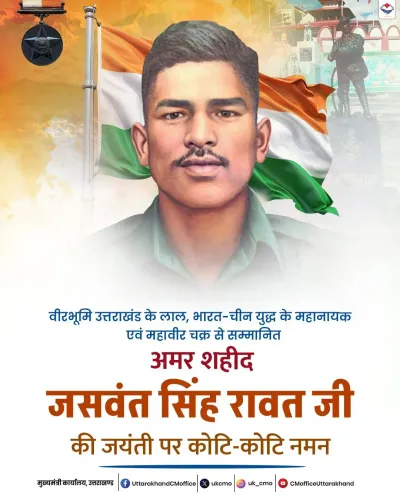
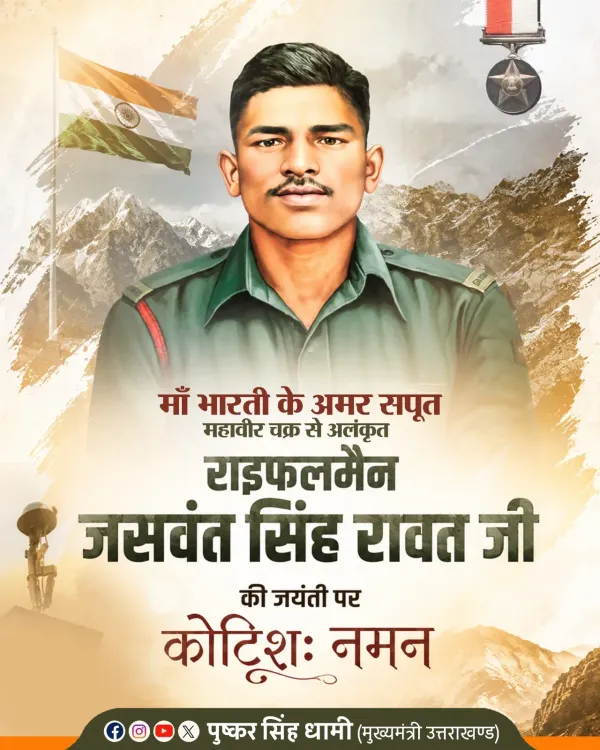
On the birth anniversary of Rifleman Jaswant Singh Rawat, one of the most celebrated martyrs of the 1962 Sino-Indian War, Uttarakhand Chief Minister Pushkar Singh Dhami offered his deepest respects on Wednesday, 19 August 2026, honouring a soldier whose lone stand in the mountains of Arunachal Pradesh passed into legend.
Posting in Hindi, CM Dhami wrote: '1962 ke Bharat-China yuddh mein adamya shaurya evam sahas ke parichayak...' — saluting Rawat as a symbol of 'indomitable valour and courage' in the 1962 India-China War, decorated with the Mahavir Chakra, and pledging that 'your saga of bravery will always inspire us toward service to the nation.'
The stand at Nuranang that India did not forget
Rifleman Jaswant Singh Rawat served with the 4th Garhwal Rifles during the brief but devastating border conflict fought between October and November 1962. At Nuranang in present-day Arunachal Pradesh, he held off advancing Chinese forces almost single-handedly, a feat of gallantry that earned him the Mahavir Chakra — India's second-highest wartime gallantry award, instituted in 1950 and conferred for conspicuous bravery in the presence of the enemy. He did not survive the battle. The honour came posthumously.
The 1962 war remains one of independent India's most consequential military episodes — a conflict that reshaped the country's strategic outlook, accelerated military modernisation, and left an enduring imprint on how India approaches its northern borders. Soldiers like Rawat, drawn from the hill communities of what is today Uttarakhand, bore a disproportionate share of that burden.
Garhwali soldiers and the weight of memory
Uttarakhand — a state with one of the highest per-capita military enlistment rates in India — has a particularly intimate relationship with the 1962 war. The Garhwal Rifles, one of the Indian Army's most decorated regiments, recruited heavily from these hills. For communities here, tributes to Rawat are not ceremonial abstractions; they are personal.
CM Dhami, who regularly issues public tributes to military figures from the state, has made the honouring of Uttarakhand's soldier heritage a consistent thread in his public communication. State-level leaders in border states have increasingly used social media to foreground 1962 war heroes, reinforcing narratives of sacrifice and territorial integrity at a time when India-China boundary negotiations remain an active diplomatic file.
The soldier's legacy endures not just in citations but in stone: a memorial to Jaswant Singh Rawat stands at Nuranang, tended by the Indian Army, a rare honour for a rifleman of his rank — a testament to how deeply his story is held.
Point of View
State leadership also keeps pressure on the Centre to advance ex-servicemen welfare and memorial upkeep — a constituency priority in hill-state politics.
NationPress
3 Oct 2026
Frequently Asked Questions
Who was Rifleman Jaswant Singh Rawat?
Rifleman Jaswant Singh Rawat was a soldier of the 4th Garhwal Rifles who displayed exceptional bravery at Nuranang in Arunachal Pradesh during the 1962 India-China War, holding off advancing Chinese forces almost alone. He was awarded the Mahavir Chakra posthumously, India's second-highest wartime gallantry honour.
What is the Mahavir Chakra?
The Mahavir Chakra is India's second-highest wartime gallantry award, instituted in 1950. It is conferred for acts of conspicuous bravery in the presence of the enemy and can be awarded posthumously.
What happened at the Battle of Nuranang in 1962?
During the 1962 Sino-Indian War, Rifleman Jaswant Singh Rawat of the 4th Garhwal Rifles made a legendary last stand at Nuranang in present-day Arunachal Pradesh, fighting off Chinese forces largely on his own before being killed in action. A memorial to him stands at the site, maintained by the Indian Army.
Why does CM Dhami frequently tribute military figures?
Uttarakhand has one of India's highest per-capita military enlistment rates and is home to storied regiments like the Garhwal Rifles. Chief Minister Pushkar Singh Dhami regularly honours soldiers from the state, reflecting both the region's deep military heritage and the political importance of the ex-servicemen community.
What was the 1962 India-China War?
The 1962 Sino-Indian War was a brief but intense border conflict fought between India and China from October to November 1962. China made significant advances in Ladakh and Arunachal Pradesh before declaring a unilateral ceasefire. The war fundamentally altered India's strategic and military posture.