CM Dhami calls for polio-free India on World Polio Day
Synopsis
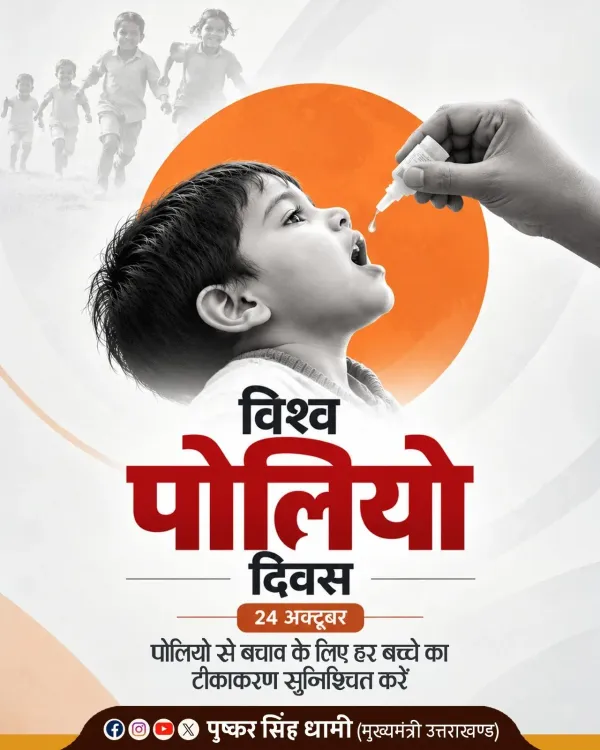
On World Polio Day, 24 October 2026, Uttarakhand CM Pushkar Singh Dhami called on citizens to renew their commitment to polio eradication and ensure every child under five receives the oral polio vaccine on time, safeguarding India's polio-free status held since 2014.
Key Takeaways
World Polio Day is observed annually on 24 October to drive awareness of global polio eradication efforts.
India was declared polio-free by WHO in 2014 after the last wild poliovirus case was recorded in 2011 .
CM Pushkar Singh Dhami urged every parent to ensure children receive the oral polio vaccine dose on time.
The Pulse Polio Immunisation Programme remains India's primary tool for sustaining zero-transmission status among children under five.
Uttarakhand's border geography with Nepal and China makes supplementary immunisation rounds especially critical for surveillance.
Global eradication efforts led by WHO, UNICEF , and Rotary International continue, with wild poliovirus still circulating in neighbouring regions.
On World Polio Day, 24 October 2026, Uttarakhand Chief Minister Pushkar Singh Dhami renewed his call for citizens to protect every child from polio and to sustain the hard-won gains that earned India a polio-free certificate from the World Health Organization more than a decade ago.
Posting in Hindi on X, CM Dhami urged: 'हर बच्चे को समय पर इसकी खुराक अवश्य पिलाएं' — 'Make sure every child receives the vaccine dose on time.' The message framed the occasion not merely as a commemoration, but as an active pledge to keep the virus at bay.Twelve years of polio-free status — and the work it takes to keep it
India's journey to this milestone was anything but swift. After decades of struggle, the country recorded its last wild poliovirus case in 2011, and the WHO formally declared India polio-free in March 2014 — one of the most celebrated public-health reversals in modern history. The engine behind that achievement was the Pulse Polio Immunisation Programme, a national drive that mobilises health workers every year to administer the oral polio vaccine to children under the age of five. Keeping that status requires vigilance, not just celebration.Why border and high-risk zones still demand attention
Maintaining zero transmission is a continuous, logistically demanding effort. State governments, including Uttarakhand — which shares international borders with Nepal and China — run supplementary immunisation rounds to reach migrant populations and remote communities where routine coverage can slip. The global eradication effort, coordinated by the WHO, UNICEF, and Rotary International, still tracks wild poliovirus in parts of Afghanistan and Pakistan, making cross-border surveillance a live concern for Indian health authorities.A chief minister's reminder that counts
When a sitting chief minister uses a high-visibility day like World Polio Day to address parents and caregivers directly, the message carries institutional weight — it signals that state machinery is aligned behind the programme. CM Dhami's post follows a pattern seen across BJP-governed states of amplifying central health campaigns through elected leadership, reinforcing the Pulse Polio drive at the grassroots level where the last-mile delivery happens.India defeated polio once through relentless, door-to-door commitment — and the only way to stay ahead of the virus is to make sure not a single child is missed on the next round.
Point of View
Echoing the communication architecture of campaigns like Mission Indradhanush. For Uttarakhand specifically, the message carries operational subtext: a border state with mobile populations faces genuine last-mile challenges that institutional reminders help address. The real test, as always, will be whether the political signal translates into measurable coverage in the state's harder-to-reach communities.
NationPress
24 Oct 2026
Frequently Asked Questions
When is World Polio Day observed and why?
World Polio Day is observed every year on 24 October to raise awareness about global polio eradication efforts and to encourage vaccination. The date was chosen by Rotary International to mark the birth anniversary of Jonas Salk, who developed the first effective polio vaccine.
Is India officially polio-free?
Yes. India was declared polio-free by the World Health Organization in March 2014 , after recording no new wild poliovirus case since 2011 . The country has sustained this status through continued immunisation rounds.
What is the Pulse Polio Immunisation Programme?
The Pulse Polio Immunisation Programme is India's national drive to administer oral polio vaccine to all children under the age of five. Conducted in annual or biannual rounds, it is the cornerstone of India's effort to maintain its polio-free status.
What did Uttarakhand CM Dhami say on World Polio Day 2026?
CM Pushkar Singh Dhami posted on X urging citizens to renew their commitment to a polio-free society and to ensure every child receives the polio vaccine dose on time, calling it a collective responsibility.
Why is polio vaccination still important if India is already polio-free?
Maintaining polio-free status requires continuous vaccination because the wild poliovirus still circulates in some countries. Any gap in immunisation coverage, especially in border or high-migration areas, could allow the virus to re-enter, making ongoing campaigns like Pulse Polio essential.