CM Dhami Pledges Child Rights Push via Operation Mukti
Synopsis
Uttarakhand Chief Minister Pushkar Singh Dhami on 1 June 2026 pledged to uphold child rights, highlighting Operation Mukti — a state programme rescuing children from begging and labour and linking them to education — alongside welfare schemes for children of labour families covering nutrition, health, and a secure future.
Key Takeaways
CM Pushkar Singh Dhami on 1 June 2026 publicly reaffirmed Uttarakhand government's commitment to child rights protection.
Operation Mukti is the state's dedicated programme to free children from begging and child labour and enrol them in formal education.
The government is implementing multiple welfare schemes to provide children of labour families with education, nutrition, healthcare, and a secure future.
India's Child Labour (Prohibition and Regulation) Amendment Act, 2016 prohibits employment of children below 14 years , underpinning such state-level interventions.
India's commitments under the UN Convention on the Rights of the Child set the international framework within which Uttarakhand's initiatives operate.
Verified outcome data on rescue numbers and school enrolment under Operation Mukti is yet to be publicly released by the state government.
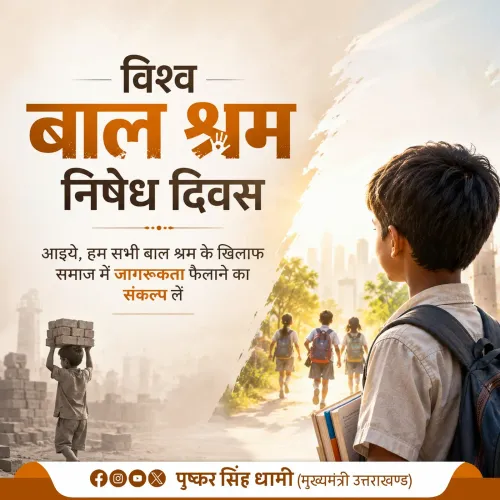
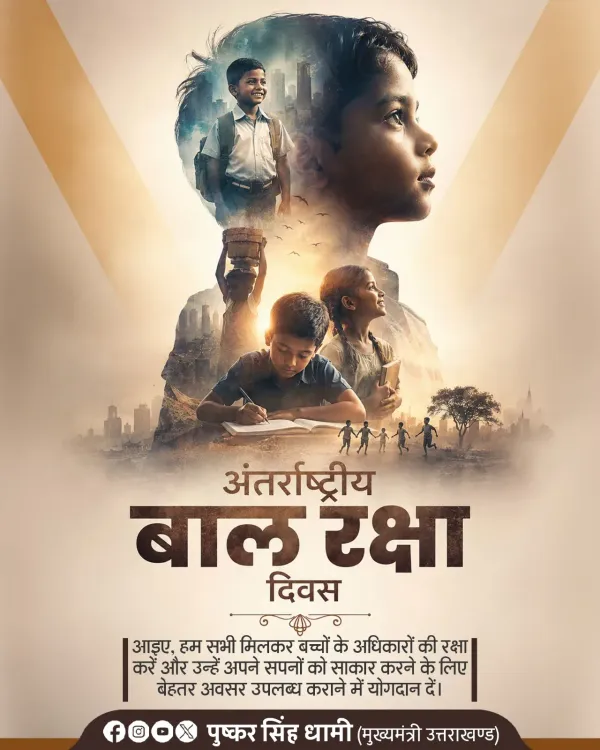
Uttarakhand Chief Minister Pushkar Singh Dhami on Monday, 1 June 2026, reaffirmed his government's commitment to child rights, announcing that the state is actively rescuing children from begging and child labour under a dedicated programme called 'Operation Mukti' and linking them to formal education.
In his post, Dhami called on citizens to collectively resolve to respect child rights and ensure every child receives a 'safe, healthy, educated and dignified environment' — ('सुरक्षित, स्वस्थ, शिक्षित और सम्मानपूर्ण वातावरण'). He stated that his government is working with dedication to protect child rights across Uttarakhand.
Context
The Chief Minister's statement comes on the occasion of Global Day of Parents (1 June), a period when child welfare commitments from governments across India are often publicly renewed. Dhami's post specifically highlights Operation Mukti as the state's primary intervention tool to free children from begging and labour, subsequently enrolling them in schools.
Beyond rescue operations, the post notes that various public welfare schemes are being effectively implemented to provide children of labour families with better education, nutrition, health facilities, and a secure future.
Policy Backdrop
India's Child Labour (Prohibition and Regulation) Amendment Act, 2016 prohibits employment of children below 14 years in all occupations, providing the legal backbone for state-level rescue operations such as the one Dhami references. The Juvenile Justice (Care and Protection of Children) Act, 2015 further strengthened rehabilitation and education linkage mechanisms for rescued children.
Uttarakhand, as a Himalayan state with a significant migrant labour population, faces particular challenges around child labour in informal sectors and child begging in urban and pilgrimage centres. State governments across India have increasingly combined rescue operations with integration into centrally sponsored schemes covering mid-day meals, health cover, and conditional cash transfers.
India is also a signatory to the UN Convention on the Rights of the Child, and periodic national action plans on child labour elimination set targets that states are expected to operationalise through ground-level programmes.
Stakeholders and Impact
The primary beneficiaries cited by CM Dhami are children trapped in begging and child labour, as well as children of labour families who lack access to quality education, nutrition, and healthcare. Successful rehabilitation under programmes like Operation Mukti can break intergenerational cycles of poverty by ensuring school enrolment and continuity.
Civil society organisations and child rights bodies working in Uttarakhand have long flagged the vulnerability of children in the state's unorganised labour sector, particularly in construction, agriculture, and the tourism and pilgrimage economy around sites such as Haridwar and Dehradun. Effective implementation of welfare schemes for this cohort remains a closely watched indicator of the state government's social policy delivery.
What's Next
Progress on Operation Mukti and the broader child welfare scheme implementation will likely be tracked through state assembly discussions and periodic administrative reports from the Uttarakhand government. The Chief Minister's public commitment raises the expectation of measurable outcome data — number of children rescued, enrolled in schools, and covered under nutrition and health programmes.
If the state releases verified figures on scheme coverage and rescue numbers, it would provide a concrete benchmark against which Uttarakhand's child rights record can be assessed ahead of future electoral cycles and governance reviews.
Point of View
Operation Mukti, rather than speaking only in generalities, the communication attempts to signal administrative action rather than mere aspiration. However, the absence of verified outcome data means the announcement remains a statement of intent until corroborated by independent figures. In the broader BJP governance narrative, child welfare and 'rescue-and-rehabilitate' programmes serve a dual purpose: they address genuine social needs while also reinforcing the party's positioning as a pro-poor, pro-family administration ahead of state-level political cycles.
NationPress
15 Oct 2026
Frequently Asked Questions
What is Operation Mukti in Uttarakhand?
Operation Mukti is a programme announced by the Uttarakhand government under Chief Minister Pushkar Singh Dhami that aims to rescue children from begging and child labour and enrol them in formal education. Detailed verified outcome figures have not yet been publicly released.
What did CM Dhami say about child rights on 1 June 2026?
CM Dhami called on citizens to resolve to respect child rights and ensure every child gets a safe, healthy, educated, and dignified environment, while highlighting Operation Mukti and welfare schemes for children of labour families in Uttarakhand.
What is the law against child labour in India?
The Child Labour (Prohibition and Regulation) Amendment Act, 2016 prohibits the employment of children below 14 years of age in all occupations and processes across India, providing the legal basis for state-level rescue operations.
How does Uttarakhand support children of labour families?
According to CM Dhami's statement, the Uttarakhand government is implementing various public welfare schemes to provide children of labour families with better education, nutrition, health facilities, and a secure future.
Is India a signatory to the UN Convention on the Rights of the Child?
Yes, India is a signatory to the UN Convention on the Rights of the Child, and national and state-level action plans on child labour elimination and child protection are framed in alignment with its commitments under this convention.