CM Fadnavis Adds MD Drug Precursor to Schedule A Controls

Synopsis
Maharashtra CM Devendra Fadnavis announced on 10 July 2026 that the precursor chemical used to manufacture MD drugs has been added to Schedule A of controlled substances, tightening the regulatory net against mephedrone production and illicit trade in the state.
Key Takeaways
Maharashtra CM Devendra Fadnavis announced the move on 10 July 2026 during the Monsoon Session of the state assembly in Mumbai .
The precursor chemical used in manufacturing MD drugs (mephedrone) has been added to Schedule A of controlled substances.
Schedule A classification imposes the strictest controls — mandatory record-keeping, restricted sale, and enhanced penalties for violations.
The move targets the supply chain upstream, enabling law enforcement to act before a finished narcotic is produced.
An official gazette notification naming the exact chemical and its effective enforcement date is expected to follow.
Maharashtra has recorded repeated large-scale mephedrone seizures , particularly in and around Mumbai , making precursor control a long-standing enforcement demand.
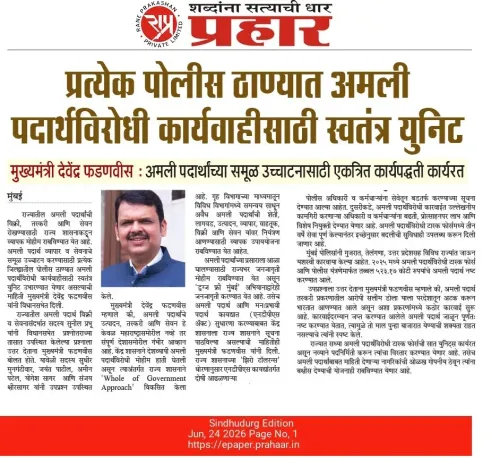
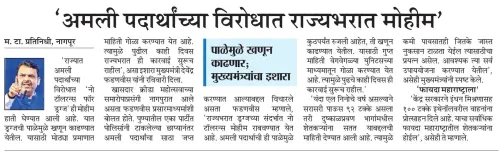
Maharashtra Chief Minister Devendra Fadnavis announced on Friday, 10 July 2026, that the chemical used in the manufacture of MD drugs has been included in Schedule A of controlled substances under Maharashtra's drug regulatory framework, a move aimed at curbing the illicit trade in mephedrone and related synthetic narcotics. The announcement was made from the floor of the Maharashtra Legislative Assembly, Mumbai, during the ongoing Monsoon Session 2026.
Context
Speaking in the assembly, CM Fadnavis stated — in both English and Marathi — that the precursor chemical central to MD drug production has now been formally classified under Schedule A of controlled substances. In his words: 'एमडी ड्रग्ज निर्मितीसाठी वापरल्या जाणाऱ्या रसायनाचा शेड्युल A मधील नियंत्रित पदार्थांमध्ये समावेश' — meaning, 'the chemical used in the manufacture of MD drugs has been included among Schedule A controlled substances.' The classification is expected to impose stricter licensing, tracking, and trade restrictions on the chemical in question.
MD drugs — a street name for mephedrone, a synthetic stimulant — have been a persistent law-enforcement concern in Maharashtra, particularly in Mumbai and its satellite cities. Seizures of the substance have featured prominently in state police records over the past several years, making precursor control a long-demanded measure by enforcement agencies.
Policy Backdrop
India's primary legal framework for narcotics control is the Narcotic Drugs and Psychotropic Substances (NDPS) Act, 1985, subsequently amended in 2001 and 2014, which established schedules for both controlled substances and their precursor chemicals. Schedule A classification typically subjects a chemical to the most stringent controls, including mandatory record-keeping by manufacturers, restrictions on sale and transfer, and enhanced penalties for violations.
Indian states periodically update their own enforcement frameworks in alignment with central NDPS rules to respond to emerging synthetic drug trends. The inclusion of a precursor chemical in Schedule A closes a regulatory gap that illicit manufacturers have historically exploited — procuring chemicals legally before converting them into prohibited narcotics.
Stakeholders and Impact
Law enforcement agencies across Maharashtra stand to gain a sharper legal instrument: once a precursor is scheduled, its unauthorised possession or trade becomes independently prosecutable, even before a finished narcotic is detected. This allows police and the Anti-Narcotics Cell to intervene earlier in the supply chain.
Chemical manufacturers and traders dealing in the now-scheduled substance will be required to comply with new documentation and licensing obligations. Industry bodies representing the chemicals sector may seek clarity on implementation timelines and the specific compound named in the gazette notification.
What's Next
The operative detail to watch is the official gazette notification that will name the exact chemical added to Schedule A and specify the effective date of enforcement. That notification will also define the penalties applicable to violations and the compliance window for existing traders.
Subsequent enforcement actions — raids, prosecutions, and seizure data — will determine whether the scheduling translates into a measurable reduction in MD drug availability on Maharashtra's streets. The Monsoon Session 2026 may see further legislative measures as the state government signals a broader push against synthetic drug networks.
Point of View
The announcement from the assembly floor during the Monsoon Session signals an intent to demonstrate legislative action on urban drug crime, a politically salient issue in Mumbai. The real test, however, will be implementation: gazette notifications that name specific chemicals are often delayed, and compliance by the chemicals industry depends heavily on inspection capacity. If followed through, the measure aligns Maharashtra with the broader national pattern of states tightening NDPS-adjacent rules to address the mephedrone epidemic that has spread well beyond the state's coastline.
NationPress
10 Jul 2026
Frequently Asked Questions
What is the MD drug precursor added to Schedule A in Maharashtra?
The exact chemical name has not been specified in the public announcement; the official gazette notification is expected to name the compound. MD drugs refer to mephedrone, a synthetic stimulant, and its manufacture relies on specific precursor chemicals that will now fall under Schedule A controls.
What does Schedule A classification mean for a chemical in India?
Schedule A is the most stringent category under India's controlled-substances framework. It requires mandatory record-keeping by manufacturers and traders, restricts sale and transfer of the chemical, and makes unauthorised possession or trade independently prosecutable under the NDPS Act.
Why did CM Fadnavis announce this during the Monsoon Session 2026?
The Maharashtra Legislative Assembly's Monsoon Session 2026 provided a legislative forum for the Chief Minister to formally communicate the regulatory change, signalling government action on synthetic drug proliferation — a persistent law-enforcement concern in Mumbai and surrounding areas.
How does scheduling a precursor chemical help curb MD drug production?
By classifying the precursor under Schedule A, authorities can legally intercept the chemical before it is converted into a finished narcotic. This allows police to act earlier in the supply chain, disrupting production networks rather than waiting to seize the finished drug.
What happens next after this announcement?
An official gazette notification is expected to be issued, naming the specific chemical, the effective date of the new classification, and compliance requirements for manufacturers and traders. Enforcement actions — including inspections and prosecutions — are anticipated to follow.