CM Fadnavis pays tribute at Hutatma Chowk on Martyrs Day
Synopsis
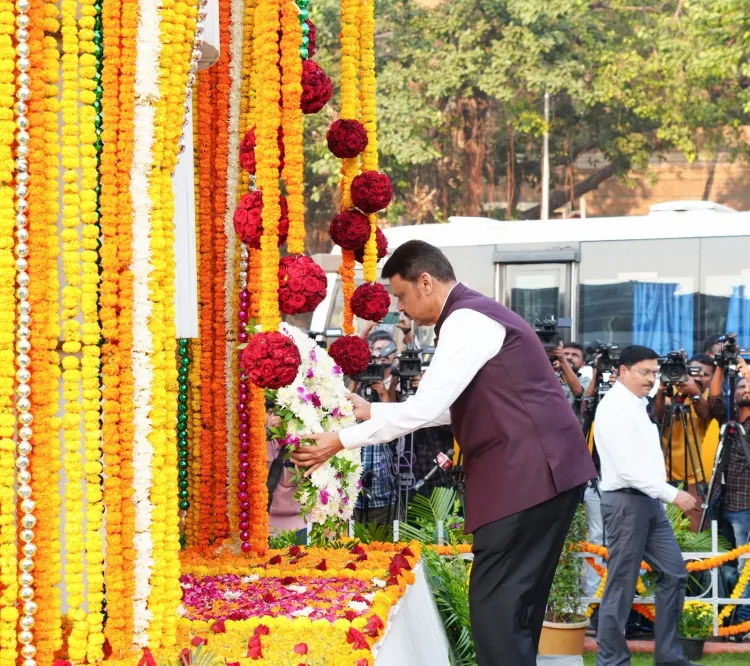
Chief Minister Devendra Fadnavis led Maharashtra's official Hutatma Smruti Din observance on 21 November 2026, laying a wreath at Hutatma Chowk, Mumbai, to honour those who died in the Samyukta Maharashtra movement that led to the state's formation in 1960.
Key Takeaways
CM Devendra Fadnavis laid a floral wreath at Hutatma Chowk Smarak, Mumbai on 21 November 2026 at 8 a.m.
The occasion was Hutatma Smruti Din , Maharashtra's annual day of remembrance for martyrs of the Samyukta Maharashtra agitation.
Senior dignitaries present included Speaker Rahul Narwekar , Deputy CM Sunetra Ajit Pawar , Minister Mangalprabhat Lodha , Dr.
Neelam Gorhe , and Zeeshan Siddiqui .
The Samyukta Maharashtra movement of the 1950s secured the creation of Maharashtra as a unified Marathi-speaking state on 1 May 1960 .
Hutatma Chowk , located at Flora Fountain in south Mumbai, was renamed to honour the movement's fallen protesters.
At 8 a.m. on 21 November 2026, Hutatma Chowk in the heart of Mumbai fell quiet as Maharashtra's highest constitutional office came to bow before history. The Chief Minister's Office of Maharashtra announced that Chief Minister Devendra Fadnavis laid a wreath at the iconic memorial, paying solemn homage to every martyr who gave their life in the Samyukta Maharashtra movement — the agitation that made the state possible.
The post, shared in both Marathi and Hindi, described the occasion as 'Hutatma Smruti Din — tyaag, dhairya, samarpan' (Martyrs' Remembrance Day — sacrifice, courage, dedication). Flanking the Chief Minister were Legislative Assembly Speaker Adv. Rahul Narwekar, Deputy Chief Minister Sunetra Ajit Pawar, Minister Mangalprabhat Lodha, MLA Dr. Neelam Gorhe, MLA Zeeshan Siddiqui, and other senior dignitaries.
The movement that forged a state — and the memorial that guards its memory
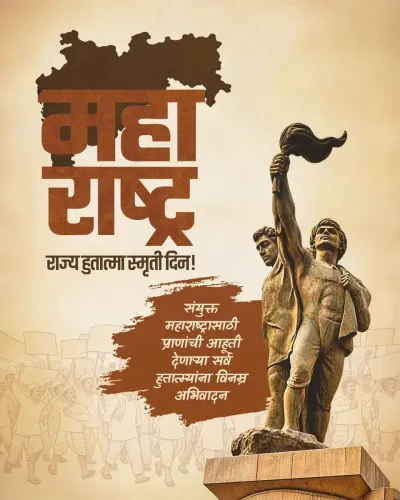
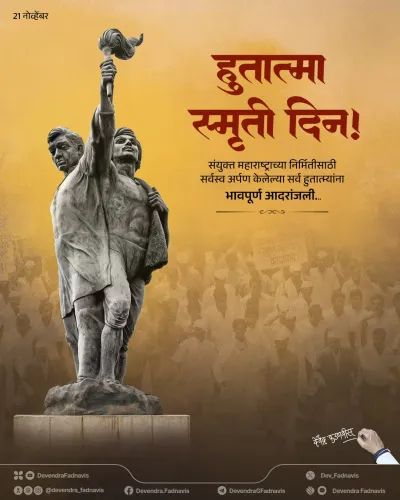
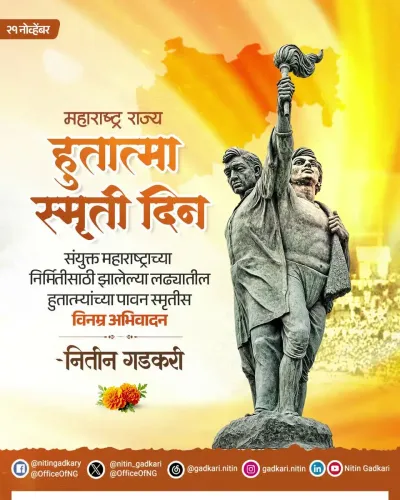
The Hutatma Chowk Smarak — literally 'Martyrs' Square Memorial' — stands as a permanent civic reminder of the blood price paid for Maharashtra's creation. During the 1950s, the demand for a unified Marathi-speaking state ran headlong into the existence of the bilingual Bombay State, which the central government had carved out as a compromise. Protesters filled the streets of Mumbai and towns across the region; police opened fire on multiple occasions, and lives were lost.
That agitation culminated on 1 May 1960, when Maharashtra was formally constituted as a separate state — a date still observed each year as Maharashtra Day. The martyrs of the movement occupy a foundational place in the state's civic identity, and Hutatma Chowk, situated at the southern end of Flora Fountain in Mumbai, was renamed in their honour.
An annual ritual of remembrance — and what it signals
Maharashtra governments across party lines have observed Hutatma Smruti Din with official wreath-laying ceremonies at the Chowk each year. The ritual is more than ceremonial: it anchors the ruling administration to the founding narrative of the state, affirming continuity between the sacrifices of the past and the governance of the present.
That CM Fadnavis was joined by legislators from across the coalition — including MLA Zeeshan Siddiqui, signalling cross-community participation — adds a layer of symbolic breadth to the observance. The choice to publish the post in both Marathi and Hindi reflects the administration's effort to reach the state's full linguistic spectrum on a day rooted in the politics of language itself.
Sixty-six years after Maharashtra's birth, the state's leaders still walk to that square at dawn. That is not routine — that is a promise, renewed in public, to the people whose names are etched in stone there.
Point of View
Compelling every ruling coalition to publicly reaffirm the state's founding sacrifice. For the Fadnavis administration, attending in full force — CM, Deputy CM, Speaker, and MLAs — signals institutional continuity with a narrative that predates any single party's dominance. The linguistic dimension is quietly significant: the Samyukta Maharashtra movement was fundamentally about language and identity, and publishing the tribute in both Marathi and Hindi on that very day is a deliberate act of political balancing. How successive governments inflect this remembrance — which names they emphasise, who stands at the Chowk — often reflects the broader regional identity politics of their moment.
NationPress
21 Nov 2026
Frequently Asked Questions
What is Hutatma Smruti Din in Maharashtra?
Hutatma Smruti Din is Maharashtra's annual day of remembrance for the martyrs who sacrificed their lives during the Samyukta Maharashtra agitation of the 1950s, which led to the formation of Maharashtra as a separate Marathi-speaking state on 1 May 1960.
Where is Hutatma Chowk located?
Hutatma Chowk is located at Flora Fountain in south Mumbai. The area was renamed in honour of the martyrs of the Samyukta Maharashtra movement.
What was the Samyukta Maharashtra movement?
The Samyukta Maharashtra movement was a mass agitation in the 1950s demanding a unified state for Marathi-speaking people. After sustained protests, in which many lives were lost, Maharashtra was formally constituted on 1 May 1960.
Who attended the Hutatma Smruti Din 2026 ceremony in Mumbai?
Chief Minister Devendra Fadnavis led the wreath-laying at Hutatma Chowk on 21 November 2026, joined by Speaker Rahul Narwekar, Deputy CM Sunetra Ajit Pawar, Minister Mangalprabhat Lodha, MLA Dr. Neelam Gorhe, and MLA Zeeshan Siddiqui.
Why is 21 November observed as Hutatma Smruti Din?
21 November is observed as Hutatma Smruti Din in Maharashtra to commemorate the martyrs of the Samyukta Maharashtra movement. The Maharashtra government holds an annual official ceremony at Hutatma Chowk, Mumbai, on this date.