CM Fadnavis: Maharashtra conviction rates on the rise
Synopsis
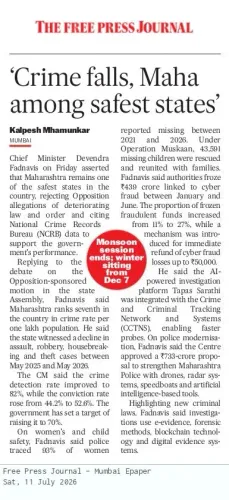
Chief Minister Devendra Fadnavis declared on July 11, 2026, that Maharashtra's crime conviction rate has risen, underscoring his administration's focus on strengthening police-prosecution coordination and criminal justice outcomes across the state.
Key Takeaways
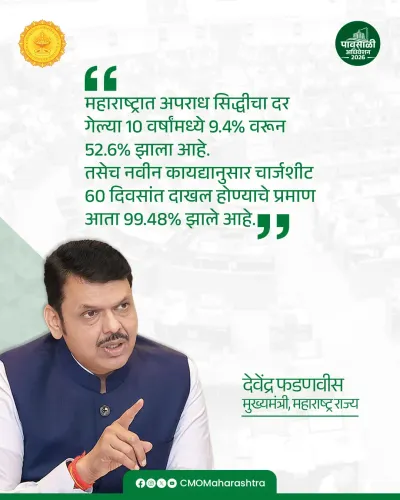
The Chief Minister's Office of Maharashtra posted on July 11, 2026 , citing CM Devendra Fadnavis on a rise in the state's crime conviction rate.
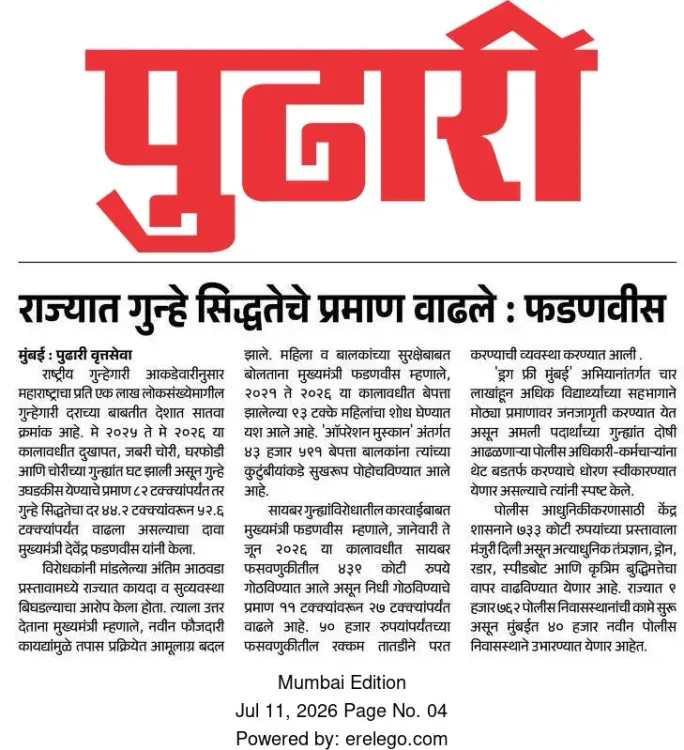
The Marathi statement 'राज्यात गुन्हे सिद्धतेचे प्रमाण वाढले' translates to 'The crime conviction rate in the state has increased.' Fadnavis has prioritised law-and-order reform since his first term as CM, beginning in 2014 , with measures targeting investigation and prosecution quality.
Maharashtra has historically featured in national comparisons of case disposal and conviction metrics tracked by the NCRB .
The next NCRB 'Crime in India' report and state home department data releases will be key to verifying the improvement cited.
Law enforcement agencies, public prosecutors, and the state judiciary are the primary stakeholders affected by conviction rate trends.
The Chief Minister's Office of Maharashtra, in a post on X (formerly Twitter) on Saturday, July 11, 2026, highlighted a statement by Chief Minister Devendra Fadnavis declaring that the crime conviction rate in the state has increased — signalling a renewed focus on criminal justice outcomes under his administration.
Context
The post, shared from the official @CMOMaharashtra account, carries the message: 'राज्यात गुन्हे सिद्धतेचे प्रमाण वाढले' — translated as 'The crime conviction rate in the state has increased.' The statement is attributed directly to Chief Minister Devendra Fadnavis, who has consistently positioned law and order as a cornerstone of his governance agenda.
The post was tagged with #Maharashtra, #DevendraFadnavis, and #LawAndOrder, indicating an intentional public communication push around the state's criminal justice record.
Policy Backdrop
Fadnavis, who has served as Maharashtra's Chief Minister across multiple terms, began prioritising improvements to investigation and prosecution processes as far back as his 2014–2019 tenure. Measures introduced during that period aimed at tightening coordination between state police and the prosecution machinery.
State governments across India periodically cite conviction rate data — often drawn from National Crime Records Bureau (NCRB) reports or state home department figures — as a metric of criminal justice effectiveness. Maharashtra has featured in national comparisons of case disposal and conviction metrics over successive years, making such announcements a meaningful signal in the state's governance narrative.
Improvements in conviction rates are generally attributed to a combination of factors: stronger evidence collection, better coordination between investigators and public prosecutors, faster trial completion, and targeted attention to pending cases in district courts.
Stakeholders and Impact
Maharashtra's law enforcement agencies — including the state police and the prosecution directorate — stand at the centre of this development. A rising conviction rate is a direct performance indicator for both wings, reflecting the quality of charge sheets filed and the strength of cases presented before courts.
For the state judiciary, higher conviction rates can indicate improved quality of cases brought to trial, though they also raise questions about pendency and the pace at which courts are able to dispose of matters. Citizens and civil society groups tracking accountability in the criminal justice system are likely to scrutinise the underlying data when it becomes publicly available.
What's Next
The next release of the NCRB's annual 'Crime in India' report will be closely watched for state-level conviction data that can contextualise CM Fadnavis's claim. The Maharashtra home department's own data releases on case pendency and disposal rates will provide additional granularity.
If the figures hold up under scrutiny, the development could be cited as a model for other states grappling with low conviction rates — and is likely to feature prominently in the ruling coalition's governance messaging ahead of future electoral cycles.
Point of View
Where law and order has been a recurring political flashpoint, this announcement serves a dual purpose: reassuring citizens and signalling administrative competence to a national audience. The real test will come when granular data from the NCRB or the state home department is made public, allowing independent scrutiny of the claim. Until then, the statement functions primarily as a governance-communication exercise — one that opposition parties are likely to probe for specifics.
NationPress
11 Jul 2026
Frequently Asked Questions
What did CM Devendra Fadnavis say about Maharashtra's conviction rate?
CM Devendra Fadnavis stated on July 11, 2026, that the crime conviction rate in Maharashtra has increased, signalling improvement in the state's criminal justice performance.
What is a crime conviction rate and why does it matter?
A crime conviction rate measures the proportion of criminal cases that result in a guilty verdict out of the total cases tried. A higher rate generally indicates stronger evidence, better prosecution, and more effective policing.
How is Maharashtra's conviction rate measured?
Maharashtra's conviction rate is typically tracked through data compiled by the National Crime Records Bureau (NCRB) in its annual 'Crime in India' report, as well as through state home department figures on case disposal.
What steps has Maharashtra taken to improve law and order under Fadnavis?
Since his first term beginning in 2014, Fadnavis has pursued measures to improve investigation quality and police-prosecution coordination, aimed at increasing the rate at which criminal cases result in convictions.
When will official data confirm Maharashtra's conviction rate improvement?
The next NCRB 'Crime in India' annual report and Maharashtra home department data releases are the primary sources expected to provide verifiable figures on the state's conviction rate trends.