Giriraj Singh: Toy Imports Down 71%, India Eyes 25% Global Share
Synopsis
Union Textiles Minister Giriraj Singh has flagged a 71 per cent decline in toy imports and a government target of 25 per cent global market share, marking a significant shift from Chinese import dependence to domestic manufacturing under the Made in India and Atmanirbhar Bharat frameworks.
Key Takeaways
Union Textiles Minister Giriraj Singh shared data on 11 July 2026 showing India's toy imports have fallen by 71 per cent .
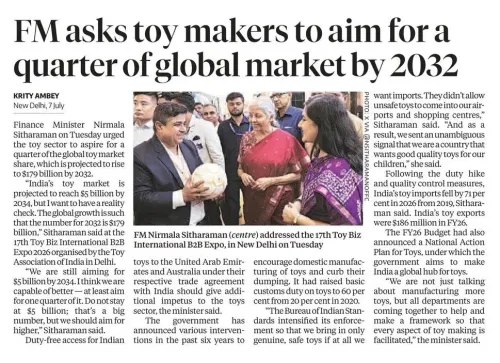
The government is targeting a 25 per cent share of the global toy market for Indian manufacturers.
The turnaround is attributed to higher customs duties , mandatory Quality Control Orders , and MSME cluster support introduced from 2020 onward.
The policy shift aligns with the Make in India (2014) and Atmanirbhar Bharat (2020) campaigns aimed at reducing Chinese import dependence.
Key beneficiaries include domestic toy manufacturers and MSME exporters in clusters across Karnataka, Uttar Pradesh , and Rajasthan .
Upcoming Commerce Ministry trade data and any PLI-style incentive expansion will be critical indicators of whether the trend holds.
Union Textiles Minister Giriraj Singh on Saturday, 11 July 2026, highlighted a dramatic turnaround in India's toy sector, sharing data showing that toy imports have fallen by 71 per cent while the government now targets a 25 per cent share of the global toy market — a sharp pivot from a landscape once dominated by Chinese goods.
Context
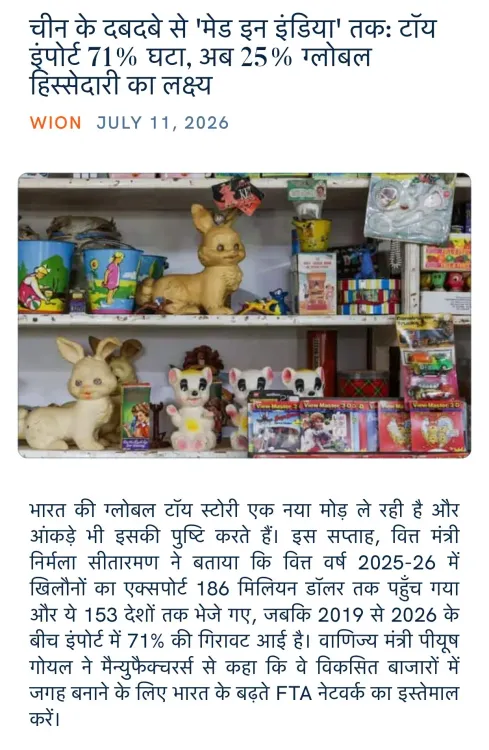
The minister shared a report headlined 'Cheen ke dabdabe se Made in India tak' ('From China's shadow to Made in India'), underscoring the government's framing of the toy sector's revival as a national manufacturing success story. The post, shared via the NaMo App, signals continued political ownership of the 'Made in India' brand at the Cabinet level.
Until the early 2020s, India was heavily reliant on Chinese toy imports, which accounted for the bulk of the domestic market. Concerns over product safety, supply-chain vulnerability, and trade imbalance pushed the government to act decisively through regulatory and tariff measures.
Policy Backdrop
The turnaround is rooted in a layered policy response that began with the Make in India initiative launched in September 2014 and deepened under the Atmanirbhar Bharat campaign announced in May 2020. Together, these programmes pushed domestic manufacturing as a strategic priority, particularly in sectors where Chinese suppliers held near-monopoly positions.
For toys specifically, the government deployed a combination of higher customs duties, mandatory Quality Control Orders (QCOs) requiring Bureau of Indian Standards certification, and targeted support for MSME toy clusters in states such as Karnataka, Uttar Pradesh, and Rajasthan. These measures made it harder for sub-standard imports to enter the market while creating space for domestic producers to scale up.
The policy push also aligned with a broader post-2020 strategic recalibration in India-China trade relations, following border tensions that accelerated calls for reducing economic dependence on Chinese supply chains across consumer goods categories.
Stakeholders and Impact
The primary beneficiaries of this shift are domestic toy manufacturers and MSME exporters, many of whom operate in labour-intensive clusters that had struggled to compete against cheaper Chinese imports. A 71 per cent reduction in toy imports represents a significant reallocation of market share toward homegrown producers.
For consumers, the transition has come with an emphasis on quality assurance through BIS certification norms, though industry bodies have previously flagged concerns about compliance costs for smaller units. The net effect, as the government presents it, is a more competitive and self-reliant domestic industry.
On the export side, the 25 per cent global market share target is ambitious. India's current share of the roughly $100 billion global toy trade remains modest, but the directional trend — rising exports alongside falling imports — has been cited by the ministry as evidence that the structural shift is real and durable.
What's Next
Attention will now turn to quarterly trade data from the Commerce Ministry, which will either validate or test the 71 per cent import-reduction figure as a sustained trend rather than a cyclical dip. Any expansion of Production Linked Incentive (PLI)-style schemes or additional quality norms for toys and allied manufacturing categories will be closely watched by industry.
With Giriraj Singh publicly amplifying these metrics, the toy sector is likely to remain a showcase example in the government's broader narrative of manufacturing-led growth — and a bellwether for how India manages the delicate balance between protecting domestic industry and meeting consumer demand at scale.
Point of View
Placing the Textiles Ministry at the centre of India's manufacturing-revival narrative ahead of what is likely to be an intensified push on export targets. The 71 per cent import reduction, if borne out by Commerce Ministry data, would represent one of the more striking sectoral outcomes of the post-2020 China-decoupling strategy. The 25 per cent global share target, however, is a stretch goal that will require sustained export competitiveness, not just import substitution. This episode illustrates a wider pattern in which Cabinet ministers use social media to pre-empt formal data releases and shape the economic narrative on their own terms.
NationPress
11 Jul 2026
Frequently Asked Questions
Why have India's toy imports fallen by 71 per cent?
India's toy imports have fallen sharply following a combination of higher customs duties, mandatory Bureau of Indian Standards quality certifications under Quality Control Orders, and government support for domestic MSME toy clusters — measures intensified after 2020 to reduce dependence on Chinese goods.
What is India's target for the global toy market?
The Indian government is targeting a 25 per cent share of the global toy market, a significant leap from the country's current modest share of the roughly $100 billion global trade in toys.
What is the Made in India initiative?
Make in India is a flagship manufacturing initiative launched in September 2014 to position India as a global production hub, reduce import dependence, and attract investment into domestic industry across sectors including toys, textiles, and electronics.
What is Atmanirbhar Bharat and how does it relate to toys?
Atmanirbhar Bharat, announced in May 2020, is a self-reliance campaign that accelerated import-substitution policies across consumer goods sectors. For toys, it provided the political and policy framework for stricter import norms and domestic production incentives.
Who benefits from India's toy manufacturing push?
Domestic toy manufacturers and MSME exporters — particularly those in clusters in Karnataka, Uttar Pradesh, and Rajasthan — are the primary beneficiaries, gaining market space that was previously occupied by cheaper Chinese imports.