Giriraj Singh: India's toy imports down 71% since 2019
Synopsis
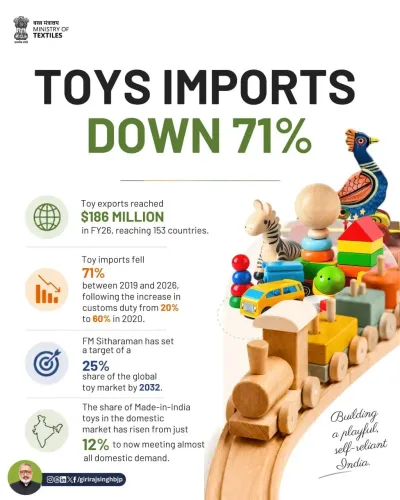
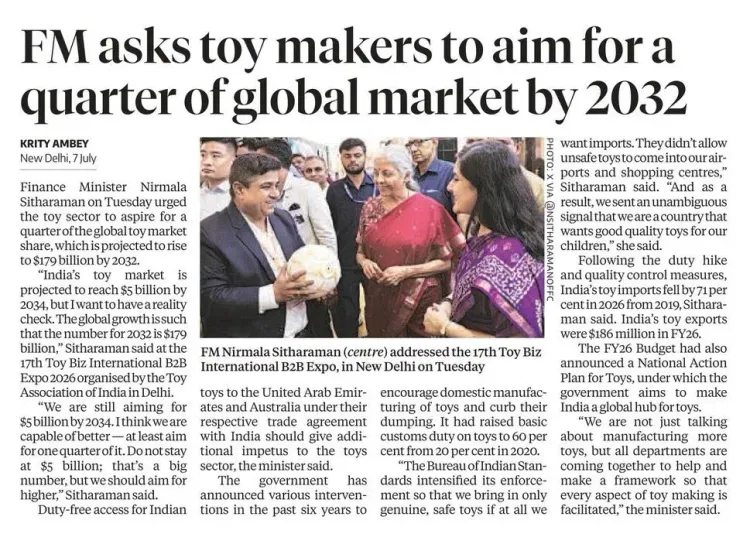
Union Textiles Minister Giriraj Singh announced on 8 July 2026 that toy imports have dropped 71 per cent since 2019, crediting PM Modi's quality-standards push and domestic manufacturing policies. He set a target of capturing 25 per cent of the global toy market by 2032, positioning India as a world toy hub.
Key Takeaways
Union Textiles Minister Giriraj Singh posted on 8 July 2026 that India's toy imports have fallen 71 per cent compared to 2019 levels.
The decline is attributed to stricter quality standards enforced through the Toys (Quality Control) Order 2020 , which mandates BIS certification for all toys sold in India.
The government's stated next target is a 25 per cent share of the global toy market by 2032 , positioning India as a world toy hub.
The policy sits within the broader Make in India (2014) and Aatmanirbhar Bharat (2020) frameworks aimed at reducing import dependence and building domestic manufacturing capacity.
MSME toy clusters across states including Uttar Pradesh , Karnataka , and Rajasthan are key beneficiaries of the import-substitution drive.
Future policy signals to watch include PLI-style incentives for toys and progress on state-level toy parks in upcoming Union Budgets.
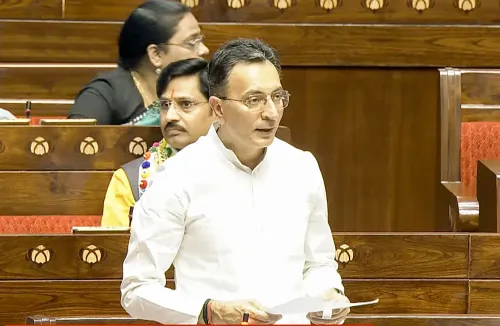
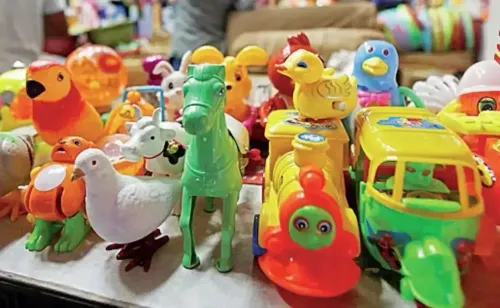
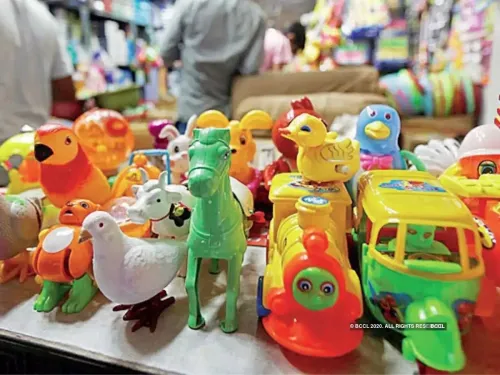
Union Textiles Minister Giriraj Singh on Wednesday, 8 July 2026 said India's toy industry is advancing toward self-reliance under Prime Minister Narendra Modi's vision, citing a 71 per cent fall in toy imports compared to 2019 levels as evidence of the government's manufacturing push.
Posting in Hindi on X, the minister said: 'माननीय प्रधानमंत्री श्री नरेन्द्र मोदी जी के विजन से आज भारतीय खिलौना उद्योग आत्मनिर्भरता की ओर बढ़ रहा है' ['Under the vision of honourable Prime Minister Narendra Modi, the Indian toy industry is today moving toward self-reliance']. He attributed the import decline to stricter quality standards, promotion of domestic manufacturing, and industry-friendly policies. The minister also set out an ambitious target: making India a global toy hub with a 25 per cent share of the world toy market by 2032.
Context
India's toy sector was long dominated by low-cost imports, particularly from China, which accounted for the bulk of toys sold in the domestic market. The shift began around 2020 when the government introduced the Toys (Quality Control) Order, mandating Bureau of Indian Standards (BIS) certification for both imported and domestically produced toys. The measure effectively raised the compliance bar for foreign suppliers and gave domestic manufacturers a more level playing field.
The Make in India programme, launched in September 2014, and the Aatmanirbhar Bharat initiative, announced in May 2020, together form the policy scaffold underpinning this transformation. Both schemes aim to reduce import dependence and build India's position in global manufacturing value chains.
Policy Backdrop
The BIS Quality Control Order on toys is a non-tariff instrument that requires products to meet Indian safety standards before they can enter the market. Its enforcement from 2020 onward created a significant compliance burden for foreign exporters, many of whom found the certification process costly or time-consuming. Domestic producers, by contrast, were simultaneously supported through cluster development programmes and easier access to formal credit under the MSME framework.
This combination of import-substitution policy and domestic capacity building mirrors the approach applied to other consumer-goods sectors under Aatmanirbhar Bharat. The government has also explored production-linked incentive structures for labour-intensive industries, and the toy sector has been identified as a priority area for employment generation, particularly in MSME clusters in states such as Uttar Pradesh, Karnataka, and Rajasthan.
Stakeholders and Impact
Domestic toy manufacturers and MSME clusters stand to gain most directly from the import reduction. A shrinking share for imported toys translates into expanded shelf space and market opportunity for Indian producers, many of whom operate at small or medium scale. The sector is also a significant employer of semi-skilled labour, and growth in domestic production carries multiplier effects for ancillary industries including plastics, textiles, and electronics components used in toys.
For consumers, the policy shift raises questions about price and variety: quality standards protect buyers from unsafe products, but reduced import competition can, over time, affect pricing. The government's stated export ambition — a 25 per cent global market share by 2032 — would require Indian manufacturers to compete on cost, design, and quality at an international level, a considerably larger challenge than substituting imports at home.
What's Next
The 2032 global market share target will be closely watched by industry bodies and trade analysts. Achieving it would require sustained investment in design capabilities, supply-chain logistics, and international marketing — areas where India's toy sector is still maturing. Upcoming Union Budgets will be scrutinised for any new cluster-development funds, PLI-style incentives, or export-promotion schemes tailored to the sector.
Progress on BIS enforcement outcomes and the development of state-level toy parks will serve as near-term indicators of whether the policy momentum is being translated into durable industrial capacity. The minister's post, tagged with #MakeInIndia, #AatmanirbharBharat, #ToyIndustry, and #ViksitBharat, signals that the sector will remain a visible part of the government's manufacturing narrative in the run-up to the next electoral cycle.
Point of View
Using a striking headline statistic — a 71 per cent import drop — to validate the Modi government's post-2020 non-tariff barrier strategy ahead of what are likely to be budget-season conversations about industrial policy. The framing moves the narrative from defensive import-substitution to an offensive export ambition, with the 2032 global market-share target serving as a long-horizon goalpost that is difficult to contest in the near term. This mirrors a broader BJP communications pattern of anchoring manufacturing success stories in the twin pillars of Make in India and Aatmanirbhar Bharat, keeping both schemes politically visible. The real test will come when independent trade data either corroborates or complicates the ministerial figures, and when the sector must demonstrate export competitiveness rather than simply benefiting from import restrictions.
NationPress
7 Oct 2026
Frequently Asked Questions
How much have toy imports fallen in India?
Union Textiles Minister Giriraj Singh has stated that toy imports have fallen by 71 per cent compared to 2019 levels, citing stricter quality standards and domestic manufacturing promotion as the key drivers.
What is India's toy hub target for 2032?
The government's stated goal is for India to capture a 25 per cent share of the global toy market by 2032 , making it a leading world toy hub.
What is the Toys Quality Control Order and how does it affect imports?
The Toys (Quality Control) Order 2020 requires all toys sold in India — whether imported or domestically made — to carry Bureau of Indian Standards (BIS) certification , raising the compliance bar for foreign suppliers and effectively reducing cheap imports.
How does Make in India relate to the toy sector?
Make in India , launched in September 2014 , is a flagship programme to build India's manufacturing base. The toy sector has been a focus area under this initiative, alongside the Aatmanirbhar Bharat self-reliance drive announced in 2020 .
Which states have toy manufacturing clusters in India?
Key toy manufacturing MSME clusters are located in states including Uttar Pradesh , Karnataka , and Rajasthan , which are primary beneficiaries of policies aimed at boosting domestic toy production.