FM Sitharaman urges toy industry to target 25% of $179 bn global market

Synopsis
Finance Minister Nirmala Sitharaman has thrown down a striking challenge to India's toy sector: stop thinking in billions and start thinking in market share. With the global toy market heading to $179 billion by 2032, she wants India — currently eyeing $5 billion by 2034 — to capture a full quarter of that pie. The gap between those two numbers is the story.
Key Takeaways
Finance Minister Nirmala Sitharaman addressed the 17th Toy Biz International B2B Expo 2026 in New Delhi on 7 July 2026 .
She urged India's toy industry to target 25% of the global toy market, projected to reach $179 billion by 2032 .
India's domestic toy market is currently projected to reach $5 billion by 2034 — a figure Sitharaman called insufficiently ambitious.
The Bureau of Indian Standards (BIS) has intensified enforcement to block unsafe toy imports at ports and retail channels.
The government's National Action Plan for Toys , announced in the FY26 Budget , targets manufacturing clusters, skills development, and a 'Made in India' toy brand.
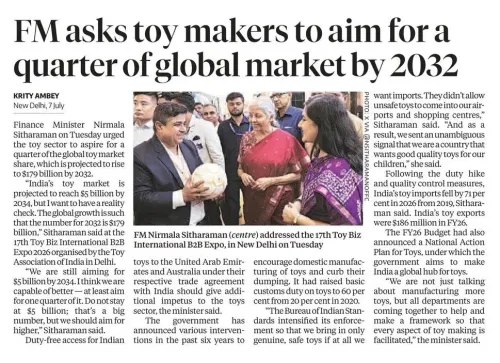
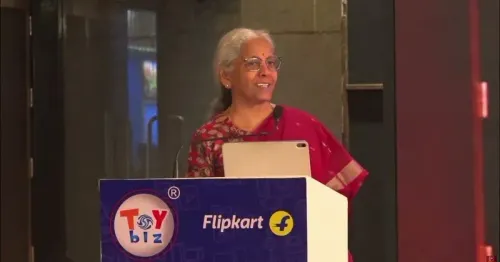
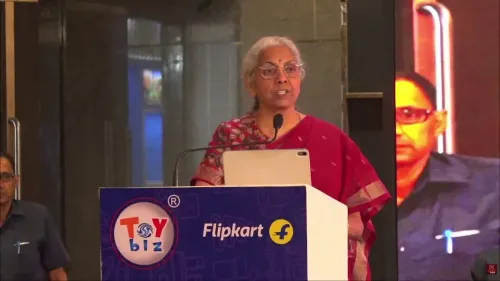
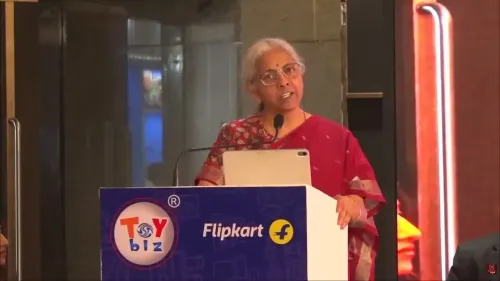
Finance Minister Nirmala Sitharaman on Tuesday, 7 July 2026 challenged India's toy sector to claim one-fourth of the global toy market — a business projected to reach $179 billion by 2032 — calling current domestic ambitions insufficiently scaled against the worldwide opportunity. She made the remarks at the 17th Toy Biz International B2B Expo 2026, organised by the Toy Association of India in New Delhi.
The Scale of the Ambition
Sitharaman pointed to a sharp contrast in projections: India's toy market is on course to reach $5 billion by 2034, while the global market is set to more than double to $179 billion by 2032. She urged industry stakeholders to recalibrate their targets accordingly.
'India's toy market is projected to reach $5 billion by 2034, but I want to have a reality check. The global growth is such that the number for 2032 is $179 billion,' Sitharaman said, pressing the sector to set far more ambitious goals.
Quality Standards and Regulatory Push
The Finance Minister credited tighter quality enforcement with reshaping the domestic toy ecosystem. She noted that the Bureau of Indian Standards (BIS) has significantly intensified its oversight to keep unsafe products out of the country.
'The Bureau of Indian Standards intensified its enforcement so that we bring in only genuine, safe toys if at all we want imports. They didn't allow unsafe toys to come into our airports and shopping centres,' Sitharaman said.
National Action Plan for Toys
Sitharaman also spotlighted the government's National Action Plan for Toys, announced in the FY26 Union Budget, which is designed to position India as a global manufacturing hub for the sector. The plan focuses on developing dedicated manufacturing clusters, strengthening the skill base, and building an integrated ecosystem capable of producing high-quality, innovative, sustainable, and distinctively Indian toys under the 'Made in India' brand.
'We are not just talking about manufacturing more toys, but all departments are coming together to help and create a framework so that every aspect of toy-making is facilitated,' she said.
Why This Matters
India has historically been a net importer of toys, with Chinese products dominating domestic shelves. The regulatory tightening since 2020 — including mandatory BIS certification for imported toys — has already contributed to a notable rise in domestic production and a reduction in low-quality imports. This comes amid a broader government push to develop India as a manufacturing alternative to China across multiple consumer-goods sectors.
Notably, the toy sector's alignment with the 'Make in India' and 'Atmanirbhar Bharat' frameworks gives it policy tailwinds that few other consumer industries currently enjoy. Whether industry investment will match ministerial ambition remains the central question as the sector heads into its next growth phase.
Point of View
But domestic manufacturing capacity, design capability, and export infrastructure remain nascent. The National Action Plan for Toys is the right framework; the real test is whether cluster development and skilling investments are funded and executed at the pace the minister's rhetoric implies. Ambition without a credible investment roadmap risks becoming another headline number.
NationPress
6 Oct 2026
Frequently Asked Questions
What did FM Nirmala Sitharaman say about India's toy industry at the Toy Biz Expo 2026?
Sitharaman urged India's toy industry to target one-fourth — approximately 25% — of the global toy market, which is projected to reach $179 billion by 2032. She said India's current domestic projection of $5 billion by 2034 needed a 'reality check' given the scale of global growth.
What is India's National Action Plan for Toys?
The National Action Plan for Toys is a government initiative announced in the FY26 Union Budget, aimed at positioning India as a global toy manufacturing hub. It focuses on building manufacturing clusters, enhancing workforce skills, and creating an ecosystem for high-quality, innovative, and sustainable 'Made in India' toys.
How has BIS enforcement changed India's toy imports?
The Bureau of Indian Standards has intensified inspections to ensure only safe, quality-compliant toys enter India through airports and retail channels. Sitharaman credited this enforcement with transforming the domestic toy ecosystem by weeding out unsafe and substandard imported products.
How large is India's toy market compared to the global market?
India's toy market is projected to reach $5 billion by 2034, while the global toy market is forecast to hit $179 billion by 2032. Sitharaman highlighted this gap to argue that India must dramatically scale its ambitions to capture a meaningful global share.
Why is the toy sector strategically important for India?
The toy sector sits at the intersection of 'Make in India', 'Atmanirbhar Bharat', and export diversification goals. India has historically been a net importer of toys, dominated by Chinese products, and the government sees regulatory tightening and cluster-based manufacturing as a path to reversing that position.