CM Fadnavis: Maharashtra Police busts ₹58 cr digital arrest scam via AI
Synopsis
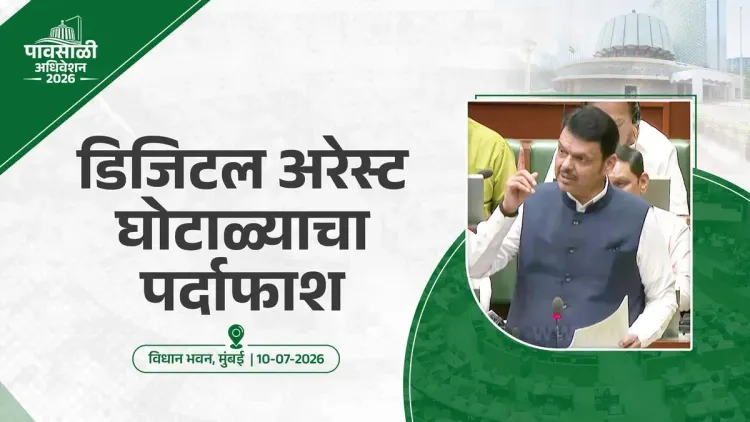
Maharashtra Chief Minister Devendra Fadnavis revealed on 10 July 2026 that Maharashtra Police dismantled a ₹58 crore digital arrest scam using an AI-based cyber complaint management system, announcing the breakthrough during the state assembly's Monsoon Session in Mumbai.
Key Takeaways
Maharashtra Police uncovered a ₹58 crore digital arrest scam using an AI-based cyber complaint management system.
The announcement was made by CM Devendra Fadnavis during the Monsoon Session 2026 of the Maharashtra Vidhan Sabha on 10 July 2026 .
Digital arrest scams involve fraudsters impersonating officials via video calls to extort money from victims under threat of fabricated legal action.
Maharashtra Police has been building dedicated cyber crime infrastructure since 2016 , with the AI system representing its latest upgrade.
The central government's Indian Cyber Crime Coordination Centre (I4C) , established in 2018 , provides the national framework within which state-level AI tools operate.
Further details on arrests, victim count, and possible statewide rollout of the AI system are expected as the assembly session continues.
Maharashtra Chief Minister Devendra Fadnavis announced on Friday, 10 July 2026, that Maharashtra Police had uncovered a ₹58 crore digital arrest scam using an AI-based cyber complaint management system — a disclosure made during the ongoing Monsoon Session 2026 of the state legislative assembly in Mumbai.
Context
In his post, CM Fadnavis stated: 'Through an AI-based cyber complaint management system, Maharashtra Police uncovered a ₹58 crore digital arrest scam.' The original Marathi text — AI-आधारित सायबर तक्रार व्यवस्थापनाच्या माध्यमातून महाराष्ट्र पोलिसांनी ₹58 कोटींचा डिजिटल अरेस्ट घोटाळा उघडकीस आणला ['Through AI-based cyber complaint management, Maharashtra Police exposed a ₹58 crore digital arrest scam'] — was posted from the Vidhan Bhavan (state assembly), Mumbai, signalling the announcement was made as part of official legislative proceedings.
Digital arrest scams are a category of online fraud in which perpetrators impersonate law enforcement or government officials — typically via video calls — and coerce victims into transferring large sums of money under the threat of fabricated legal action. These schemes have proliferated across India alongside the rapid expansion of digital payments and instant messaging platforms.
Policy Backdrop
The deployment of an AI-driven complaint management system by Maharashtra Police builds on a layered national and state policy architecture. The central government established the Indian Cyber Crime Coordination Centre (I4C) in 2018 under the Ministry of Home Affairs to coordinate nationwide responses to online fraud. The National Cyber Crime Reporting Portal, introduced in 2019, further enabled citizens to file complaints online, generating large datasets that state agencies can now analyse at scale.
Maharashtra Police began establishing dedicated cyber crime cells in major cities from 2016 onwards. The integration of AI-based triage and pattern-detection tools represents the next evolution of that infrastructure — enabling investigators to identify connected complaints, trace money trails, and flag large-scale organised fraud faster than manual methods allow.
Stakeholders and Impact
The victims in digital arrest cases are typically ordinary citizens — salaried professionals, senior citizens, and small business owners — who are psychologically coerced over extended periods, often losing their life savings. A ₹58 crore scam represents significant aggregate harm across multiple victims. The use of AI to surface the scam suggests investigators were able to link seemingly unrelated complaints into a single pattern, a capability that manual complaint handling rarely achieves at speed.
For Maharashtra Police, the bust signals a broader institutional shift toward technology-driven policing. For citizens, it underscores both the scale of the digital fraud threat and the growing capacity of state agencies to respond. CM Fadnavis, who has consistently emphasised law enforcement modernisation during his tenures as Chief Minister, used the assembly session to publicly validate the AI system's operational results.
What's Next
The Monsoon Session 2026 of the Maharashtra Vidhan Sabha provides a natural forum for further disclosures on arrests made in connection with the scam, the number of victims identified, and the status of any victim restitution efforts. Legislators and civil society groups are likely to press for details on the AI system's architecture, its data-privacy safeguards, and whether a statewide rollout is planned beyond the pilot phase. The case may also inform central-level deliberations on standardising AI tools for cyber complaint management across state police forces.
Point of View
Lending it political weight ahead of any budgetary or policy debates during the Monsoon Session. The ₹58 crore bust is significant not just for its scale but for the method: AI-based complaint triage can surface organised fraud rings that would otherwise appear as isolated incidents, representing a qualitative shift in investigative capacity. This fits a broader national pattern in which state police forces are competing to demonstrate technology adoption under the umbrella of central schemes like I4C. The key test will be whether the AI system's results translate into convictions and victim restitution, or remain a headline statistic.
NationPress
10 Jul 2026
Frequently Asked Questions
What is a digital arrest scam?
A digital arrest scam is a type of online fraud where criminals impersonate police officers, CBI agents, or other officials — usually via video call — and falsely claim the victim is under 'digital arrest' for a fabricated crime, then coerce them into transferring money to avoid prosecution.
How did Maharashtra Police uncover the ₹58 crore digital arrest scam?
According to CM Devendra Fadnavis, Maharashtra Police used an AI-based cyber complaint management system that analysed complaints to detect patterns and uncover the ₹58 crore scam.
What is the AI-based cyber complaint management system used by Maharashtra Police?
It is an artificial-intelligence-powered platform used by Maharashtra Police to manage, triage, and analyse cyber crime complaints, enabling faster detection of organised fraud networks. Specific technical details of the system have not been publicly disclosed.
What is the Indian Cyber Crime Coordination Centre (I4C)?
The I4C is a body established by the Ministry of Home Affairs in 2018 to coordinate India's response to cyber crime, providing a national framework that state police forces, including Maharashtra Police, operate within.
What happens next after the Maharashtra digital arrest scam bust?
Further details on arrests, the number of victims, and victim restitution are expected during the ongoing Monsoon Session 2026 of the Maharashtra Vidhan Sabha. A statewide rollout of the AI system is also being watched.